The Zepbound KwikPen is a multi-dose prefilled pen that holds four fixed weekly doses of tirzepatide, one month of treatment, in each of six strengths from 2.5 mg to 15 mg.[1] Unlike the single-dose autoinjector, you attach a new pen needle, prime the pen and dial the dose each week, and you throw the pen away after four doses or 30 days after first use.[1]
Lilly announced the KwikPen option for Zepbound on February 23, 2026.[2] This guide covers the strengths, the weekly steps from the FDA-approved Instructions for Use, storage, cost and Medicare. For the drug itself, see our tirzepatide profile.
What the KwikPen is, and how it differs
Zepbound now comes in four presentations: a single-dose autoinjector pen, single-dose vials, multi-dose vials and the single-patient-use KwikPen.[1] Each KwikPen contains 2.4 mL of solution, which gives four doses of 0.6 mL, plus a little extra volume used for priming.[1]
Because the pen is used four times, the solution contains preservatives (benzyl alcohol and phenol) that the single-dose pen does not.[1] Mounjaro, the diabetes brand of tirzepatide, also comes in a KwikPen.[5]
| Presentation | Doses per unit | Needle | How you set the dose |
|---|---|---|---|
| Single-dose pen | 1 | Built in, hidden | Fixed; press and hold up to 10 seconds |
| Single-dose vial | 1 | Separate syringe and needle | Draw up 0.5 mL |
| Multi-dose vial | 4 | Separate syringe and needle | Draw up 0.6 mL |
| KwikPen | 4 | Separate pen needle | Turn the dose knob all the way |
Zepbound KwikPen strengths
Each strength is a separate pen. The whole pen delivers the same dose four times.[1]
| Dose per weekly injection | Total in pen | Concentration |
|---|---|---|
| 2.5 mg | 10 mg/2.4 mL | 4.17 mg/mL |
| 5 mg | 20 mg/2.4 mL | 8.33 mg/mL |
| 7.5 mg | 30 mg/2.4 mL | 12.5 mg/mL |
| 10 mg | 40 mg/2.4 mL | 16.7 mg/mL |
| 12.5 mg | 50 mg/2.4 mL | 20.8 mg/mL |
| 15 mg | 60 mg/2.4 mL | 25 mg/mL |
The label dosing is the same for every Zepbound presentation. You start at 2.5 mg once weekly for 4 weeks, which is a starting dose only. The dose then goes up in 2.5 mg steps, after at least 4 weeks on each dose.[1]
- Weight reduction: maintenance dose of 5 mg, 10 mg or 15 mg weekly.
- Moderate to severe obstructive sleep apnea with obesity: 10 mg or 15 mg weekly.
- Maximum: 15 mg weekly.
A four-dose pen lines up with the minimum four weeks on each step. Your clinician decides when to move up and which maintenance dose fits. Our tirzepatide dosage chart lays out the full schedule.
How to use the Zepbound KwikPen, step by step
This is a summary of the KwikPen Instructions for Use. Your clinician or pharmacist should train you on this specific pen before your first dose, because the steps differ from the single-dose pen.[1]
Prepare
- Wash your hands with soap and water.
- Pull the pen cap straight off. Check the name, dose and expiration date. Do not use it if the liquid is frozen, cloudy, discolored or has particles; it should be colorless to slightly yellow.
- Wipe the red inner seal with an alcohol swab.
- Push a new pen needle straight on and twist until tight. Pull off the outer shield (keep it) and the inner shield (throw it away).
Prime (every week)
- Slowly turn the dose knob until you hear 2 clicks and an extended line shows in the dose window. This is the prime position.
- Hold the pen needle-up and tap the cartridge holder so air bubbles rise.
- Push the dose knob in until it stops and slowly count to 5. A drop of medicine at the needle tip means the pen is primed. If no drop appears, the leaflet says to repeat priming up to 2 more times, then change the needle and try once more, then call Lilly.
Inject
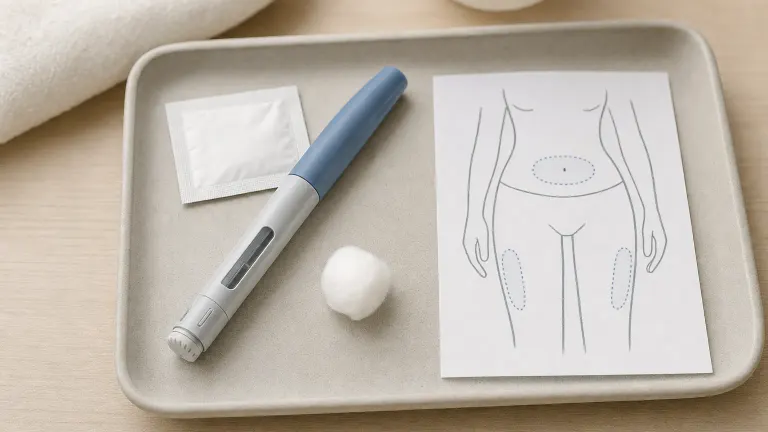
- Choose a site: stomach at least 2 inches from the belly button, or thigh. Another person can use the back of your upper arm. Rotate sites each week.
- Turn the dose knob all the way until it stops and the dose icon shows in the window. Do not count clicks.
- Insert the needle, push the knob in until it stops, and slowly count to 5 before pulling out.
- Check that the icon is in the dose window. If it is not, put the needle back in and finish. Do not redial or repeat the injection.
Finish
- If you see blood, press lightly with gauze; do not rub.
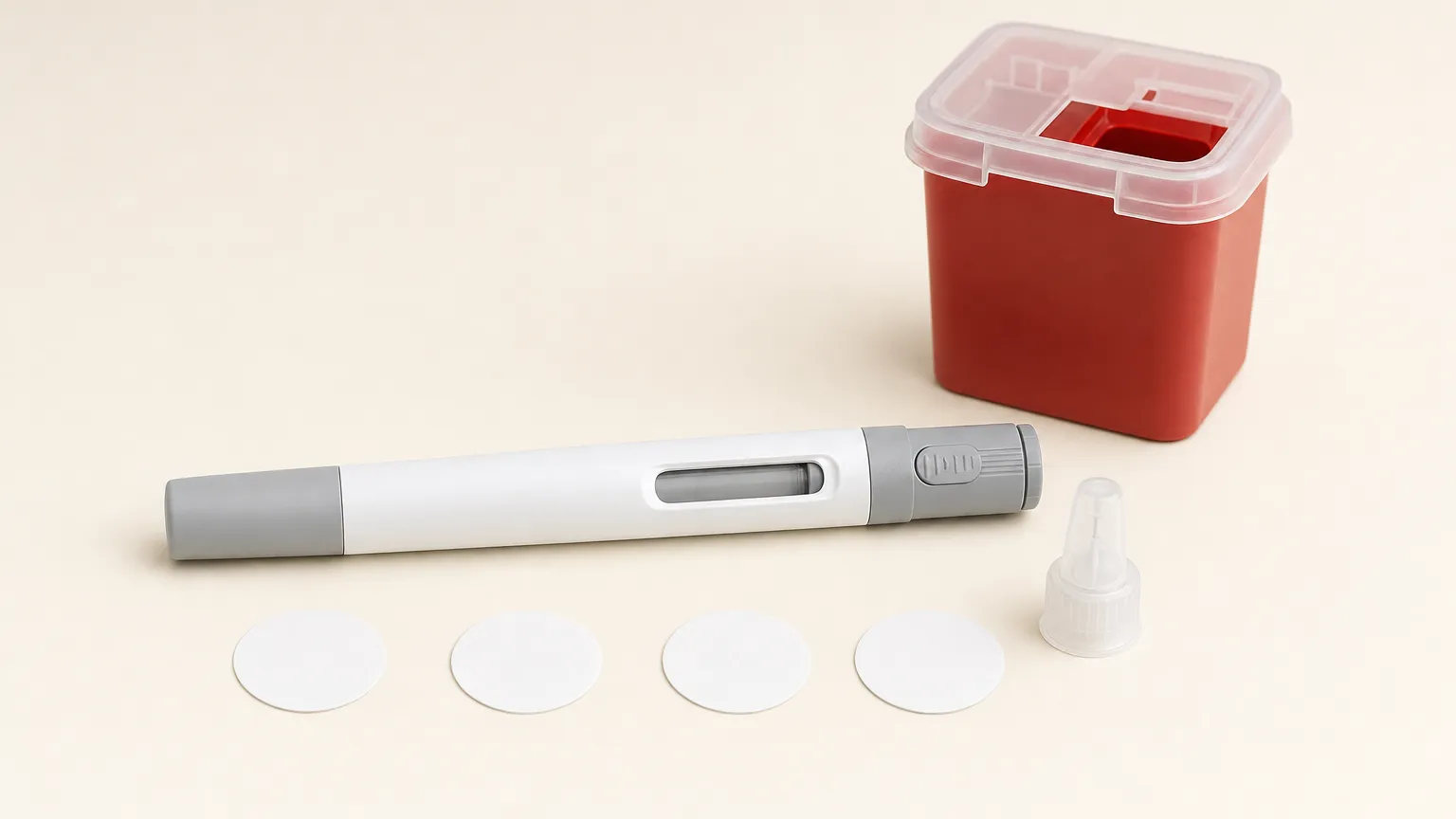
- Replace the outer needle shield, unscrew the needle and put it in a sharps container. Do not store the pen with a needle attached.
- Put the pen cap back on.
Our guides to GLP-1 injection sites and disposing of needles cover those steps in more detail.
Storage and when to throw the pen away
The KwikPen has different storage rules from the single-dose pen, which can stay at room temperature for up to 21 days in total.[1]
- Unopened: keep in the refrigerator at 36°F to 46°F (2°C to 8°C) until the expiration date. If an unopened pen is kept at room temperature (up to 86°F), throw it away after 30 days.
- After first use: store in the original carton, in the fridge or at room temperature up to 86°F, away from heat and light.
- Throw it away 30 days after first use, after 30 total days at room temperature, or after four weekly doses, even if liquid remains.
- Never freeze it. Throw away a pen that has been frozen.
After four doses, the pen will not let you dial a full dose. The leaflet warns not to inject leftover medicine and not to move it into a syringe, because you could get an incomplete dose.[1] For travel tips, see GLP-1 storage.
Safety points specific to the KwikPen
- Never share a pen, even with a new needle. The label lists this as a warning because sharing can spread blood-borne infections.[1]
- Vision problems: the label says the KwikPen is not recommended for self-injection by people with visual impairment, unless their clinician decides they can use it properly. A trained helper can give the dose.[1]
- Switching presentations: the label asks clinicians to retrain you whenever you change from a vial or single-dose pen to the KwikPen, or the other way round.[1]
All Zepbound forms carry the same boxed warning about thyroid C-cell tumors seen in rats. Zepbound should not be used by people with a personal or family history of medullary thyroid carcinoma or MEN 2.[1]
How much does the Zepbound KwikPen cost?
Prices and program terms checked October 2026. They change often; confirm with the manufacturer or your plan.
When Lilly launched the KwikPen in February 2026, it said self-pay patients using LillyDirect could choose the KwikPen or single-dose vials at every dose, starting at $299 a month for 2.5 mg.[2] Prices for higher doses and refill rules are in our Zepbound cost without insurance guide, and coupon terms are in the Zepbound savings card guide.
Pen needles are sold separately, so budget for one per weekly dose.[1]
Medicare and the KwikPen
The KwikPen is the only Zepbound form in the Medicare GLP-1 Bridge. From July 1, 2026, through December 31, 2027, eligible Part D members using Zepbound for weight reduction pay a $50 monthly copay. The Bridge does not cover single-dose Zepbound pens or vials.[3][4]
- Each fill is one monthly supply; 60- and 90-day fills are not allowed.[3]
- Pen needles should not be billed to the Bridge or your Part D plan; you buy them separately. Coupons cannot be applied to the $50 copay.[3]
See does Medicare cover Zepbound? for eligibility rules.
Questions to ask your clinician or pharmacist
- Is the KwikPen, a vial or the single-dose pen the best fit for my hands, eyesight and budget?
- Which pen needle length should I use, and how many should I buy?
- When should I start the next strength, and what if I miss a weekly dose?
- Can someone show me how to prime and dial the pen before my first injection?