Quick answer: GLP-1 storage rules are set by each drug’s label. Unopened injectable pens go in the refrigerator at 36°F to 46°F (2°C to 8°C), never in the freezer.[1][4] Room-temperature limits range from 14 days for Trulicity to 21 days for Zepbound and Mounjaro single-dose pens and 56 days for an in-use Ozempic pen.[6][5][1] Tablets such as Wegovy pills and Rybelsus stay at room temperature in their original bottle.[2][3]
The figures below come from the current DailyMed prescribing information for each brand, checked October 2026. Always go by the leaflet in your own box, since presentations change. For background, see the GLP-1 basics hub.
GLP-1 storage chart by brand
| Product | Before first use | Out of the fridge | After that |
|---|---|---|---|
| Ozempic pen | Fridge until expiration date | After first use: 56 days at 59–86°F (15–30°C) or in fridge | Discard after 56 days[1] |
| Ozempic prefilled syringe | Fridge | Up to 28 days at 46–86°F (8–30°C) | Single use; discard after injecting[1] |
| Wegovy single-dose pen or syringe | Fridge | Up to 28 days at 46–86°F (8–30°C), before the cap is removed | Discard after use[2] |
| Wegovy FlexTouch pen | Fridge | After first use: 56 days at 59–86°F (15–30°C) or in fridge | Discard after 56 days[2] |
| Wegovy tablets | Room temp 68–77°F (20–25°C); brief 59–86°F (15–30°C) allowed | Not refrigerated | Keep in original bottle[2] |
| Rybelsus / Ozempic tablets | Room temp 68–77°F (20–25°C); brief 59–86°F (15–30°C) allowed | Not refrigerated | Keep in original bottle[3] |
| Mounjaro / Zepbound single-dose pen or vial | Fridge | Up to 86°F (30°C) for a total of 21 days | Discard after 21 days out[4][5] |
| Mounjaro / Zepbound multi-dose vial or KwikPen | Fridge until expiration date | Unopened: up to 30 days at up to 86°F (30°C) | Once opened: discard after 30 days at room temp, 30 days from first use, or 4 weekly doses[4][5] |
| Trulicity pen | Fridge | Up to 86°F (30°C) for a total of 14 days | Single use[6] |
| Saxenda pen | Fridge | After first use: 30 days at 59–86°F (15–30°C) or in fridge | Discard after 30 days[7] |
| Victoza pen | Fridge | After first use: 30 days at 59–86°F (15–30°C) or in fridge | Discard after 30 days[8] |
“Room temperature” days are usually counted in total, not in one stretch. Lilly’s labels say Zepbound and Mounjaro single-dose products can be unrefrigerated “for up to a total of 21 days.”[5] If you take a pen in and out of the fridge, keep a running count.
Refrigeration basics
- Temperature: 36°F to 46°F (2°C to 8°C) for every injectable GLP-1.[1][2][4][5][6][7]
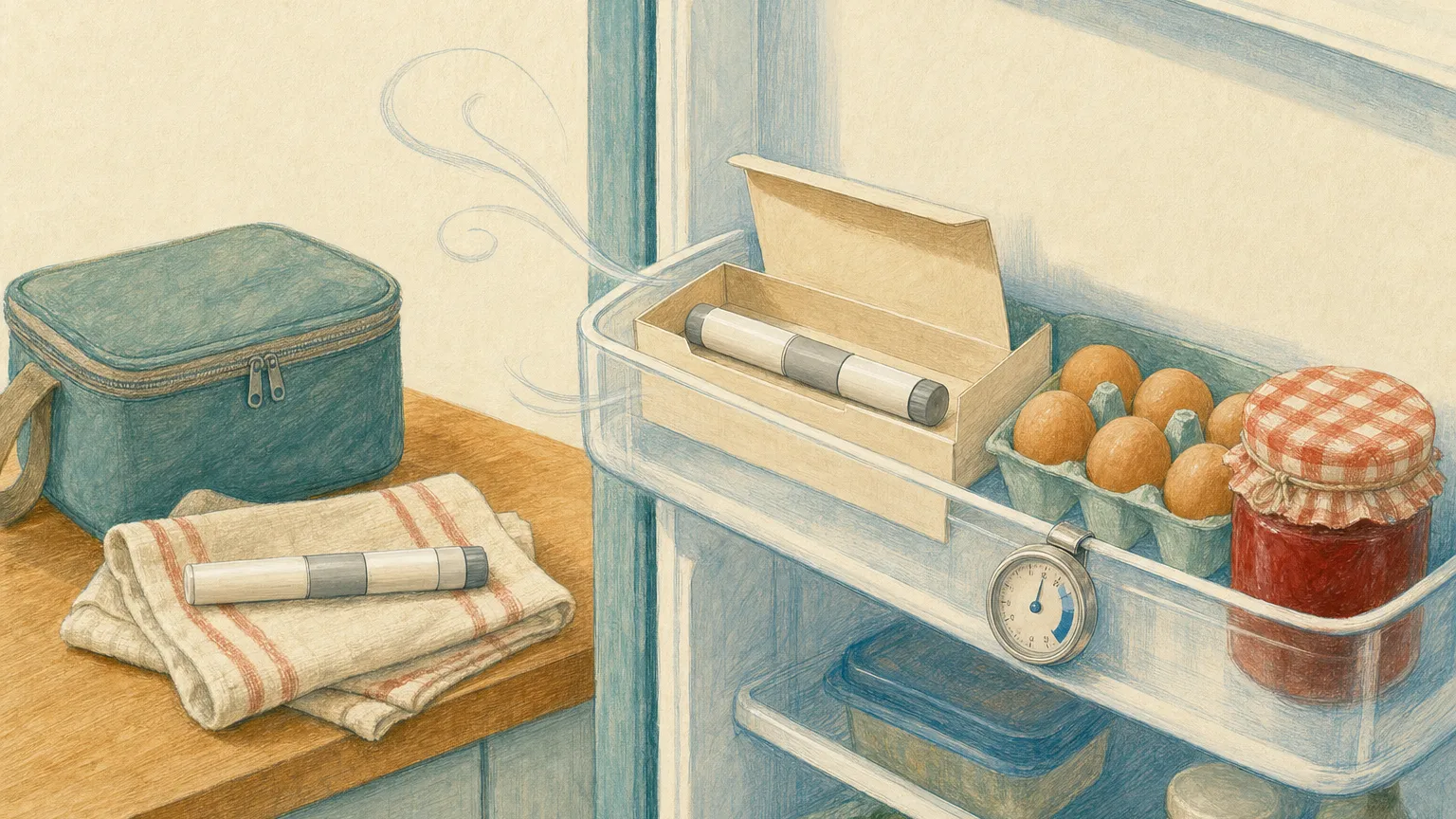
- Placement: Novo Nordisk labels say not to store pens in the freezer or directly next to the refrigerator’s cooling element.[1][7] A middle shelf away from the back wall is a safe choice.
- Light: keep pens in the original carton until use. Ozempic, Wegovy, Mounjaro, Zepbound and Trulicity labels all mention protecting the medicine from light.[1][2][5][6]
- Needles: for multidose pens (Ozempic, Wegovy FlexTouch, Saxenda, Victoza), remove the needle after each injection and store the pen with the cap on.[1][2][7]
For an Ozempic pen that seems to run out early, see Ozempic pen empty. For where to inject, see GLP-1 injection sites.
What if it freezes or overheats?
Frozen: do not use it. Every injectable GLP-1 label in the chart says not to use the medicine if it has been frozen.[1][2][4][5][6][7][8] Thawing does not make it usable again. This includes a pen that froze against the back of the fridge or in a checked bag.
Too hot: the room-temperature limit for all injectable GLP-1s tops out at 86°F (30°C).[1][5][6] The Wegovy patient leaflet says to throw away single-dose pens or syringes that have been exposed to temperatures above 86°F (30°C).[2] Never leave a pen in a parked car.
Tablets: Wegovy, Rybelsus and Ozempic tablets do not need a fridge, but they are sensitive to moisture. Labels say to keep them in the original bottle until you take one and to store the bottle in a dry place, so a steamy bathroom cabinet is a poor spot.[2][3] See oral vs injectable semaglutide for how the two forms differ.
Traveling? See traveling with GLP-1 medications for coolers, flights and time zones.
Can you inject a GLP-1 straight from the fridge?
Yes, for Lilly products. The Mounjaro and Zepbound pen instructions say “it is not necessary to warm the pen to room temperature.”[4][5] Some people find a cold injection stings more and choose to let it sit briefly, but that is a comfort choice, not a requirement.
Do not use heat to warm any GLP-1. The Ozempic and Wegovy syringe instructions say not to warm the syringe with hot water, a microwave or any other heat source.[1][2]
Expired or past the in-use limit
There are two different deadlines:
- The expiration date printed on the box applies to products kept refrigerated and unopened. Labels for Ozempic, Mounjaro and Zepbound multi-dose products say they can be used until that date if kept in the fridge.[1][4][5]
- The in-use or room-temperature limit (14, 21, 28, 30 or 56 days, depending on the product) starts once you open it or take it out of the fridge. Whichever deadline comes first applies.[1][4][6][7]
The Mounjaro and Zepbound labels are explicit: throw away an opened multi-dose vial or KwikPen after 4 weekly doses, “even if there is medicine left in it.”[4][5] There is no published data on how well expired GLP-1s work, so the safe default is not to use them. If disposal leaves you short, see missed GLP-1 dose.
Compounded vials and beyond-use dates
Compounded semaglutide and tirzepatide are not reviewed by FDA for quality, safety or effectiveness, and FDA says they should be used only when an approved drug cannot meet a patient’s medical need.[11] They do not follow the brand-name storage rules above. Instead, the pharmacy assigns a beyond-use date (BUD): the date after which the preparation must not be used, counted from when it was compounded.[9]
Under USP chapter <797>, revised in November 2022, maximum BUDs for sterile injectables depend on how the product was made and tested:[9]
| Type of preparation | Room temp | Fridge | Freezer |
|---|---|---|---|
| Category 1 | 12 hours | 24 hours | — |
| Category 2, aseptic, sterile ingredients, no sterility test | 4 days | 10 days | 45 days |
| Category 2, aseptic, passed sterility testing | 30 days | 45 days | 60 days |
| Category 3, aseptic, all Category 3 tests passed | 60 days | 90 days | 120 days |
Freezer limits apply only if the pharmacy froze it on purpose; do not freeze a vial yourself.
A 2026 review of 33 compounded semaglutide and tirzepatide products sold online found that only 18% listed beyond-use date information and 28% listed storage conditions.[10] If your vial has no BUD or storage directions, ask the dispensing pharmacy before using it. For how vials are mixed, see our guide to reconstituting peptides, and for the regulatory background, see compounded semaglutide vs Ozempic.
Quick checklist
- New pens: fridge, 36–46°F (2–8°C), in the carton, away from the cooling element.
- Track the days out of the fridge for your brand.
- Never freeze; never use if frozen.
- Keep below 86°F (30°C); no hot cars.
- Tablets: room temperature, original bottle, dry place.
- Compounded vials: follow the pharmacy’s beyond-use date.
For drug details, see our profiles of semaglutide, tirzepatide, liraglutide and dulaglutide.