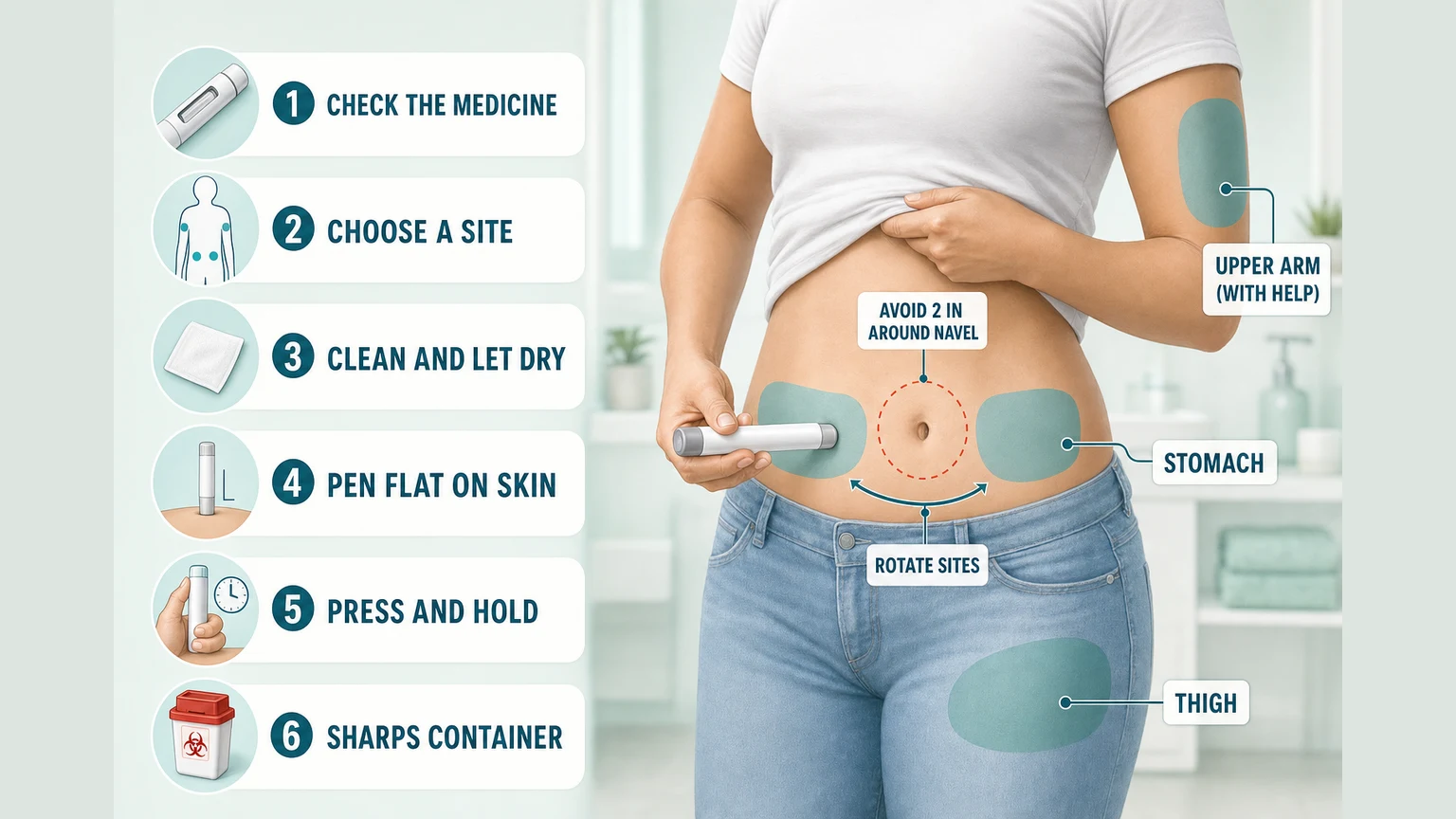
GLP-1 injection sites are the stomach area (abdomen), the front of the thigh and the upper arm. The labels for Ozempic, Wegovy, Mounjaro and Zepbound say all three give similar drug exposure, so the choice comes down to comfort.[1][2][3][4] Rotate to a new spot each week, and expect mild redness or itching in a small share of people: 0.2% on Ozempic and 6% to 8% on Zepbound in trials.[1][4]
The same rules apply to the once-daily liraglutide pen (Saxenda) and the weekly dulaglutide pen (Trulicity).[5][6] For more on these medicines, see the GLP-1 basics hub.
Where you can inject
| Medicine | Abdomen | Thigh | Upper arm |
|---|---|---|---|
| Ozempic | Yes | Yes | Yes[1] |
| Wegovy | Yes | Yes | Yes[2] |
| Mounjaro | Yes | Yes | Back of arm, by another person[3] |
| Zepbound | Yes | Yes | Back of arm, by another person[4] |
| Saxenda | Yes | Yes | Yes[5] |
| Trulicity | Yes | Yes | Yes; the instructions say another person should inject the back of the arm[6] |
A few practical details from the instructions for use:
- Stomach: the Ozempic and Wegovy instructions say to stay at least 2 inches from the belly button.[1][2]
- Thigh: use the front of the upper leg.[2]
- Arm: the back of the upper arm is hard to reach on your own. Several instructions say to inject there only with help from someone else.[1][3]
Does the injection site change how well it works?
No meaningful difference has been found. Each of the main labels states the same thing in its pharmacology section:
- Semaglutide (Ozempic, Wegovy): similar exposure in the abdomen, thigh or upper arm.[1][2]
- Tirzepatide (Mounjaro, Zepbound): similar exposure in the abdomen, thigh or upper arm.[3][4]
- Liraglutide (Saxenda): exposure was considered similar across the three sites, and no dose change is needed when you switch site.[5]
- Dulaglutide (Trulicity): injection site had no statistically significant effect on exposure.[6]
Population studies back this up. A model built from 1,612 people in the semaglutide SUSTAIN trials found no clinically relevant effect of injection site on drug levels; body weight was the only factor that mattered.[7] A similar analysis of liraglutide 3.0 mg in the SCALE weight-loss trials found that injection site did not significantly affect exposure.[8]
How to rotate injection sites
Rotation means moving each injection to a new spot. All six labels tell patients to rotate.[1][2][3][4][5][6]
- You can stay in one area. You may use the same body area each week, but pick a different spot within it.[1][6]
- Why it matters: the Mounjaro and Zepbound instructions say rotating lowers the risk of lipodystrophy (pits or thickened skin) and localized cutaneous amyloidosis (lumps under the skin).[3][4] Saxenda’s label gives the same reason for amyloidosis.[5]
- Skip problem skin. Don’t inject where the skin is pitted, thickened, lumpy, tender, bruised, scaly or hard, or into scars or damaged skin.[3]
- Keep other shots separate. If you also inject insulin or another medicine, don’t use the same spot.[3][4]
A simple pattern is to divide the stomach into four quarters around the belly button and move clockwise each week, or alternate left and right thighs.
Injection technique, step by step
Always follow the instructions for use that come with your pen, because devices differ. The common steps are:
- Check the medicine. Ozempic should be clear and colorless; Zepbound should not be cloudy or frozen, can be colorless to slightly yellow, and should have no particles.[1][4]
- Clean the skin. Wipe the site with an alcohol swab or soap and water and let it dry.[2]
- Inject and hold. How long depends on the device:
- Ozempic and Saxenda pens: keep the dose button pressed and count slowly to 6 before removing the needle.[1][5]
- Wegovy single-dose pen: press firmly until the yellow bar stops moving.[2]
- Mounjaro and Zepbound single-dose pens: place the clear base flat on the skin, unlock, then press and hold the button for up to 10 seconds until the second click.[3][4]
- Trulicity pen: hold the clear base firmly on the skin until the second click, which comes in about 5 to 10 seconds. On all three Lilly pens, a visible gray plunger shows the dose was given.[6][3]
- Vials and syringes (Mounjaro, Zepbound): keep the needle in the skin for at least 5 seconds after pushing the plunger.[3][4]
- Bleeding: if you see blood, press lightly with gauze or a cotton ball. Don’t rub.[1]
- Needles: use a new needle each time with multi-dose pens like Ozempic, and never share a pen, even with a new needle.[1]
Put used needles and pens straight into a sharps disposal container, then dispose of it according to your community’s rules.[9]
Injection site reactions: how common are they?
Reactions include redness, itching, pain, swelling, bruising or a rash where the needle went in. Rates in clinical trials:
| Medicine | Drug | Placebo |
|---|---|---|
| Ozempic | 0.2% | Not given in label[1] |
| Trulicity (adults) | 0.5% | 0.0%[6] |
| Wegovy 2.4 mg | 1.4% | 1%[2] |
| Mounjaro | 3.2% | 0.4%[3] |
| Zepbound 5 / 10 / 15 mg | 6% / 8% / 8% | 2%[4] |
| Saxenda | 13.9% | 10.5%[5] |
Tirzepatide reactions were more frequent in people who developed antibodies to the drug: 11.3% versus 1% in the Zepbound weight-loss trials, and 4.6% versus 0.7% across seven Mounjaro trials.[4][3]
Tips if injections are uncomfortable
- Choose firmer tissue. Wegovy’s troubleshooting advice suggests switching to a firmer site, such as the thigh or upper arm, or standing up when injecting into the lower stomach.[2]
- Pick a consistent routine. Same day, same area, new spot. Our guide to the best time to take a GLP-1 covers timing.
If you forget a dose, see our guide to a missed GLP-1 dose. For pens away from home, see traveling with GLP-1 medications and our GLP-1 storage guide.