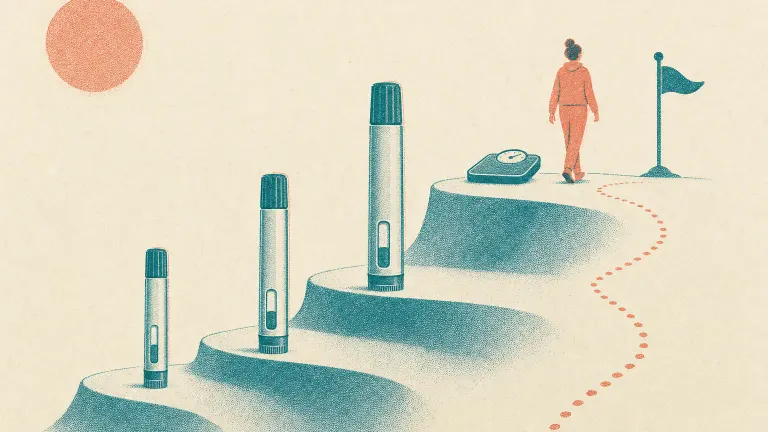
Quick answer: a standard tirzepatide dosage chart starts at 2.5 mg once a week for 4 weeks, then rises in 2.5 mg steps every 4 weeks or longer, up to a maximum of 15 mg weekly.[1][2] The schedule is the same for Mounjaro (type 2 diabetes) and Zepbound (weight management and sleep apnea). Your prescriber decides how far up the ladder you go and how fast.
The step-by-step build-up exists mainly to limit nausea, diarrhea and vomiting, which are most common while the dose is rising.[3] For background on the drug itself, see our tirzepatide profile.
Tirzepatide dosage chart (Mounjaro and Zepbound)
This chart follows the shortest schedule allowed by the labels. Many people stay on a dose longer than 4 weeks.
| Weeks | Weekly dose | Purpose |
|---|---|---|
| 1-4 | 2.5 mg | Starting dose only, to let the body adjust[1] |
| 5-8 | 5 mg | First maintenance option[1] |
| 9-12 | 7.5 mg | Step toward a higher dose[1] |
| 13-16 | 10 mg | Maintenance option (weight and sleep apnea)[1] |
| 17-20 | 12.5 mg | Step toward the top dose[1] |
| 21+ | 15 mg | Maximum dose[1][2] |
The earliest anyone can reach 15 mg on this schedule is week 21. In the SURMOUNT-1 obesity trial, participants assigned to 15 mg reached it after 20 weeks of 4-week steps.[3]
What each step of the chart means
- 2.5 mg is a warm-up dose. It is too low to be the long-term dose for weight loss. The Zepbound label says plainly that 2.5 mg is for starting treatment and is not approved for maintenance.[1] Many people notice less appetite at this dose, but the main job of the first month is to let the stomach get used to the drug.
- 5 mg is the first dose that can be a maintenance dose. In SURMOUNT-1, people who stayed on 5 mg for the whole trial still lost 15% of their weight on average.[3] Some people stop here because it works and they tolerate it well.
- 7.5 mg and 12.5 mg are stepping stones. They are approved strengths, but in the main trials they were used on the way to the 10 mg and 15 mg target doses rather than as fixed treatment groups.[3][4]
- 10 mg and 15 mg are the higher maintenance doses. They are the only maintenance doses for sleep apnea, and they produced the most weight loss in the trials.[1][3]
Each step is a decision point. Before going up, prescribers usually ask how your appetite, weight or blood sugar has changed and how well you have tolerated the current dose.
Mounjaro vs Zepbound dosing at a glance
Both brands contain the same drug, tirzepatide, so the doses and steps match. What differs is the approved use and the recommended maintenance dose.
| Mounjaro | Zepbound | |
|---|---|---|
| Approved for | Type 2 diabetes (adults and children 10+); lowering heart attack and stroke risk in type 2 diabetes[2] | Weight reduction and long-term maintenance; moderate to severe obstructive sleep apnea with obesity[1] |
| Starting dose | 2.5 mg weekly[2] | 2.5 mg weekly for 4 weeks[1] |
| When to increase | If more blood sugar control is needed, +2.5 mg after at least 4 weeks[2] | +2.5 mg after at least 4 weeks, based on response and tolerability[1] |
| Maintenance dose | Whatever dose controls blood sugar[2] | 5, 10 or 15 mg (weight); 10 or 15 mg (sleep apnea)[1] |
| Maximum | 15 mg (adults), 10 mg (children)[2] | 15 mg[1] |
For a fuller side-by-side, see Zepbound vs Mounjaro.
When and why the dose is increased
Doses go up for two reasons: to reach a dose that works, and to get there slowly enough that the stomach can adapt.
- Gut side effects peak during escalation. In SURMOUNT-1, gastrointestinal effects were mostly mild to moderate and happened mainly while the dose was being raised.[3]
- Higher doses usually mean more effect. Average 72-week weight loss was 15.0% on 5 mg, 19.5% on 10 mg and 20.9% on 15 mg, versus 3.1% on placebo.[3] In type 2 diabetes (SURPASS-1), HbA1c fell by 1.87, 1.89 and 2.07 percentage points on 5, 10 and 15 mg.[4]
- Escalation is not mandatory. The Zepbound label tells prescribers to weigh response and tolerability when picking a maintenance dose, and to consider a lower dose if a higher one is not tolerated.[1]
If side effects are hard to manage at a new dose, prescribers commonly wait longer before the next step. The label sets a minimum of 4 weeks per step, not a maximum. How long it takes to feel an effect at each step is covered in how long does tirzepatide take to work.
Pens, single-dose vials and the KwikPen
Tirzepatide now comes in four presentations. The weekly dose is the same whichever one is prescribed.[1][2]
| Presentation | Strengths | How it works |
|---|---|---|
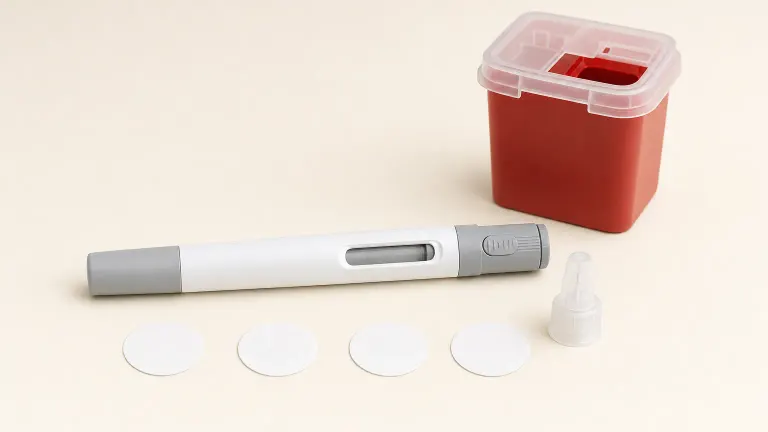
| Single-dose pen | 2.5, 5, 7.5, 10, 12.5, 15 mg per 0.5 mL | Prefilled autoinjector, one pen per week, needle hidden[1] |
| Single-dose vial | 2.5, 5, 7.5, 10, 12.5, 15 mg per 0.5 mL | Draw up the full vial with a syringe each week[1] |
| Multi-dose vial | 10-60 mg per 2.4 mL (four doses of 2.5-15 mg) | One vial holds four weekly doses[1][2] |
| KwikPen | 10-60 mg per 2.4 mL (four doses of 2.5-15 mg) | One pen holds four fixed weekly doses; attach a new needle each time[1][2] |
A few practical points:
- Zepbound vials through LillyDirect. Lilly sells Zepbound single-dose vials and the KwikPen to self-pay patients through LillyDirect, starting at $299 a month for the 2.5 mg dose, with the same price for both formats.[5] Prices for higher doses differ; check the current terms.
- Training matters when you switch. The label asks prescribers to train patients on the specific presentation and to retrain if it changes.[1] A KwikPen must never be shared, even with a new needle.[1]
- Medicare’s temporary weight-loss program covers only one form. From July 1, 2026, the Medicare GLP-1 Bridge covers the Zepbound KwikPen but not the single-dose pen or vial.[6]
For mixing and syringe basics with research peptides, our reconstitution guide explains units and volumes. Approved tirzepatide vials come premixed and do not need reconstituting.[1]
Missed doses and changing your injection day
Both labels give the same rules:[1][2]
- Within 4 days (96 hours): take the missed dose as soon as you remember.
- More than 4 days: skip it and take the next dose on your usual day.
- Changing your day: allowed, as long as doses are at least 3 days (72 hours) apart.
If you have missed several weeks in a row, ask your prescriber before restarting. Some people need to step back down the ladder to avoid strong stomach side effects.
Doses for children and special cases
- Children 10 and older with type 2 diabetes follow the same 2.5 mg start and 2.5 mg steps on Mounjaro, but the maximum is 10 mg a week.[2] Zepbound is not approved for children.[1]
- People on insulin or a sulfonylurea may need those doses lowered when tirzepatide starts, to avoid low blood sugar.[1][2]
- Kidney disease: no dose adjustment is recommended, but kidney function should be watched if vomiting or diarrhea causes dehydration.[1]
Once a stable dose is reached, the question becomes how long to stay on it. See our guide to the tirzepatide maintenance dose.