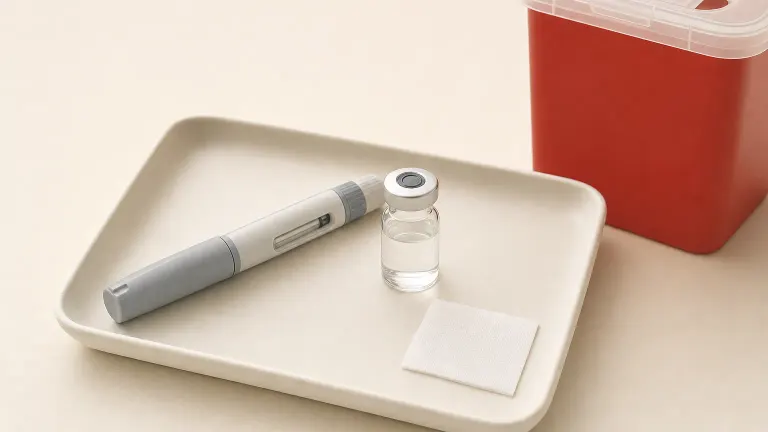
Subcutaneous vs intramuscular injection differs mainly in depth and absorption speed. A subcutaneous (SC) injection goes into the fat layer just under the skin and is absorbed more slowly and steadily. An intramuscular (IM) injection goes deeper into muscle, which has a richer blood supply, so absorption is usually faster.[1] Most peptide drugs, such as semaglutide and tesamorelin, are labeled for SC use, while urine-derived hCG (Novarel) is labeled IM only.[7][8][5]
This guide is part of our peptide basics hub. For technique, see how to reconstitute peptides and our guide to GLP-1 injection sites.
Subcutaneous vs intramuscular at a glance
| Subcutaneous (SC) | Intramuscular (IM) | |
|---|---|---|
| Where it goes | Fat layer under the skin[1] | Into muscle[1] |
| Absorption | Slower, more sustained; often incomplete for large molecules[1][3] | Usually faster[1] |
| Typical uses | Insulin, GLP-1 drugs, many peptides[1][7] | Vaccines, some hormones[1][5] |
| Common sites | Abdomen, thigh, upper arm[7] | Shoulder (deltoid), thigh, buttock |
| Needle | Short; 4 to 5 mm suffices for insulin in nearly all adults[2] | Longer, chosen by site and body size[1] |
| Self-injection | Common; pens and autoinjectors[6][7] | Possible but harder |
| Site-specific risks | Lumps, fat necrosis, calcification[1] | Nerve injury (especially buttock), bone contact if too deep[1] |
How absorption differs
The choice of route depends on the drug. A 2022 primer in a health-system pharmacy journal explains that SC injection is preferred where a slower, more sustained response is wanted, as with insulin, while IM is usually preferred for vaccines, where faster absorption gives a quicker immune response.[1]
Under the skin, absorption of biologic drugs is relatively slow and often incomplete, according to a 2014 review, because the drug has to move through tissue to reach small blood or lymph vessels. Larger proteins, above about 20 kilodaltons, are absorbed mostly through the lymphatic system.[3] Most therapeutic peptides are much smaller than that.
The difference can be large enough to matter. In a crossover study, 16 people with type 2 diabetes received insulin by IM injection; fast-acting insulin lispro reached peak levels in about 47 minutes on average, compared with about 95 minutes for regular human insulin by the same route.[4] Accidental IM injection is one reason insulin users are advised to use short needles.[2]
Needle length and body size
In an ultrasound study of 388 US adults with diabetes, skin was about 2 mm thick at common injection sites, while the fat layer ranged more widely, averaging about 10 to 15 mm depending on site, and was thicker in women and with higher BMI. Needles 8 mm or longer inserted straight in often reached muscle in the limbs of men and leaner adults, while 4 to 5 mm needles reached fat with minimal risk of IM injection in virtually all adults.[2]
Body size also affects IM injections: in people with obesity, a needle that is too short may leave an intended IM drug in fat instead.[1]
Which route peptide drugs use
| Drug | Labeled route | Label notes |
|---|---|---|
| Semaglutide (Ozempic) | SC | Abdomen, thigh or upper arm; rotate sites weekly[7] |
| Tesamorelin (Egrifta WR) | SC | Abdomen only; rotate sites; avoid scars and bruises[8] |
| hCG (Novarel) | IM only | Reconstituted powder[5] |
| Testosterone enanthate (Xyosted) | SC | Abdomen only; avoid IM or intravascular injection[6] |
Xyosted shows that the route depends on the product, not just the drug: its label specifies SC injection in the abdomen with an autoinjector and says to avoid IM injection.[6]
Unapproved research peptides come with no FDA-reviewed route at all. If a clinician prescribes a peptide, ask which route the product was studied with.
Subcutaneous self-injection: what labels ask
Because most peptide drugs are self-injected under the skin, their labels spell out the basics:
- Rotate sites. Ozempic’s instructions say to use a different injection site each week when injecting in the same body region.[7] Egrifta WR’s label asks patients to rotate among areas of the abdomen.[8]
- Avoid damaged skin. Egrifta WR’s label says not to inject into scar tissue, bruises or the navel.[8]
- Check the solution. Egrifta WR should be used only if the mixed solution is clear, colorless and free of particles.[8]
- Stay in the labeled area. Xyosted is for the abdomen only.[6]
Route changes the risk, not just the speed
Changing route can turn a manageable drug into a dangerous one. FDA’s review of compounded peptides notes that a published study reported serious adverse events, including death, when ipamorelin was given intravenously for gut motility, and that FDA had no safety information for some other injectable routes.[9] For most research peptides, FDA says it lacks the data to know whether a given route would cause harm.[9] If a product has never been tested by a particular route, neither its dose nor its risks can be assumed from another route.
Side effects and safety
Both routes can cause pain, bruising and bleeding at the site. Beyond that:[1]
- IM: sciatic nerve injury, especially with injections in the upper outer buttock; bone bruising or, rarely, bone damage if the needle goes too deep.
- SC: lumps (granulomas), fat necrosis and calcification.
- Label-specific reactions: Egrifta WR’s label lists injection-site reactions as a warning, and Ozempic’s instructions ask patients to rotate sites.[7][8]
Always use sterile, single-use needles and syringes. Don’t change routes on your own.
Legal status and access
Route doesn’t change a drug’s legal status, but the approved route is part of the FDA label.[6][7] Using a different route is off-label and should be a prescriber’s decision. For peptides delivered without needles, see peptide nasal spray vs injection, and for product forms, lyophilized vs premixed peptides.
Questions to ask your clinician
- Which route is my drug labeled for, and why?
- What needle length and site suit my body size?[2]
- If I accidentally inject into muscle or the wrong layer, what should I watch for?
The verdict
SC injection is slower, gentler and easier to do yourself, which is why most peptide drugs use it.[1][7] IM injection gives faster absorption and suits drugs such as vaccines and some hormones.[1][5] Neither is better overall; the right route is the one on the drug’s label.