Ipamorelin is a lab-made peptide, five amino acids long, that mimics the hunger hormone ghrelin and signals the pituitary gland to release growth hormone.[1] It was developed at Novo Nordisk in the 1990s and later tested to speed gut recovery after surgery, where it did not beat placebo.[4][7] No approved drug contains it.[4]
This profile covers how ipamorelin works, what the human research found, side effects, the doses that have been studied, how it compares with CJC-1295, MK-677 and sermorelin, and its legal status.
What is ipamorelin?
Ipamorelin belongs to a family called growth hormone secretagogues: drugs that make the body release more of its own growth hormone. It activates the ghrelin receptor (also called the growth hormone secretagogue receptor), the same target as older peptides such as GHRP-6 and the pill MK-677.[1]
When Novo Nordisk scientists first described it in 1998, they called it the first “selective” secretagogue. In pigs, it released growth hormone about as strongly as GHRP-6, but unlike GHRP-6 and GHRP-2 it did not raise the stress hormones ACTH and cortisol, even at doses over 200 times higher than needed.[1] That selectivity was shown in animals; the main human study measured growth hormone, not those stress hormones.[5]
How ipamorelin works in people
The main human data come from one study of healthy men who received 15-minute IV infusions at five dose levels:[5]
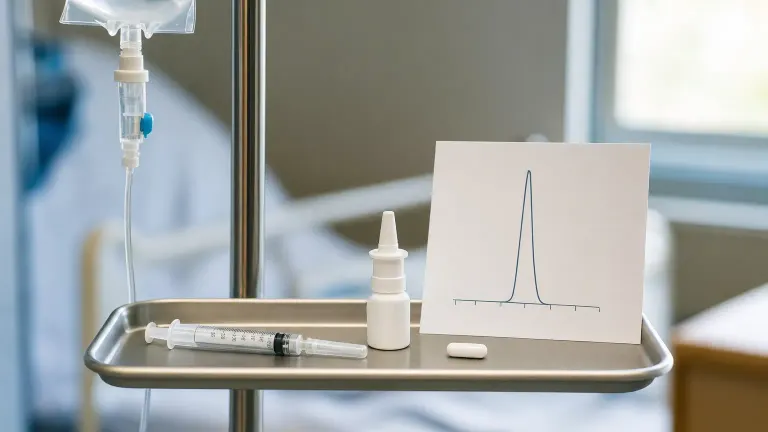
- Ipamorelin caused one burst of growth hormone, peaking about 40 minutes after the infusion and falling to very low levels by about 6 hours.[4]
- Its half-life was about 2 hours, and blood levels rose in proportion to the dose.
- Responses varied more from person to person than the drug levels themselves.
In rats, ipamorelin was mainly excreted in urine, much of it as intact peptide, and about 20% of a nasal dose was absorbed.[6] A Moscow anti-doping laboratory, working with German colleagues, gave a single nasal dose to a volunteer and found ipamorelin and its breakdown products in urine, and added these to its routine doping tests.[14]
Ipamorelin benefits: what the research shows
The surgery trial
Helsinn Therapeutics tested IV ipamorelin to speed recovery of gut function (postoperative ileus) after bowel surgery.[8] In the published phase 2 trial of 114 patients, ipamorelin 0.03 mg/kg twice daily did not significantly shorten the time to a tolerated solid meal (median 25.3 hours vs 32.6 hours on placebo).[7] A larger dose-finding trial of 320 patients finished in 2014, but no results have been posted, and we found no published report.[9]
Growth, bone and muscle
Every result here comes from animals, not people:
- In adult female rats, ipamorelin injections increased bone growth and body weight over 15 days.[10]
- In rats given steroid drugs, ipamorelin counteracted the loss of muscle strength and bone formation.[11]
Weight and fat
Ipamorelin is often marketed for fat loss, but the animal evidence points the other way. In mice, two weeks of ipamorelin increased body fat and food intake, an effect that did not depend on growth hormone.[12] No human study has measured fat loss on ipamorelin.[16]
Sleep
Sleep claims rest on related compounds. In seven men in Munich, IV ghrelin increased deep slow-wave sleep.[13] In young adults in Brussels, a week of the oral ghrelin-receptor drug MK-677 lengthened deep sleep by about 50%.[18] Ipamorelin itself has not been studied for sleep, and in the surgery trial insomnia was more common on ipamorelin than placebo.[4]
Ipamorelin side effects
Human safety data are limited to IV use in hospital patients after surgery. In FDA’s review of the published trial:[4]
- Low potassium: 12.5% on ipamorelin vs 3.4% on placebo
- Insomnia: 10.7% vs 5.2%
- High blood sugar at discharge: 14.3% vs 8.6%
- Deaths: two patients on ipamorelin died after surgical complications. FDA said it is unclear whether the deaths were related to the drug.
Nausea, vomiting and bloating were common in both groups and slightly less frequent on ipamorelin.[4] FDA’s adverse event database held only two reports through September 2023, both non-serious and both involving compounded products.[4]
FDA’s broader concerns are about product quality: immune reactions from clumped peptide or impurities, and the unusual amino acids in ipamorelin that make it hard to confirm what is in a vial.[3]
Ipamorelin dosage: what has been studied
| Setting | Dose |
|---|---|
| Healthy men (single IV infusion) | 4.21 to 140.45 nmol/kg over 15 minutes[5] |
| After bowel surgery (phase 2) | 0.03 mg/kg IV twice daily, up to 7 days[7] |
| Dose-finding surgery trial | 0.03 or 0.06 mg/kg IV, two or three times daily[9] |
No under-the-skin dose has been tested in a published human trial.[4] Doses promoted online come from forums and sellers, not studies, and no human study has tested ipamorelin for muscle, fat loss or other GH-related metabolic uses.[16] For converting milligrams to syringe units, see our peptide calculator.
Ipamorelin vs CJC-1295, MK-677 and sermorelin
| Ipamorelin | CJC-1295 with DAC | MK-677 | |
|---|---|---|---|
| Mimics | Ghrelin[1] | GHRH[17] | Ghrelin[18] |
| Form | Peptide; IV in trials[5] | Peptide injected under the skin[17] | Pill taken by mouth[18] |
| Half-life | About 2 hours[5] | 5.8 to 8.1 days[17] | See our MK-677 profile |
| Dosing in studies | Single infusion, or twice daily after surgery[7] | Weekly or every two weeks[17] | Once daily at bedtime[18] |
- CJC-1295 copies the other natural signal, GHRH, so the two are often combined; see our CJC-1295 + ipamorelin guide.
- MK-677 hits the same receptor but is taken by mouth. FDA lists it as a significant safety risk for both kinds of compounding, citing a hip-fracture trial stopped early over possible heart failure.[3]
- Sermorelin is a short GHRH analog that WADA also bans;[15] tesamorelin is a GHRH analog approved in the US as Egrifta.[16]
More compounds are on our growth hormone peptides page.
What users report
Is ipamorelin legal?
- Not approved: FDA confirms there is no approved drug containing ipamorelin.[4]
- Outsourcing facilities (503B): FDA’s current list, updated April 2026, places ipamorelin acetate in category 2, substances that may present significant safety risks, under 503B since September 29, 2023. It is not in category 2 under 503A; FDA lists its 503A nomination among those withdrawn by the nominators.[3]
- Traditional pharmacies (503A): on October 29, 2024, FDA’s Pharmacy Compounding Advisory Committee voted 0 to 12, with one abstention, against adding ipamorelin to the 503A bulks list, citing a lack of safety and effectiveness data. FDA had proposed not including it.[2]
- Australia: regulators added ipamorelin to the Poisons Standard, so possession without a prescription is illegal there.[4]
- Banned in sport: WADA lists ipamorelin under S2 as a growth hormone secretagogue, prohibited at all times.[15]
This is general information, not legal advice.