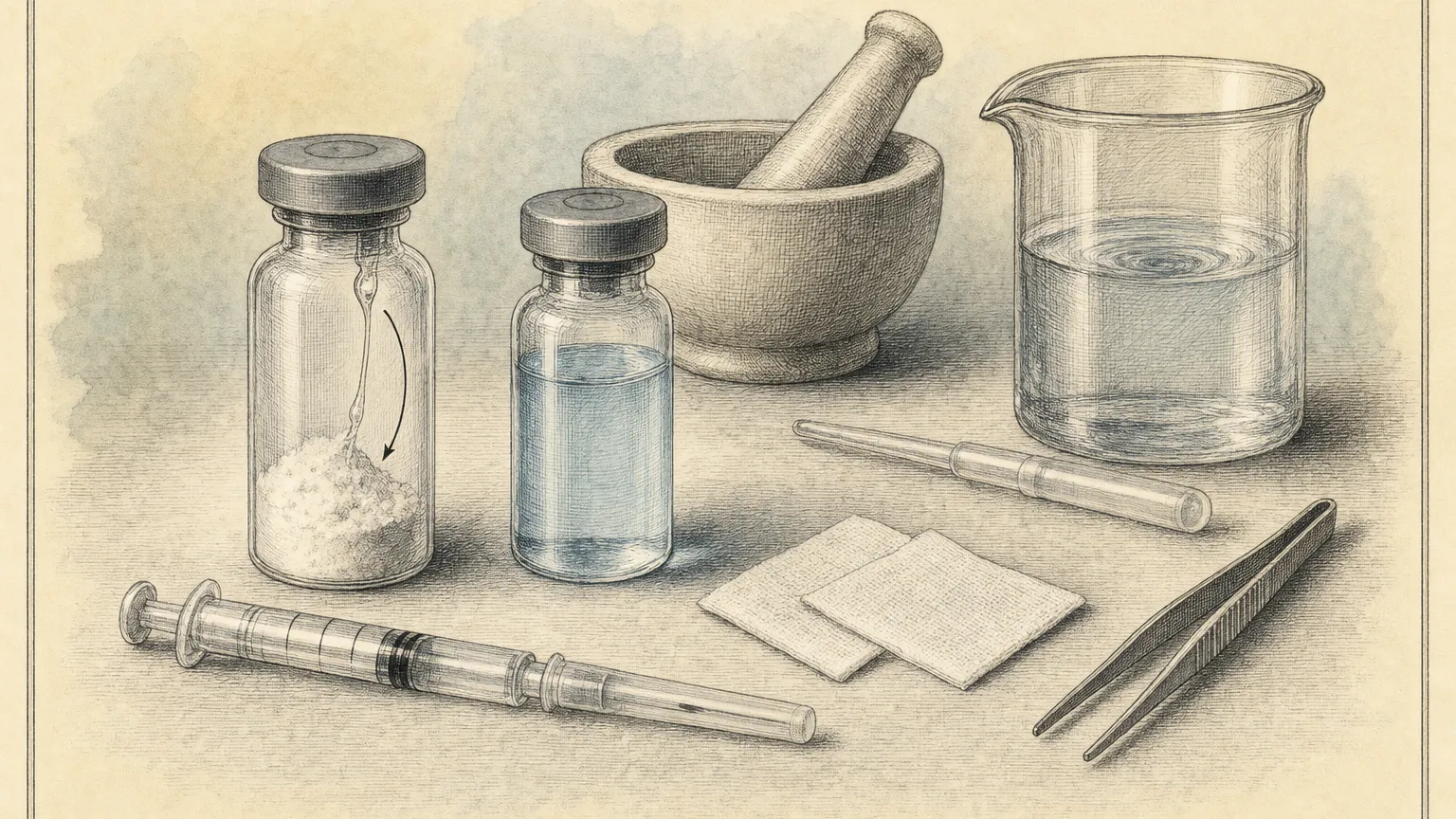
Quick answer: to reconstitute peptides, you add a measured volume of the right diluent (usually bacteriostatic water) to the freeze-dried powder, letting it run down the inside wall of the vial, then swirl gently until it dissolves. Do not shake.[7][9] The water volume sets the concentration, which you then convert into syringe units for each dose. Bacteriostatic water vials are discarded 28 days after first puncture by default.[3]
This guide uses the instructions on FDA-approved peptide products as the model, because research peptides have no tested instructions. To run the numbers for your own vial, use our peptide calculator. For more on handling, see our guides to bacteriostatic water, calculating a peptide dose and storing peptides, and our peptide basics hub.
What you need
- The peptide vial (freeze-dried powder).
- The diluent named for that product: usually bacteriostatic water, sometimes sterile water.
- Alcohol swabs.
- A new sterile syringe and needle for mixing, and a new one for every dose.[5][6]
- A clean, well-lit, flat surface.[7]
Bacteriostatic water vs sterile water
| Bacteriostatic water | Sterile water | |
|---|---|---|
| Preservative | 0.9% benzyl alcohol[1] | None[2] |
| Container | Multiple-dose vial[1] | Single-dose only[2] |
| After opening | Discard 28 days after first puncture[3][5] | Discard what is left after use[8] |
| Not for | Newborns[1] | Reuse across doses |
The bacteriostatic water label warns that it is not for use in newborns: benzyl alcohol has been linked to fatal “gasping syndrome” in premature infants.[1][18] It also notes that some drugs are incompatible with benzyl alcohol,[1] and a lab study found that preservatives, including benzyl alcohol, can push some proteins to clump together.[17] That is why approved products name their diluent. Serostim, for example, uses sterile water for some strengths and bacteriostatic water for another.[9]
How to reconstitute peptides, step by step
These steps follow the instructions for FDA-approved tesamorelin and somatropin, which are supplied as powders.[7][8][9]
- Wash and dry your hands, and check the powder is white to off-white. Do not use it if it is discolored.[7]
- Wipe both rubber stoppers (peptide vial and water vial) with an alcohol swab.[6][7]
- Draw the planned volume of water into a new syringe.
- Inject the water slowly down the inside wall of the vial, not directly onto the powder, to avoid foaming.[8][9]
- Swirl or roll the vial gently until the powder dissolves. Do not shake.[7][8] Shaking can damage proteins and cause clumping.[15]
- Let any foam settle for a few seconds.[7]
- Inspect the solution. Use it only if it is clear and free of particles; do not use it if it is cloudy or colored.[7][9]
- Label the vial with the date you mixed it and the concentration.
How to calculate your dose in syringe units
Insulin syringes are marked for U-100 insulin, which means 100 units per mL.[10] With a peptide, those “units” measure volume only: 1 unit = 0.01 mL.
- Concentration = mg in the vial ÷ mL of water
- Volume per dose = dose ÷ concentration
- Units = volume in mL × 100
| Vial | Water added | Concentration | Dose | Volume | Units |
|---|---|---|---|---|---|
| 5 mg | 2 mL | 2.5 mg/mL | 250 mcg | 0.1 mL | 10 |
| 5 mg | 1 mL | 5 mg/mL | 250 mcg | 0.05 mL | 5 |
| 10 mg | 2 mL | 5 mg/mL | 250 mcg | 0.05 mL | 5 |
| 10 mg | 2 mL | 5 mg/mL | 2.5 mg | 0.5 mL | 50 |
| 10 mg | 3 mL | 3.33 mg/mL | 250 mcg | 0.075 mL | 7.5 |
Adding more water lowers the concentration and raises the units per dose, which makes small doses easier to measure. Pick a volume that gives round numbers; the last row shows how awkward volumes create hard-to-measure doses. Our peptide calculator does this math for any vial, dose and syringe size.
Why dose math matters: real dosing errors
In 2024, FDA warned that people using compounded semaglutide from multiple-dose vials had taken 5 to 20 times their intended dose, often from confusion between milligrams, milliliters and units. Some patients told to draw 5 units drew 50. Reported effects included vomiting, pancreatitis and gallstones, and some patients were hospitalized.[11]
- A poison center case series found two patients who gave themselves 10-fold overdoses; one had received a vial and syringes with no instruction.[13]
- US poison centers logged 5,713 GLP-1 drug cases from 2017 to 2022, and 79.9% were therapeutic errors.[14]
See our semaglutide profile for its approved dosing.
How to store peptides before and after mixing
- Unmixed powder: follow the product’s labeling. Approved tesamorelin and somatropin powders are stored at room temperature in their box to protect them from light.[7][9] Light can degrade some amino acids in proteins.[16] We found no reliable source for generic freezer temperatures for research peptide powder.
- After mixing: there is no universal shelf life.[22] Approved examples range widely:
| Product | Storage after mixing |
|---|---|
| Egrifta SV (sterile water) | Use immediately; discard any left over[8] |
| Egrifta WR (bacteriostatic water) | Room temperature, up to 7 days; do not refrigerate or freeze[7] |
| Serostim 4 mg (bacteriostatic water) | Refrigerated (2 to 8°C), up to 14 days[9] |
- Do not freeze mixed solutions unless the labeling allows it.[7] Freezing and thawing can denature proteins.[19]
- The water vial is a separate clock: discard bacteriostatic water 28 days after first puncture unless its maker says otherwise.[3][4][5] FDA gives the same 28-day advice for compounded GLP-1 vials, even if medication remains.[12]
Common reconstitution mistakes
- Shaking the vial instead of swirling. Labels say do not shake, and mechanical stress can make proteins clump.[7][15]
- Spraying water straight onto the powder, which causes foaming; aim it down the vial wall.[8][9]
- Confusing units, milliliters and milligrams. This is the most common cause of overdoses with compounded GLP-1 vials.[11][13]
- Reusing needles or leaving a needle in the stopper.[5]
- Using the water vial past 28 days after first puncture.[3]
- Injecting a cloudy or discolored solution.[7]
“Research use only” peptides
Peptides sold online as “research use only” are not FDA-approved and have no tested mixing or storage instructions.[12] FDA has flagged possible immune reactions and impurities for peptides such as BPC-157.[20] In one study, semaglutide vials bought online without a prescription all contained bacterial endotoxin and had far lower purity than claimed.[21]