Quick answer: bacteriostatic water is sterile water for injection with 0.9% (9 mg/mL) benzyl alcohol added as a preservative, so a single vial can be entered more than once to dilute or dissolve injectable drugs.[1] Sterile water has no preservative and is single-dose only.[2] Once a bacteriostatic water vial has been punctured, FDA and USP say to discard it after 28 days unless the manufacturer specifies otherwise.[3][4]
This guide explains how to use it safely and when it is the wrong choice. It is educational: always use the diluent your product’s label or your pharmacist names. For mixing steps, see how to reconstitute peptides, and for wider context, the peptide basics hub.
What bacteriostatic water is
According to the Hospira label, Bacteriostatic Water for Injection, USP is:[1]
- Sterile and nonpyrogenic (free of fever-causing contaminants).
- Preserved with benzyl alcohol, at 0.9% (9 mg/mL) in 30 mL plastic vials or 1.1% (11 mg/mL) in a glass vial.
- Slightly acidic, with a pH of about 5.7 (range 4.5 to 7.0).
- For dilution only. It is indicated only for diluting or dissolving drugs for IV, intramuscular or subcutaneous injection, following the drug maker’s instructions.
- Stored at room temperature, 20 to 25°C (68 to 77°F).
“Bacteriostatic” means it slows the growth of bacteria that might get in when a needle passes through the stopper. It does not kill everything, and it does not make poor technique safe.
Bacteriostatic water vs sterile water
| Bacteriostatic water | Sterile water for injection | |
|---|---|---|
| Preservative | Benzyl alcohol, 0.9% or 1.1%[1] | None[2] |
| Container type | Multiple-dose vial[1] | Single-dose only[2] |
| After first use | Discard 28 days after first puncture unless labeled otherwise[3][4] | Discard what is left after the single use[5] |
| Newborns | Not for use[1] | Used when a preservative-free diluent is needed[1] |
| Epidural or spinal use | Not for use[1] | Per drug instructions |
When sterile water is required instead
Approved products specify their diluent, and swapping is not a safe default. Tesamorelin (Egrifta SV) is mixed only with the sterile water supplied in its kit and used immediately.[8] Serostim uses sterile water for some strengths and bacteriostatic water for another.[9] The bacteriostatic water label itself tells you to consult the drug maker’s instructions for the choice of diluent and volume.[1]
The reason is chemistry. A lab study found that antimicrobial preservatives, including benzyl alcohol, can partly unfold some proteins and push them to clump together.[7] Some peptides tolerate it well; others may not. Only stability testing for a specific product can answer that.
The 28-day multi-dose rule, verified
Three federal or standards bodies agree on the same default:
- FDA: its labeling guidance says the beyond-use date for an opened or needle-punctured multiple-dose container is 28 days, unless the manufacturer specifies otherwise on the label.[3]
- USP chapter 797: a conventionally manufactured multiple-dose vial may not be used more than 28 days after first puncture, even if its own expiry date is later.[4]
- CDC: once opened, date the vial and discard it within 28 days unless the manufacturer gives a different date, and never past the original expiry date.[5]
FDA applies the same 28-day advice to compounded multi-dose GLP-1 vials, even if medication remains.[10]
Two clocks run at once. The 28-day clock covers the water vial. A peptide mixed with that water has its own, often much shorter, in-use time set by its label.
How to use bacteriostatic water, step by step
- Confirm it is the right diluent for your product, and check the expiry date and seal.[1]
- Wash your hands and work on a clean, dry surface.
- Wipe the rubber stopper with an alcohol pad and let it dry.
- Use a new sterile needle and syringe every time you enter the vial.[5]
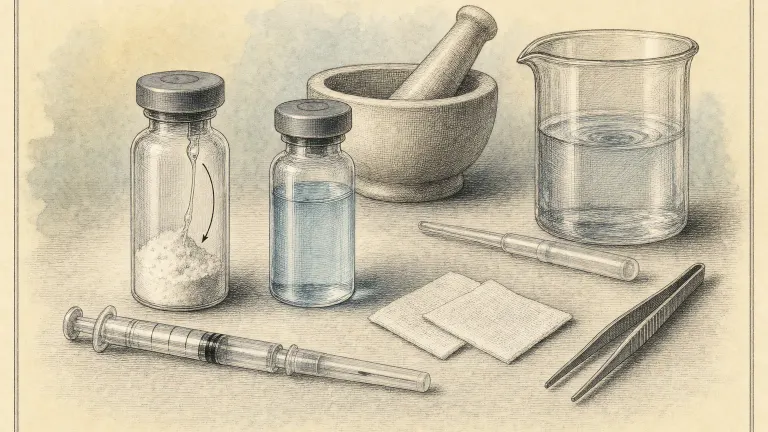
- Draw the exact volume your instructions call for. The volume sets the concentration; see how to calculate peptide dosage.
- Never leave a needle in the stopper between uses.[5]
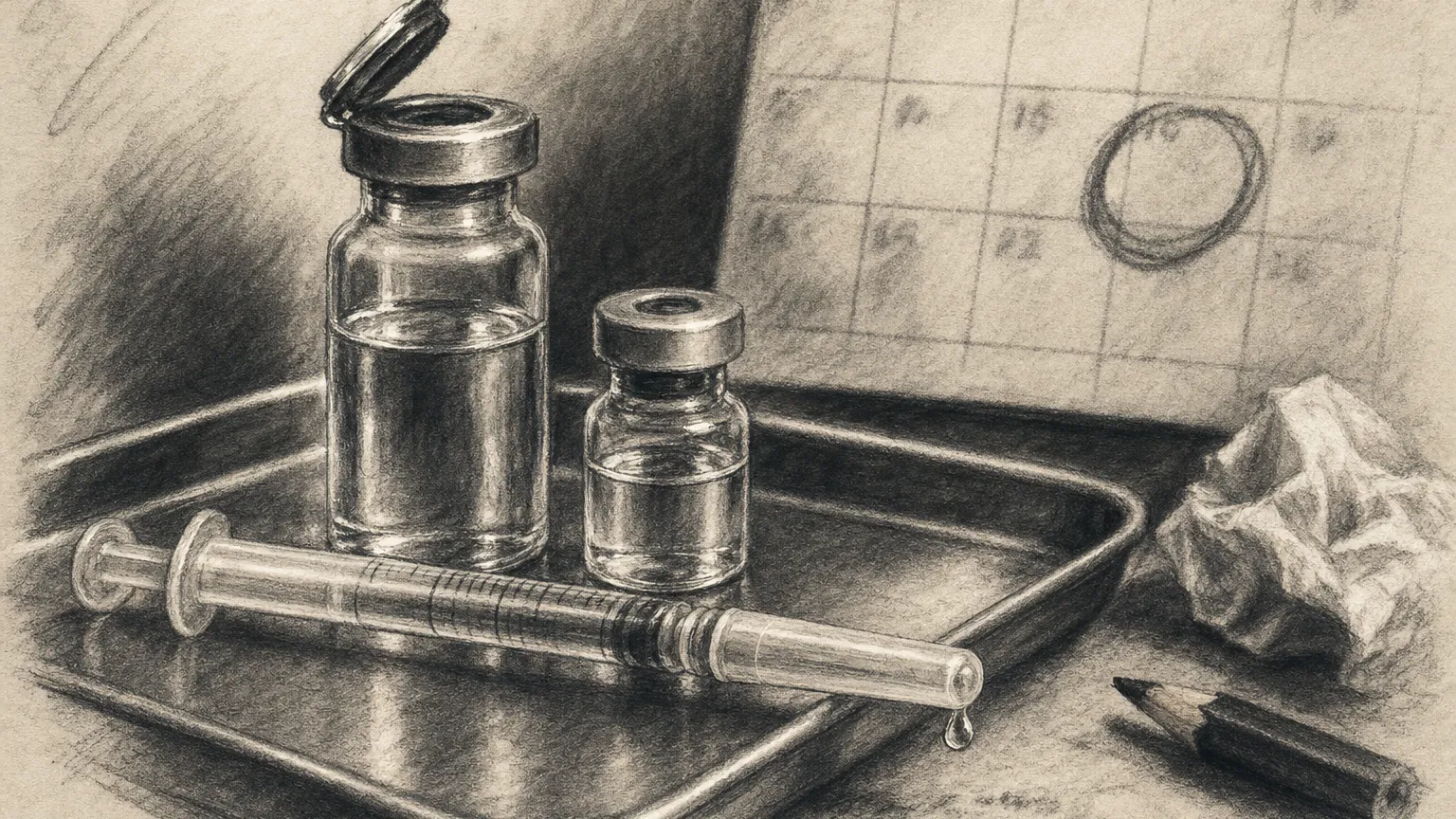
- Write the date of first puncture on the vial and discard it at 28 days, or sooner if it looks cloudy or contaminated.[3][5]
- Inspect anything you mix for clarity and particles before use.[1]
Quick safety checklist
- Diluent matches the product label
- Vial dated at first puncture
- New needle and syringe each entry
- Solution clear, no particles
- Discarded at 28 days, at expiry, or if compromised
Safety warnings on the label
- Not for newborns. Benzyl alcohol has been associated with toxicity in neonates.[1] A 1982 report linked it to a fatal “gasping syndrome” in premature infants.[6]
- Not for fluid replacement or for epidural or spinal procedures.[1]
- Not on its own into a vein. IV use without an added drug may cause hemolysis, the bursting of red blood cells.[1]
- Possible injection reactions listed for the solution or the technique include local tenderness, infection or abscess at the site, and fever.[1]
Bacteriostatic water and unapproved peptides
Bacteriostatic water is a regulated pharmaceutical. It cannot make an unapproved “research” peptide sterile, correctly dosed or tested for use in people. Those products have no stability data showing whether benzyl alcohol is compatible with them. For the difference between product types, see lyophilized vs premixed peptides and peptide clinic vs DIY. To inject a prescribed product correctly, read how to inject peptides subcutaneously.