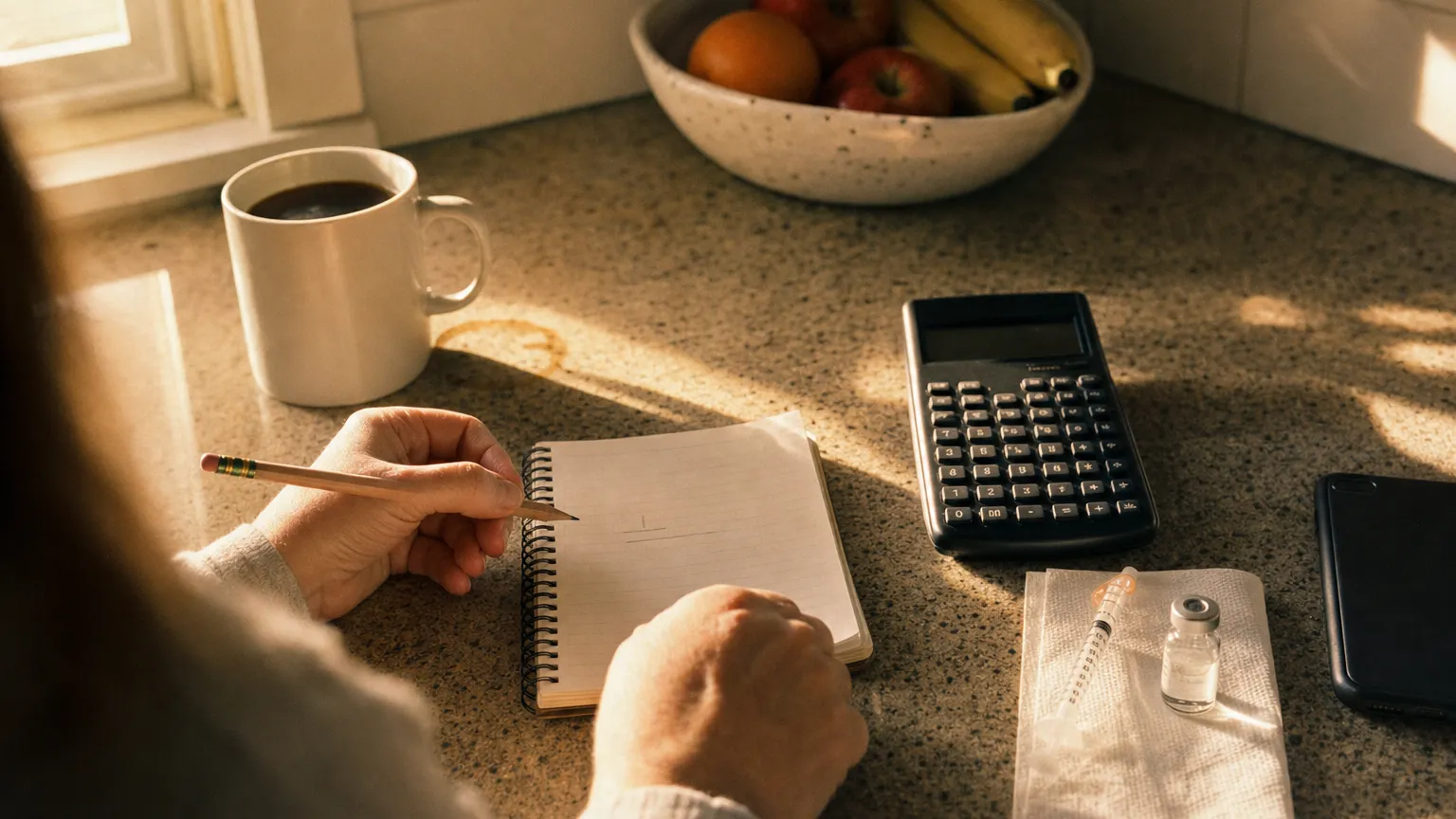
Quick answer: how to calculate peptide dosage comes down to three steps: (1) concentration = mg in the vial ÷ mL of liquid added; (2) volume = your prescribed dose ÷ concentration; (3) units = mL × 100 on a U-100 insulin syringe.[1] For example, 250 mcg from a 5 mg vial mixed with 2 mL is 0.1 mL, or 10 units. Your prescriber sets the dose; this math only turns that dose into a volume.
Getting this wrong is not a small mistake. FDA has reported patients taking 5 to 20 times their intended dose from confusion between milligrams, milliliters and units.[3] Our peptide calculator does the arithmetic for you, but it helps to understand it so you can catch errors. This guide is educational and assumes a product and dose from a licensed prescriber. More on the basics is on our peptide basics hub.
The units you need to know
| Unit | What it measures | Conversion |
|---|---|---|
| mg (milligram) | Amount of drug | 1 mg = 1,000 mcg |
| mcg (microgram) | Amount of drug | 1,000 mcg = 1 mg |
| mL (milliliter) | Volume of liquid | 1 mL = 100 syringe units (U-100) |
| Syringe “unit” (U-100) | Volume only | 1 unit = 0.01 mL[1] |
U-100 means 100 units per mL; insulin syringes are marked to match.[1] When you use an insulin syringe for a peptide, the “units” are just a volume scale. They say nothing about how much peptide you are getting until you know the concentration.
Common U-100 syringe sizes hold 0.3 mL (30 units), 0.5 mL (50 units) and 1 mL (100 units). Smaller barrels have finer markings, which makes small volumes easier to read.
How to calculate peptide dosage in 3 steps
- Find the concentration. Divide the amount of peptide in the vial by the volume of diluent added.
- 5 mg ÷ 2 mL = 2.5 mg/mL (2,500 mcg/mL)
- Convert your dose to the same unit. If the dose is in mcg and the concentration in mg/mL, convert one of them first.
- 250 mcg = 0.25 mg
- Divide the dose by the concentration to get the volume, then multiply by 100 for U-100 units.
- 0.25 mg ÷ 2.5 mg/mL = 0.1 mL → 0.1 × 100 = 10 units
Then check the answer a second way: 10 units = 0.1 mL; 0.1 mL × 2.5 mg/mL = 0.25 mg. If the reverse check does not land on your prescribed dose, stop and recheck.
Worked examples
Example 1: a label-based check
The tesamorelin (Egrifta SV) label gives a real-world example. One 2 mg vial is mixed with 0.5 mL of sterile water, and the dose is 1.4 mg, which the label states is 0.35 mL.[2]
- Concentration: 2 mg ÷ 0.5 mL = 4 mg/mL
- Volume: 1.4 mg ÷ 4 mg/mL = 0.35 mL ✓ matches the label
- On a U-100 scale: 0.35 × 100 = 35 units
Example 2: same dose, different water volume
| Vial | Liquid added | Concentration | Dose | Volume | U-100 units |
|---|---|---|---|---|---|
| 5 mg | 1 mL | 5 mg/mL | 250 mcg | 0.05 mL | 5 |
| 5 mg | 2 mL | 2.5 mg/mL | 250 mcg | 0.1 mL | 10 |
| 5 mg | 2.5 mL | 2 mg/mL | 250 mcg | 0.125 mL | 12.5 |
| 10 mg | 2 mL | 5 mg/mL | 500 mcg | 0.1 mL | 10 |
| 10 mg | 2 mL | 5 mg/mL | 2.5 mg | 0.5 mL | 50 |
Notice that “10 units” means 250 mcg in one row and 500 mcg in another. Units alone never tell you the dose.
Example 3: a dose in milligrams
Approved GLP-1 doses are written in milligrams. Tirzepatide (Zepbound), for instance, starts at 2.5 mg once weekly and is raised in 2.5 mg steps by the prescriber.[6] If a compounded multi-dose vial held 10 mg/mL, a 2.5 mg dose would be 0.25 mL, or 25 units. A vial at 2.5 mg/mL would need 1 mL, or 100 units, for the same dose. This is exactly the gap where errors happen.
Choosing how much liquid to add
If your product’s label or pharmacist names a volume, use exactly that. Egrifta SV, for example, is mixed with 0.5 mL of the supplied sterile water, no more and no less.[2] When a prescriber leaves the volume to you, a few principles help:
- More liquid means a weaker solution and more units per dose. That makes small doses easier to measure accurately.
- Less liquid means a stronger solution, so each unit carries more drug and a small misreading matters more.
- Aim for round numbers. Pick a volume where your dose lands on a whole syringe marking, such as 10 or 20 units, rather than 7.5.
- Stay within your syringe size. A dose that needs more than 100 units will not fit in one 1 mL syringe.
- Write the concentration on the vial once mixed, so the next dose uses the same number.
Our peptide calculator lets you try different volumes and see the resulting units before you mix anything.
Why the math matters: documented dosing errors
- FDA alert (2024): patients using compounded semaglutide from multi-dose vials took 5 to 20 times the intended dose. Some patients told to draw 5 units drew 50. Reported effects included vomiting, pancreatitis and gallstones, and some patients were hospitalized.[3]
- Poison center case series (2023): two patients gave themselves roughly 10-fold overdoses of compounded semaglutide; one had received a vial and syringes without instructions.[4]
- National poison data (2024): US poison centers logged 5,713 GLP-1 drug cases from 2017 to 2022, and 79.9% were therapeutic errors.[5]
FDA also warns that unapproved products may differ in strength from what is claimed, so even perfect math cannot fix a mislabeled vial.[7]
Dose calculation checklist
- Dose comes from your prescriber or the product label, in writing
- Vial strength (mg) and liquid volume (mL) confirmed
- Dose and concentration in the same unit (mg or mcg)
- Volume worked out, then converted to units
- Answer checked in reverse
- Syringe size suits the volume (0.3, 0.5 or 1 mL)
- Pharmacist or prescriber asked if anything is unclear
For mixing technique, see how to reconstitute peptides and bacteriostatic water. For the injection itself, see how to inject peptides subcutaneously.