Quick answer: “retatrutide units” usually means the markings on an insulin syringe, and those measure volume, not drug. On a U-100 syringe, 100 units is 1 mL, so 1 unit is 0.01 mL.[1] How many milligrams that volume contains depends entirely on the concentration of the liquid, so there is no single units-to-mg answer for retatrutide. Retatrutide is not FDA-approved, has no approved product or standard concentration, and in trials it was dosed in milligrams set by the study, not in units.
This page explains the arithmetic so the numbers you see make sense, and shows why the conversion goes wrong so often. It is not a dosing guide. Any dose of any medicine should be set by a licensed clinician. For background on the drug, see the retatrutide profile.
Retatrutide doses are measured in milligrams
Every published retatrutide trial reports doses in milligrams (mg) given once a week:
| Study | Doses tested |
|---|---|
| Phase 1b, type 2 diabetes | 0.5 mg up to 12 mg |
| Phase 2, obesity | 1, 4, 8 and 12 mg |
| Phase 3 TRIUMPH, starting dose | 2 mg |
| Phase 3 TRIUMPH, steps | 4 mg, then 6 mg, then 9 mg, every four weeks |
| Phase 3 TRIUMPH, target doses | 4, 9 or 12 mg |
Sources: phase 1b,[2] phase 2[3] and Lilly’s TRIUMPH-2 and TRIUMPH-3 report.[4]
Trial participants injected the study drug themselves once weekly.[5] Lilly has also run a study comparing versions of retatrutide made for different injection devices.[6] None of the published results describe doses in syringe units. See the retatrutide dosage guide for what each trial found at each dose.
What “units” on a syringe actually measure
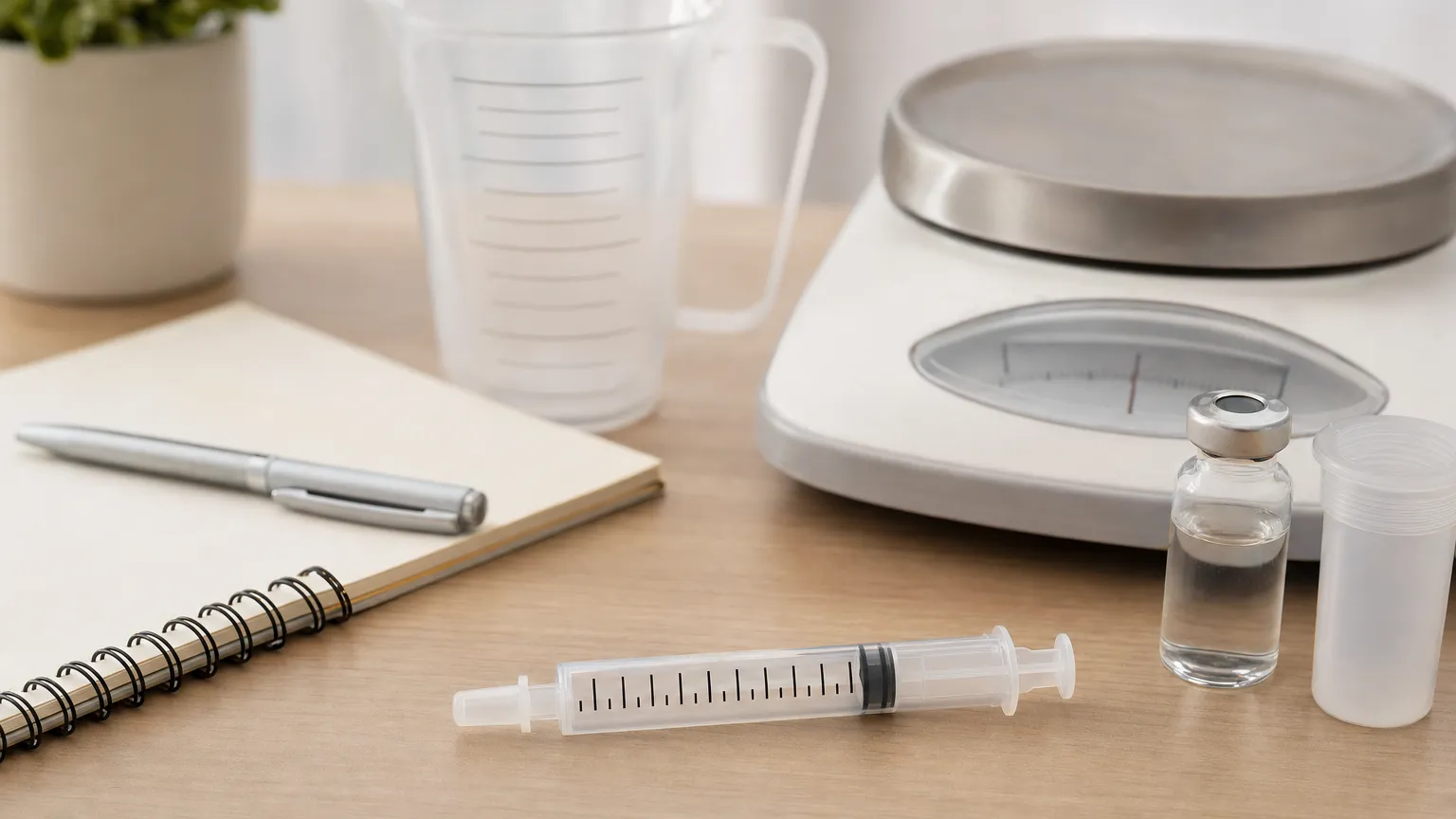
Insulin syringes are printed with unit marks instead of milliliters. On the common U-100 type:
- the full 1 mL barrel holds 100 units
- 1 unit = 0.01 mL
- 10 units = 0.1 mL
- 50 units = 0.5 mL
FDA’s dosing-error alert uses exactly this scale: it describes a U-100 (1 mL) insulin syringe and a 5-unit dose of 0.05 mL.[1] A unit mark tells you how much liquid is in the syringe. It says nothing about how much drug that liquid contains.
The conversion: you always need the concentration
The arithmetic has two steps:
- Units to mL: divide the units by 100.
- mL to mg: multiply the mL by the concentration, in mg per mL.
Put together: mg = (units ÷ 100) × concentration in mg/mL. Without a reliable concentration, the formula has no answer. That is why the same “units” figure can describe very different doses, and why a units number copied from someone else is meaningless unless the liquid is identical. Our guide to calculating peptide dosage covers the math in more detail.
Why the same volume can mean very different doses
An approved drug shows how much concentration matters. Zepbound (tirzepatide) multi-dose vials deliver every dose as 0.6 mL, but the concentration changes with the strength of the vial:[7]
| Zepbound multi-dose vial | Dose per 0.6 mL injection | Concentration |
|---|---|---|
| 10 mg / 2.4 mL | 2.5 mg | 4.17 mg/mL |
| 20 mg / 2.4 mL | 5 mg | 8.33 mg/mL |
| 40 mg / 2.4 mL | 10 mg | 16.7 mg/mL |
| 60 mg / 2.4 mL | 15 mg | 25 mg/mL |
The same 0.6 mL, which would be 60 marks on a U-100 scale, holds 2.5 mg in one vial and 15 mg in another: a sixfold difference. Approved products deal with this through fixed strengths, labeling and instructions for use. This table is an illustration of concentration, not instructions for any product.
FDA’s semaglutide reports show the same problem in practice. One prescriber intended 0.25 mg, which at that product’s concentration was 5 units, but wrote 25 units. The patient received five times the intended dose and had severe vomiting.[1]
Why there is no reliable retatrutide units chart
Searches for a retatrutide units chart lead to tables built around products sold outside Lilly’s trials. They cannot be trusted, for three reasons:
- No approved concentration exists. Retatrutide is not approved, so there is no labeled strength to convert from.
- The label on an unapproved vial may be wrong. FDA has warned companies selling retatrutide labeled “for research purposes” or “not for human consumption” with dosing instructions. It warns that drugs from illegal online sellers could contain the wrong ingredients, or too little, too much or no active ingredient at all, and it says retatrutide cannot be used in compounding.[8] If the milligram figure is wrong, every unit calculation built on it is wrong too.
- Trial doses came with supervision. In trials, doses rose slowly and side effects were tracked. Even so, stomach side effects increased with dose, and 11.3% of people on 12 mg stopped treatment because of adverse events in TRIUMPH-1, versus 4.9% on placebo.[9]
A 2026 study of people describing unapproved retatrutide use online noted that reported symptoms could reflect product or dose variability and reconstitution practices, not only the drug itself.[11]
Dosing errors FDA has documented
FDA’s 2024 alert on compounded semaglutide describes what happens when units, mL and mg get mixed up:[1]
- Drawing too much. Most reports described patients drawing more than the prescribed dose from a multi-dose vial and taking 5 to 20 times the intended amount. Some told to inject 5 units injected 50.
- Prescriber math errors. Clinicians converting from mg to units or mL miscalculated and prescribed 5 to 10 times the intended dose, including one who wrote 20 units instead of 2.
- Wrong tools. Some patients were given syringes much larger than the prescribed volume.
- Confusing instructions. Directions sometimes gave doses in “units”, whose volume varies with concentration, rather than in mg or mL.
- Harm. Reported effects included nausea, vomiting, abdominal pain, fainting, headache, migraine, dehydration, acute pancreatitis and gallstones. Some people needed hospital care.
FDA has also received reports of adverse events in people given compounded semaglutide or tirzepatide at doses above the label, or with faster dose increases.[8] At one US regional poison center, 69.2% of 237 calls involving GLP-1 drugs from 2014 to 2023 were unintentional therapeutic errors.[10]
We did not find an FDA dosing-error report specific to retatrutide. The mechanism of error, though, is the same for any injectable drawn from a vial.
If a dose may have been wrong
- FDA notes that overdoses reported with drugs in this class caused severe nausea, severe vomiting and low blood sugar, and that observation may need to be prolonged because these drugs stay in the body for days.[1] The Zepbound label advises contacting Poison Help (1-800-222-1222) or a medical toxicologist in an overdose.[7]
- Seek urgent care for vomiting that stops you keeping fluids down, fainting or severe stomach pain.
- Report errors and side effects to FDA’s MedWatch program.[1]
See also semaglutide overdose and how long retatrutide stays in your system.
About our calculator
Our peptide calculator does the mg, mL and units arithmetic when the concentration is known. It cannot choose a dose, verify what is in a vial, or make an unapproved product safe. Use it to check a dose your clinician has prescribed, and ask the prescriber or pharmacist to confirm the volume before you inject. For approved alternatives, see retatrutide vs tirzepatide and is retatrutide legal?.
Questions to ask a clinician or pharmacist
- What is my dose in mg, and what volume in mL is that for my product?
- Which syringe or device should I use, and can you show me the mark to fill to?
- What should I do if I think I injected the wrong amount?
- Is there an approved medicine with a prefilled pen that would avoid this math?