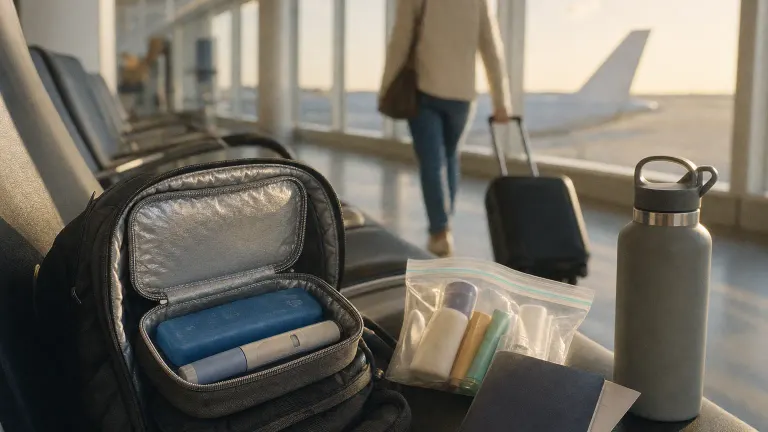
Quick answer: when traveling with peptides that are prescribed to you, pack them in your carry-on, keep them in the original labeled packaging with a copy of the prescription, cool them as the label requires, and declare them, plus any syringes and ice packs, at TSA screening.[1][2][5] TSA allows medically necessary liquids above 3.4 oz and ice packs in any state of freezing.[1] Check the destination country’s rules before you go, because unapproved peptides can be illegal to import.[5][8]
This guide is educational and assumes a prescribed product. For GLP-1 pens specifically, see traveling with GLP-1 medications. More basics are on our peptide basics hub.
Before you go: a step-by-step plan
- Check your product’s storage label for temperature limits and time out of the fridge (see the table below).
- Pack enough for the whole trip plus extra for delays.[5]
- Get a letter from your prescriber on letterhead listing your condition, medications with generic names and doses, and that you need syringes.[5][6]
- Bring copies of prescriptions. Brand names vary between countries; generic names help a pharmacist abroad.
- Contact the destination country’s embassy or consulate to ask whether your medication is restricted.[5]
- Pack a travel sharps container for used needles.[6]
- Plan dose timing across time zones with your prescriber.
TSA screening rules
| Item | TSA rule |
|---|---|
| Medically necessary liquids over 3.4 oz | Allowed in reasonable quantities; declare at the checkpoint[1][4] |
| Unused syringes | Allowed when accompanied by injectable medication; declare them[2] |
| Used syringes | Allowed in a sharps disposal container or similar hard-surface container[3] |
| Ice packs and gel packs for medication | Allowed frozen, partially frozen or melted[1] |
| Labels | Recommended, not required, to speed screening[2] |
At the checkpoint, take medications out of your bag and tell the officer what they are; they are screened separately.[1][4] The officer has the final say on what passes.[3]
At the airport, step by step
- Keep medications together in one clear pouch in your carry-on so they are easy to pull out.
- Tell the officer before screening that you have medication, syringes and ice packs.[1][2]
- Place them in a separate bin for screening.[1][4]
- Tell the officer if you do not want liquid medication X-rayed or opened. TSA will then take extra steps to clear it, which may include a pat-down and extra screening of your bag.[1]
- Keep your prescriber’s letter handy in case of questions, especially on international flights.[5]
- Repack the cooler right after screening so the product stays cool during boarding and delays.
Keeping peptides cool: what the labels allow
| Product | Storage while traveling |
|---|---|
| Zepbound single-dose pen or vial (tirzepatide) | Refrigerate; if needed, up to 30°C (86°F) for a total of 21 days; do not freeze; protect from heat and light[9] |
| Wegovy single-dose pen (semaglutide) | Refrigerate; if needed, 8°C to 30°C (46°F to 86°F) for up to 28 days before cap removal; do not freeze[10] |
| Egrifta SV powder (tesamorelin) | Room temperature 20°C to 25°C (68°F to 77°F), excursions 15°C to 30°C; keep in the box away from light[11] |
General packing tips:
- Use an insulated pouch with an ice pack, but keep the product from touching the ice directly. Most labels say do not freeze.[9][10]
- Never put peptides in checked luggage. CDC advises carrying all medications in hand luggage.[5]
- Do not leave them in a hot car, on a sunny windowsill or in direct sunlight.
- Use a hotel fridge if available, away from the freezer compartment.
- Inspect before each dose. Do not use anything frozen, cloudy or discolored.
Road trips, cruises and hot weather
- Cars heat up fast. Keep the cooler in the cabin, out of direct sun, and take it with you when you stop.
- Bring a small thermometer in the cooler if you are traveling somewhere hot, so you know whether you stayed within the label’s range.
- Track time out of the fridge. For products like Zepbound pens, the 21 days at room temperature is a running total, not per trip.[9]
- On cruises or long trips, ask ahead whether a cabin fridge is available, and confirm it is not set so cold that items freeze near the back wall.
- If a product froze or overheated, do not use it. Call your pharmacist for advice on a replacement rather than guessing.
Reconstituted peptides are more fragile than powder or pens and often have short in-use times. See how to reconstitute peptides and lyophilized vs premixed peptides.
International travel and import rules
Leaving and entering other countries. CDC says some countries do not allow visitors to bring certain medications and advises checking with the destination’s embassy or consulate.[5] Rules on injectable medications, quantity limits and paperwork differ widely; see peptide legality by country.
Coming back to the US. CBP advises travelers to carry medicines in their original containers, with a prescription or doctor’s letter, and generally no more than a 90-day supply, and to declare them.[7] CBP also warns that buying drugs abroad and bringing them home is illegal in most cases.[7]
Unapproved and “research” peptides. These are not prescription medicines, so traveler allowances may not cover them. FDA says personal importation of drugs is illegal in most circumstances, and its discretion policy has narrow conditions that online-marketed peptides generally fail.[8] Our guide to peptide import laws explains detentions and seizures in detail.
Travel packing checklist
- Prescribed peptide in original labeled packaging
- Copy of prescription and prescriber’s letter
- Enough supply plus extra for delays
- Insulated pouch and ice pack (product not touching ice)
- Syringes or pen needles, alcohol pads
- Travel sharps container
- Destination medication rules checked
- Local pharmacy or clinic contact at your destination
At your destination, dispose of used needles under local rules; our guide on how to dispose of needles covers the options. For injection technique away from home, see how to inject peptides subcutaneously.