In the topical vs injectable peptides for skin debate, the short answer is that topical peptides barely penetrate but have small controlled trials and a good safety record, while injected peptide “skin boosters” bypass the barrier but are not FDA-approved and carry infection and purity risks.[2][12] Most cosmetic peptides are larger than the roughly 500-dalton size limit for easy skin absorption, which is why makers add fatty-acid tails, special emulsions or microneedles.[1][4]
This guide explains why skin is hard to get through, what injected products claim and how regulators treat each route. For background, see our peptide basics hub.
Evidence-graded table
| Approach | Evidence level | What was shown | FDA status | Our profile |
|---|---|---|---|---|
| Topical pal-KTTKS (Matrixyl) cream | Human RCTs (small) | Fewer wrinkles vs placebo in 93 women over 12 weeks[6] | Cosmetic | None |
| Topical argireline (acetyl hexapeptide-8) | Small human studies | Modest wrinkle effects; reaching muscle uncertain[5] | Cosmetic | SNAP-8 (related) |
| Topical GHK-Cu | Small human studies | Lab collagen effects; limited clinical data[2] | Cosmetic | GHK-Cu |
| Dissolving microneedle patch with acetyl octapeptide-3 | Small human studies | Eye wrinkles improved vs placebo patch in 24 people[7] | Cosmetic | SNAP-8 |
| Peptide serum added to injected recombinant collagen | Small human studies | Better skin satisfaction on the serum side in 54 people[10] | No US approval identified | None |
| Injected peptides (GHK-Cu, argireline) | No evidence, marketing only | Infection case reported after argireline injection[12] | Not approved; injectable GHK-Cu flagged by FDA[13] | GHK-Cu |
| Hyaluronic acid dermal fillers | FDA-approved devices for specific uses | Fill wrinkles and add volume in approved areas[11] | Approved (devices) | None |
Results come from different groups of people and are not head-to-head comparisons.
Why skin is hard to get through
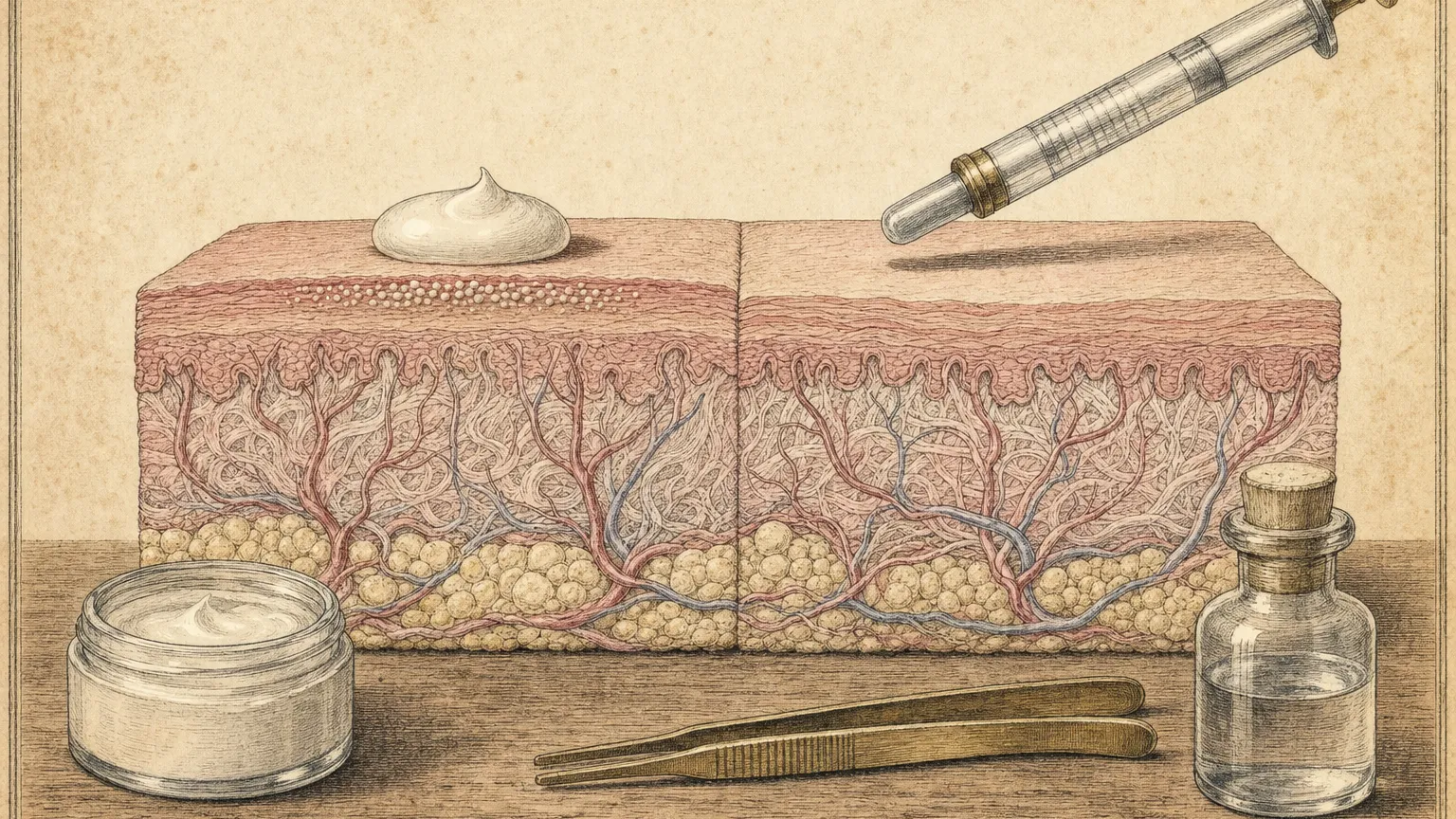
The outermost layer of skin, the stratum corneum, is a tight wall of dead cells and fats. A classic dermatology paper argues that compounds generally need to be under about 500 daltons (a unit of molecular weight) to pass it, noting that virtually all topical drugs that work through skin are under that size.[1] A peptide of five or more amino acids usually exceeds that limit.
Size is only part of the problem. Most anti-wrinkle peptides are water-loving and electrically charged, and enzymes in skin break them down. A 2022 review concluded that most of these peptides might not reach their targets at the right concentrations without enhancement methods.[2] For more on this, see peptide bioavailability.
How topical products try to get around it
- Fatty-acid tails: adding palmitic acid turns water-soluble KTTKS (log P of about −1.6) into a fat-friendly molecule (log P of about 3.7), which helps it enter the oily outer layer.[4]
- Emulsions and carriers: oil-in-water and water-in-oil-in-water emulsions have been tested for acetyl hexapeptide-8, but a 2025 review says its ability to reach nerve-muscle junctions remains uncertain.[5]
- Real-world tracking: in a 2026 study of three volunteers, imaging mass spectrometry found palmitoyl tripeptide-1 and palmitoyl tetrapeptide-7 throughout the outer skin layer, but mostly on cell surfaces, with levels falling quickly with depth.[3]
- Microneedle patches: dissolving needles create tiny channels. An overnight patch with acetyl octapeptide-3 improved eye wrinkles more than a placebo patch in 24 people.[7]
Despite these limits, some topical peptides show measurable effects. A 12-week split-face trial of 93 women found that a moisturizer with pal-KTTKS reduced wrinkles and fine lines more than the same moisturizer without it.[6] Our peptide cream vs serum guide explains how the vehicle matters.
Injectable “skin boosters”: the claims
Skin boosters are small-volume injections meant to improve skin quality, hydration and elasticity rather than add volume. A 2024 review describes a growing range of materials and summarizes their evidence as still developing.[9]
Peptide-specific injectable data are scarce. In one 2026 split-face trial in 54 adults in China, all participants received injected recombinant type III collagen, and one side also got a collagen-peptide serum. The serum side scored better on satisfaction and fine lines by 12 weeks.[10] That tests a serum added to an injection, not an injected peptide.
Regulatory status in the US
- Cosmetics vs drugs: a product intended to change skin structure or function is a drug under federal law.[15] Topical peptide serums are sold as cosmetics and avoid efficacy review by making appearance claims.
- Fillers: FDA regulates dermal fillers as devices approved for specific areas, and warns that injection into a blood vessel can cause blanching, vision changes or stroke-like symptoms.[11]
- Microneedling: FDA says microneedling devices are not approved to deliver cosmetics, topical medicines, vitamin solutions or drugs into the skin, and warns against reusing cartridges.[8]
- Injectable peptides: no peptide is FDA-approved for cosmetic injection into skin. FDA flagged injectable GHK-Cu for possible immune reactions from aggregation and impurities, with limited human data; it now appears among nominations withdrawn by their sponsors, which is not an approval.[13]
Matching the route to the goal
- Fine lines and texture: daily sunscreen, a retinoid and, if you like, a topical peptide such as palmitoyl pentapeptide-4.[6]
- Volume loss or deep folds: creams cannot add volume; FDA-approved fillers are designed for this in specific areas.[11]
- Better delivery without needles: formulations with fatty-acid-modified peptides, or dissolving microneedle patches sold as cosmetics.[4][7]
- “Glow” or “skin quality” injections: ask exactly what is being injected, whether it is approved for that use and what evidence supports it.[9]
In short, the strongest evidence sits with approved treatments and simple topical routines, not with injected peptides.
Questions to ask before choosing
- Is this product approved, cleared or simply sold as a cosmetic?
- For an injection, which FDA-approved product is being used, and is the area an approved use?
- Is the provider licensed and trained, and are needles and cartridges single-use?
The bottom line
Topical peptides are low-risk with modest benefits; their main limit is getting into skin. Injecting peptides solves the delivery problem on paper but trades it for unproven benefit and real risks. If you want injectables, stick to FDA-approved products from qualified providers.