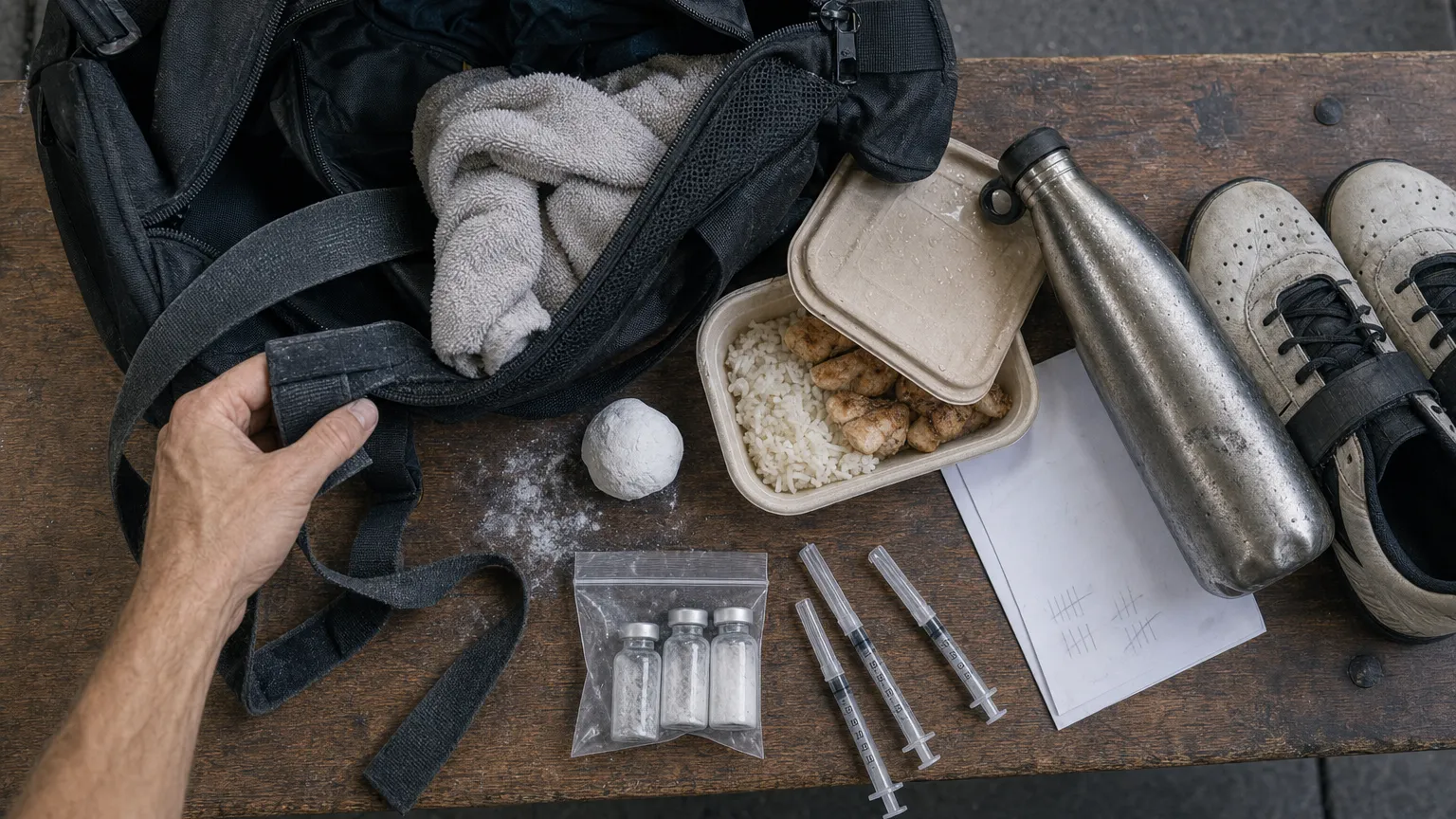
Peptides for bodybuilding usually means injectable growth hormone secretagogues such as CJC-1295, ipamorelin and MK-677, plus IGF-1 LR3 and healing peptides like BPC-157. The short answer: none has a controlled trial in trained bodybuilders, all are banned under WADA rules, and products sold online are often mislabeled.[1][2][14] Even growth hormone itself added about 2.1 kg of lean mass but no strength in fit young adults.[4]
This guide explains what is actually used, what the evidence shows and where the real risks lie. For more, see our muscle and metabolism peptides hub.
Evidence-graded table
| Peptide | Evidence level | What was shown | FDA status | Our profile |
|---|---|---|---|---|
| Growth hormone (somatropin) | Human RCTs (not in bodybuilders) | +2.1 kg lean mass, no strength gain; sprint capacity up 3.9% in one trial[4][5] | Approved for GH deficiency only | HGH |
| MK-677 (ibutamoren) | Human RCTs (older adults) | +1.1 kg fat-free mass, no strength gain, higher blood sugar[6] | Not approved; FDA safety-risk list[8] | MK-677 |
| CJC-1295 | Small human studies | Raised GH and IGF-1; no body-composition outcomes[7] | Not approved | CJC-1295 |
| Ipamorelin, GHRP-2, GHRP-6, hexarelin | Small human studies | Raise GH; no muscle trials[2] | Not approved; first three on FDA safety-risk list[8] | Ipamorelin, GHRP-2, GHRP-6, Hexarelin |
| IGF-1 LR3 | Animal or lab only | No human studies[2] | Not approved | IGF-1 LR3 |
| PEG-MGF | Animal or lab only | No human studies[2] | Not approved | PEG-MGF |
| BPC-157 | Animal or lab only (one tiny human series) | 35 of 36 studies were preclinical; no clinical safety data[16] | Not approved | BPC-157 |
| TB-500 | Animal or lab only | Tissue repair in animals | Not approved | TB-500 |
| AOD-9604 and fragment 176-191 | No evidence for muscle | Promoted for fat metabolism; no trials in lifters[1] | Not approved | AOD-9604 |
Trial results come from different groups of people and are not head-to-head comparisons.
What bodybuilders actually use, and why
A 2026 critical review describes a shift from anabolic steroids toward peptides, marketed as more selective and safer. The usual targets are muscle growth, fat loss, recovery and joint pain.[1] A separate 2026 endocrine review lists the agents most often seen in online protocols:[2]
- GHRH analogues: CJC-1295 (with and without DAC), sermorelin, tesamorelin
- GH secretagogues: GHRP-2, GHRP-6, hexarelin, ipamorelin, often “stacked” with a GHRH analogue
- Growth factors: IGF-1 LR3 and PEG-MGF
- Healing peptides: BPC-157 and TB-500, used for joint and tendon pain
Both reviews make the same point: the studies that exist used controlled medical doses in patients, not the high-dose, multi-drug “stacks” common in gyms. The real extent of use among recreational lifters is unknown because prevalence studies are lacking.[1][2]
The evidence: mostly none in trained humans
Growth hormone is the benchmark, since secretagogues work by raising it. In a review of 27 study groups of fit adults averaging 27 years old, GH increased lean body mass by about 2.1 kg, but strength and exercise capacity did not improve. Swelling and fatigue were more common.[4] In a WADA-funded trial of 96 recreational athletes, 8 weeks of GH reduced fat and increased lean mass largely through extra body water. Sprint capacity rose 3.9%, but strength, power and endurance did not change, and the sprint gain disappeared 6 weeks after stopping.[5]
MK-677 raised GH and IGF-1 to young-adult levels in older adults and added 1.1 kg of fat-free mass in a year, without strength gains. Body weight rose 2.7 kg, fasting blood sugar went up, and insulin sensitivity fell.[6]
CJC-1295 raised GH and IGF-1 for days after one injection in healthy volunteers. The study measured hormones, not muscle.[7]
For IGF-1 LR3, PEG-MGF and BPC-157, there are no human muscle trials. A 2025 systematic review of BPC-157 found 36 studies, 35 of them in animals or cells, and no clinical safety data.[16]
The honest summary from a 2026 Sports Medicine review: these peptides show tissue repair and metabolic effects in animal models, but rigorous human safety data are scarce, and serious harm is possible.[3]
WADA bans and drug testing
If you compete in a tested federation, assume these are prohibited. WADA’s 2026 List bans, at all times:[14]
- GH-releasing hormone analogues, including CJC-1295, sermorelin and tesamorelin
- GH secretagogues and GHRPs, including ipamorelin, MK-677, GHRP-2, GHRP-6 and hexarelin
- IGF-1 and its analogues, mechano growth factors and TB-500
- BPC-157, under the non-approved substances class (S0)
USADA says the 2027 List names “peptides” in general under S0, and warns that not every prohibited peptide appears in its online lookup tool.[15] Our guides to the WADA prohibited list and peptides vs SARMs cover testing in more depth.
Contamination, counterfeits and dosing risk
Unapproved peptides are sold as “research chemicals,” so nobody checks what is in the vial.
- An anti-doping lab found IGF-1 LR3 carrying a lab purification tag in a black-market vial, a form never meant for injection.[10]
- Another analysis of black-market products found unexpected modified versions of GH, GHRP-2, GHRP-6 and ipamorelin.[11]
- Every growth hormone sample bought from internet sellers without a prescription contained significantly less hormone than its label claimed.[12]
- Even “custom synthesis” research peptides have been found to contain 20% to 43% undeclared filler by weight.[13]
Our counterfeit peptides guide explains how these problems arise.
Questions to discuss with a clinician
- What could explain a plateau in my training, and are there labs worth checking?
- If I have used peptides, what monitoring do I need for blood sugar, blood pressure or hormones?
- Am I subject to drug testing in my federation or job?
For comparisons with other compounds, see peptides vs prohormones and our ranked best peptides for muscle growth.
The bottom line
Peptides for bodybuilding are sold on promises that controlled trials have not tested in trained lifters. Strength gains have not been shown, the products are banned in tested sport, and quality is unreliable. Training, protein, sleep and patience remain the proven formula; in a meta-analysis of 49 trials, extra protein helped muscle gains up to about 1.6 g per kg of body weight a day.[17]