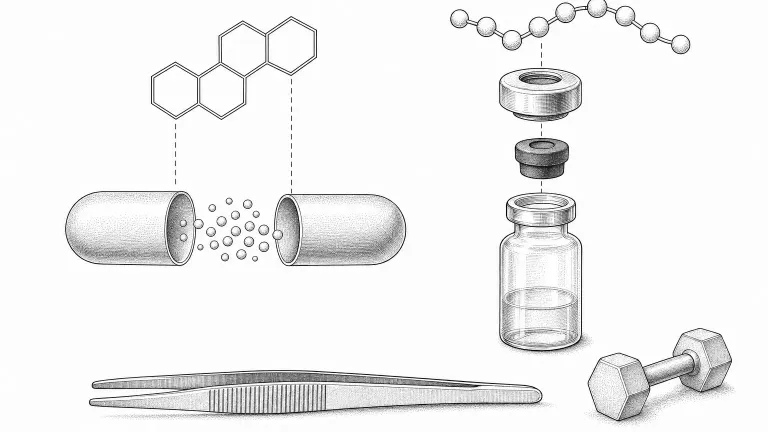
Peptides vs SARMs: SARMs (selective androgen receptor modulators) are pills that act on the same receptor as testosterone; in controlled trials, LGD-4033 and enobosarm increased lean body mass within 3 to 12 weeks.[2][3] But no SARM is FDA-approved, and FDA warns of liver injury, heart attack and stroke risk.[1] Muscle-marketed peptides, such as growth hormone secretagogues and IGF-1 analogs, act on the growth hormone system instead, and most have little or no human outcome data.[7] Neither group is approved for building muscle, and both are banned in sport.[11]
See the muscle and metabolism peptides hub and profiles such as MK-677, IGF-1 LR3 and ipamorelin.
Peptides vs SARMs at a glance
| SARMs | Muscle-marketed peptides | |
|---|---|---|
| Examples | Ostarine (enobosarm), LGD-4033, andarine[6] | Ipamorelin, CJC-1295, IGF-1 LR3, MGF[7] |
| Target | Androgen (testosterone) receptor[1] | Growth hormone or IGF-1 system[7] |
| How taken | By mouth[3] | Mostly injected |
| Human trials | Phase 1 and 2 trials, up to 12 weeks[2][3] | Few or none for muscle[7] |
| Lean mass in trials | Increased[2][3] | Mostly unstudied; MK-677 raised lean mass without strength gains[9] |
| Key risks | Liver injury, testosterone suppression, lipid changes[3][4] | Blood sugar changes, fluid retention, unknowns[7] |
| FDA status | None approved; sold as unapproved drugs[1] | Tesamorelin approved for HIV belly fat; most others not[13][10] |
| Sport | Banned[11] | Banned[11] |
How each works
SARMs bind the androgen receptor, the same switch testosterone uses. They were developed to build muscle and bone with less effect on the prostate and other tissues.[3] They are not steroids in structure, but the FDA describes them as substances that mimic the effects of testosterone and anabolic steroids.[1]
Peptides sold for muscle mostly work on the growth hormone axis: growth hormone-releasing peptides prompt the pituitary to release growth hormone, and IGF-1 analogs act downstream.[7] MK-677 is often grouped with SARMs but is neither a SARM nor a peptide: it is an oral ghrelin-receptor drug that raises growth hormone.[9]
Evidence quality
SARMs have more controlled human data than most muscle peptides:
- LGD-4033: in 76 healthy men given up to 1 mg daily for 21 days, lean body mass rose with dose, but total testosterone, HDL (“good”) cholesterol and SHBG fell. Levels returned to baseline after stopping.[3]
- Enobosarm (ostarine): in a 12-week trial of 120 older men and postmenopausal women, 3 mg daily increased lean body mass and improved physical function versus placebo; the trial was company-sponsored.[2]
Most muscle peptides lack this: a 2026 review sorted growth hormone-axis peptides into tiers and placed IGF-1 LR3 and PEG-MGF in the lowest, with no peer-reviewed human studies.[7] A second 2026 review concluded that peptides marketed for sport remain experimental with poorly defined long-term risks.[8]
Side effects and safety
SARMs
- Liver injury: a 2023 systematic review found 15 case reports of drug-induced liver injury, plus a tendon rupture and rhabdomyolysis; liver enzyme rises averaged 7.1% across trials.[4] An Australian hospital series found 14 SARMs among 40 drugs blamed for liver injury in 23 patients, one of whom needed a liver transplant.[5]
- Hormones and lipids: testosterone and HDL cholesterol fall.[3]
- FDA’s list: heart attack or stroke risk, psychosis, sexual dysfunction, infertility and testicular shrinkage.[1]
Peptides
- A 2026 review listed raised prolactin or cortisol, appetite changes, blood sugar problems, fluid retention, joint pain and injection-site reactions across growth hormone-axis peptides.[7]
- MK-677 raised fasting glucose and caused swelling in a two-year trial.[9]
- FDA lists several, including ipamorelin, among compounding substances that may present significant safety risks.[10]
Testosterone suppression and recovery
Because SARMs act on the androgen receptor, the body reads them like testosterone and turns down its own production. In the LGD-4033 trial, total testosterone, SHBG and HDL cholesterol fell with dose over 21 days; free testosterone and FSH fell significantly only at the 1 mg dose. Levels returned to baseline after stopping.[3] That trial was short and used low doses, so it cannot show what happens after months of use at the higher amounts sold online.[4]
Growth hormone-axis peptides do not act on the androgen receptor, so they are not expected to suppress testosterone the same way. That is not the same as being proven safe: their own hormonal effects, such as raised prolactin, cortisol or blood sugar, have only been studied briefly.[7] Products sold as SARMs may also contain drugs like ibutamoren without saying so.[6]
Product quality: a shared problem
In a JAMA study of 44 products sold online as SARMs, only 52% contained a SARM, 39% contained other unapproved drugs, 25% contained unlisted substances, and only 41% had the labeled amount.[6] FDA warns that some are labeled “for research purposes” or “not for human consumption” while being sold with dosing instructions.[1] The same “research use only” model is used for peptides; see research-use-only peptides.
Legal status
- SARMs: not FDA-approved. FDA treats products marketed as SARMs as unapproved drugs, not supplements, and has issued warning letters and pursued criminal cases.[1][12]
- Peptides: depends on the compound. Tesamorelin is FDA-approved for HIV-associated abdominal fat.[13] FDA advisers voted against allowing several others, including CJC-1295 and AOD-9604, in compounding.[14]
- Sport: WADA bans SARMs and growth hormone-axis peptides at all times.[11]
See are peptides legal?. This is general information, not legal advice.
Questions to discuss with a clinician
- Is low testosterone part of the picture? Approved testosterone therapy has far more data; see peptides vs TRT.
- Do you have liver disease or drink heavily? SARM liver injury cases make this important.[4]
- Do you have diabetes? Several growth hormone-axis compounds raise blood sugar.[9]
- Can you verify what is in the product? Most online SARMs could not be.[6]
The verdict
SARMs have stronger short-term evidence for adding lean mass, but also documented liver injury, hormone suppression and widespread mislabeling.[3][4][6] Muscle peptides are less studied, so their benefits and harms are mostly unknown rather than shown to be safer.[7] Neither is approved for muscle building. Related: peptides vs prohormones, IGF-1 LR3 vs MGF and Fragment 176-191 vs AOD-9604.