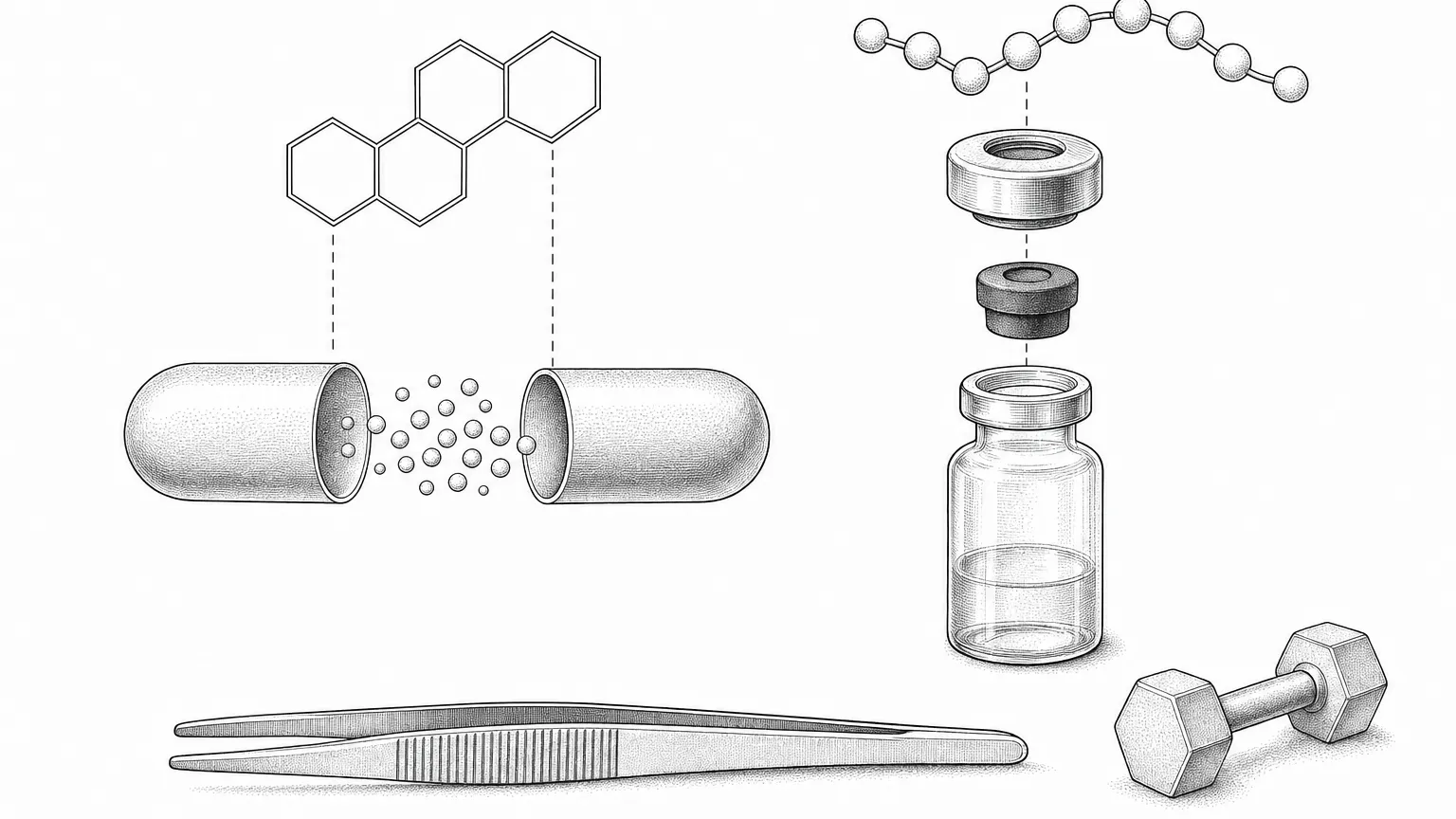
Peptides vs prohormones: prohormones are steroid precursors, such as androstenedione (“andro”), that the body turns into testosterone and related hormones. In controlled trials, andro did not raise testosterone or add muscle beyond training alone, and it lowered HDL (“good”) cholesterol.[3][4] Since 2005, androstenedione and many related precursors have been federal Schedule III controlled substances.[1][14] Muscle-marketed peptides work on a different system, mostly growth hormone and IGF-1, and most have little human outcome data.[8] Neither group is approved for building muscle.
See the muscle and metabolism peptides hub and profiles such as MK-677 and IGF-1 LR3.
Peptides vs prohormones at a glance
| Prohormones | Muscle-marketed peptides | |
|---|---|---|
| What they are | Steroid precursors (e.g., androstenedione)[1] | Short amino acid chains (e.g., ipamorelin, CJC-1295)[8] |
| Target | Converted to testosterone and estrogens[4] | Growth hormone or IGF-1 system[8] |
| How taken | Usually by mouth | Mostly injected |
| Best human evidence | Randomized trials showing no added muscle[3][4] | Few trials; MK-677 added lean mass without strength gains[11] |
| Key risks | Lower HDL, higher estrogen, liver injury[3][6] | Blood sugar changes, fluid retention, unknowns[8] |
| U.S. legal status | Most are Schedule III controlled substances[1][2] | Mostly unapproved; some on FDA’s safety-risk list[12] |
| Sport | Banned[10] | Banned[10] |
How each works
Prohormones are one or two chemical steps away from an active hormone. Androstenedione can be converted to testosterone, but much of it becomes estrogens instead. In men aged 35 to 65, andro and a related compound raised estrone and estradiol, and while testosterone rose 16% after a month on androstenedione, it was back to baseline by 12 weeks as the body’s own production (signaled by LH) fell.[4]
After andro was banned, “designer” prohormones and steroids appeared in supplements. A 2023 study traced vague symptoms in about 16 New York residents, and one hospitalization for liver damage, to vitamin supplements secretly containing methasterone, a Schedule III anabolic steroid.[5]
Peptides sold for muscle mainly act on the growth hormone axis. Growth hormone-releasing peptides prompt the pituitary to release growth hormone, and IGF-1 analogs act further downstream.[8] They do not convert into steroids.
Evidence quality
Prohormones were tested, and failed:
- Young men (JAMA, 1999): 30 healthy men; 20 did 8 weeks of resistance training with 300 mg/day androstenedione or placebo. Testosterone did not change, estrogens rose, HDL fell, and gains in strength, muscle fiber size and lean mass were the same as placebo.[3]
- Men aged 35 to 65 (Andro Project, 2000): 50 men trained for 12 weeks on androstenedione, androstenediol or placebo at 200 mg/day. Neither precursor improved strength or body composition, and both worsened cholesterol ratios and estimated heart risk.[4]
Muscle peptides are mostly untested for this use. A 2026 review placed many growth hormone-axis peptides in early or minimal evidence tiers, with some having no peer-reviewed human studies.[8] Another 2026 review called sport peptides experimental, with poorly defined long-term risks.[9]
Side effects and safety
Prohormones and related steroids
- Cholesterol and heart risk: HDL fell in both andro trials.[3][4]
- Estrogen effects: estradiol and estrone rose.[3][4]
- Liver: in Spanish and Latin American registries, steroid-related liver injury rose from under 1% of cases (2001 to 2009) to 8% (2010 to 2013), mostly in young men, with marked jaundice and sometimes kidney injury.[6] An Australian series found 18 anabolic steroids and 8 bodybuilding supplements among drugs blamed for liver injury in 23 patients.[7]
- Hidden ingredients: supplements have contained undeclared steroids, including a case of virilization in a child.[5]
Peptides
- A 2026 review listed raised prolactin or cortisol, appetite changes, blood sugar problems, fluid retention, joint pain and injection-site reactions across growth hormone-axis peptides.[8]
- MK-677, a non-peptide often sold with them, raised blood sugar and caused swelling in a two-year trial.[11]
- FDA lists several peptides among compounding substances that may present significant safety risks.[12]
Why “natural” and “research” labels mislead
Before 2004, androstenedione was sold over the counter and marketed as a natural alternative to anabolic steroids.[3] The 2004 law ended that by naming it an anabolic steroid, while leaving DHEA out of the definition.[1] The 2014 law then targeted chemically similar products sold with muscle-building claims, and made false labeling of anabolic steroids a violation.[2]
Labels still cannot be trusted. The New York investigation found methasterone and a related steroid inside ordinary-looking vitamin supplements.[5] Many peptides, meanwhile, are sold as “research chemicals” not intended for human use, a label that means no FDA review of quality, dose or safety. A 2026 review notes that the unregulated peptide supply is often mislabeled or contaminated.[9] See research-use-only peptides.
Legal status
- Prohormones: the Anabolic Steroid Control Act of 2004 rewrote the federal definition of “anabolic steroid” to include androstenedione and many related precursors, excluding DHEA.[1] Anabolic steroids are Schedule III controlled substances.[14] The Designer Anabolic Steroid Control Act of 2014 added more named compounds, treats chemically similar substances marketed for muscle growth as anabolic steroids, and added penalties for false labeling.[2]
- Peptides: most are not FDA-approved. Tesamorelin is approved, but only for HIV-associated abdominal fat.[13] Others, such as ipamorelin, appear on FDA’s safety-risk list.[12]
- Sport: WADA bans anabolic agents and growth hormone-axis peptides at all times.[10]
For more on peptide rules, see DEA peptide classification and DSHEA and peptide supplements. This is general information, not legal advice.
Questions to discuss with a clinician
- Is low testosterone suspected? Testing and approved treatment are safer than precursors; see peptides vs TRT.
- Have you used “test boosters” or bodybuilding supplements? Tell your clinician, since hidden steroids can affect liver tests.[5][7]
- Do you have diabetes or heart risk factors? Both groups can affect blood sugar or cholesterol.[4][11]
The verdict
Prohormones are the better-studied group, and the studies were negative: no added muscle, worse cholesterol, more estrogen, and they are now controlled substances.[3][4][1] Peptides work through a different system and are less studied, so their risks are largely unknown rather than proven low.[8] Related: peptides vs SARMs, IGF-1 LR3 vs MGF and Fragment 176-191 vs AOD-9604.