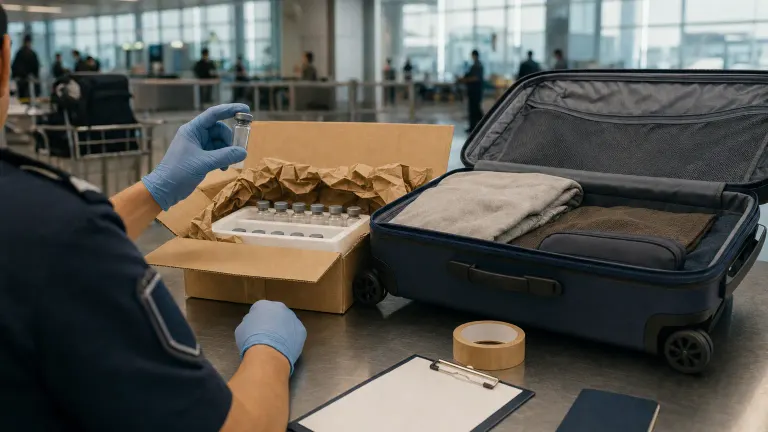
Counterfeit peptides are real and have reached ordinary pharmacies, not just shady websites. FDA has seized fake Ozempic pens from the US supply chain three times since late 2023, most recently in December 2025,[1] and in October 2026 UK regulators seized more than 12,000 fake retatrutide and tirzepatide pens.[3] You can’t reliably test a peptide at home, so the best protection is getting it from a state-licensed pharmacy with a prescription, checking it against official alerts, and reporting anything suspicious.
This guide covers the main alerts, the warning signs of fake or degraded products and what to do if you suspect one. We don’t name sellers. For the legal background, see the FDA & Regulation hub.
The documented cases
| When | What happened | Key detail |
|---|---|---|
| December 2023 | FDA seized thousands of counterfeit Ozempic 1 mg units[1] | Lot NAR0074, serial 430834149057; needles, labels, carton and inserts were fake |
| June 2024 | WHO issued a global alert on falsified Ozempic[2] | Found in Brazil and the UK (October 2023) and the US (December 2023), in the regulated supply chain |
| April 2025 | FDA seized several hundred counterfeit units[1] | Lot PAR0362, serial numbers starting 51746517 |
| December 2025 | FDA seized dozens more counterfeit units[1] | Lot PAR1229; EXP/LOT text placed left of the date and lot, not above |
| October 2026 | UK regulators seized over 12,000 fake pens, worth about £2 million[3] | Retatrutide and tirzepatide; packaging for about 30,000 more |
Note that lot PAR1229 also exists as a genuine product; the placement of the EXP/LOT text is what tells them apart.[1] Retatrutide isn’t approved in the US or authorized in the UK, so any retatrutide sold outside a clinical trial is unapproved by definition.[3]
Counterfeit vs compounded vs research-grade
These terms get mixed up. A counterfeit pretends to be a specific branded product, copying its pen, carton and lot numbers. A compounded drug is made by a licensed pharmacy for a patient with a prescription; it isn’t fake, but it isn’t FDA-approved either, and FDA had received more than 990 adverse event reports for compounded semaglutide and more than 730 for compounded tirzepatide by May 31, 2026.[5] A research-grade peptide is sold as a chemical, often labeled “not for human consumption,” with no one checking what’s inside. Our guide to compounded vs research-grade peptides explains the differences in detail.
Why fakes are dangerous
FDA testing in 2023 found the counterfeit needles were themselves fake, so their sterility couldn’t be confirmed.[1] FDA says counterfeit GLP-1 drugs may contain the wrong ingredient, too much or too little active drug, or none at all.[5] WHO warns that injecting falsified semaglutide could cause serious harm beyond simply not working.[2]
Unregulated “research” products carry similar risks. In a 2024 study, semaglutide vials bought from online sellers without a prescription had purity of only 7.7% to 14.4%, and every sample contained bacterial endotoxin.[4] Anti-doping labs have found black-market growth products containing a modified form of growth hormone and altered versions of GHRP-2, GHRP-6 and ipamorelin.[8]
Step 1: Check where it came from
The single biggest protection is the source. FDA advises getting GLP-1 drugs only with a prescription from a state-licensed pharmacy.[1] Look up the pharmacy with your state board using FDA’s BeSafeRx tool.[10] Our guide to checking a compounding pharmacy walks through each step.
FDA lists these warning signs for online sellers: deep discounts, no prescription required, misspelled labels and no doctor available to answer questions.[5]
Step 2: Inspect the package and pen
- Lot and serial numbers: compare them with FDA’s counterfeit alerts.[1]
- Label layout: for lot PAR1229, the EXP/LOT text sits above the date and lot number on genuine pens.[1]
- Print quality: WHO lists poor label quality and spelling mistakes on the carton as signs of falsification.[2]
- Needles: compare them with what your pharmacist supplied; counterfeit Ozempic came with fake needles.[1]
- Product name: check that the name, strength and form match your prescription. For what versions of these drugs legitimately exist, see generic tirzepatide and generic semaglutide.
Step 3: Look for signs of degradation
A genuine product can still be damaged by heat or age.
- Appearance: the Wegovy label says to use the injection only if the solution is clear, colorless and free of particles.[6] Treat any cloudy, discolored or speckled injectable as suspect.
- Temperature: FDA advises not using an injectable GLP-1 that arrives warm or with too little refrigeration.[5]
- Time: discard multi-dose vials within 28 days of first use, even if some is left.[5]
Our guides to GLP-1 storage, lyophilized vs premixed peptides and how to reconstitute peptides explain safe handling.
Why you can’t check it at home
There’s no home test that confirms a peptide’s identity, dose or sterility. Even laboratory testing has limits: one study used NMR to find mannitol, an undeclared filler, making up 20% and 43% of two commercially made custom peptides, and noted that standard LC-based quality tests can be blind to some impurities.[7] A certificate of analysis from a seller is only as trustworthy as the seller. Our peptide quality standards guide explains what proper testing involves.
Step 4: Report it
- Stop using it and keep the pen or vial, packaging and receipt.
- Tell the pharmacy that dispensed it, and the manufacturer if it’s a branded product.
- Report to FDA’s MedWatch program online, or by downloading the consumer form and faxing it to 1-800-FDA-0178.[1] MedWatch accepts reports of product quality problems and serious reactions.[9]
- Report suspected criminal activity through FDA’s online form or your local FDA consumer complaint coordinator.[1]
- Outside the US, report to your national regulator; WHO asks people to report suspected falsified products this way.[2]
Checklist: spotting a counterfeit or degraded peptide
- Dispensed by a state-licensed pharmacy with a prescription.
- Lot and serial numbers checked against FDA alerts.
- Carton print quality, spelling and label layout look right.
- Solution clear and particle-free; arrived cold if it should be.
- Within its use-by period after opening.
- Anything suspicious reported to MedWatch, with the product kept.
The bottom line
Fakes have appeared in legitimate supply chains, and “research” products are often worse. You can lower your risk by buying only from licensed pharmacies, checking official alerts, and refusing anything that looks or arrived wrong. For the wider legal risks, see buying peptides online and research use only peptides.