Quick answer: here’s how to use copper peptides on skin: apply a few drops of a GHK-Cu serum or cream to clean, dry skin once or twice a day, before moisturizer and sunscreen, and keep strong acids or vitamin C to a different time of day. The evidence is thin: copper peptides boost collagen in lab studies, but well-controlled human trials are scarce, and one randomized study after laser treatment found no measurable wrinkle benefit.[2][3][4]
This guide covers the practical steps and what’s actually known. For the science, see our GHK-Cu profile and GHK-Cu research review. For more beginner topics, browse the peptide basics hub.
What copper peptides are
GHK-Cu is a small natural peptide (glycine-histidine-lysine) bound to copper. It occurs in human blood, and in lab studies it affects many genes and pathways involved in skin repair.[1] In fibroblast cultures, the cells that make collagen, it stimulated collagen production.[2] On ingredient lists it usually appears as copper tripeptide-1. A related compound, AHK-Cu, is marketed mainly for hair.
How to use copper peptides: step by step
- Patch test first. Apply a small amount to a discreet area, such as the side of the neck or inner arm, once a day for several days. Stop if you see redness, itching or swelling.
- Cleanse and pat dry. Apply to clean skin so the product isn’t diluted by makeup or sweat.
- Apply the thinnest product first. If you use a serum, put it on before heavier creams. Our guide to peptide cream vs serum explains the difference.
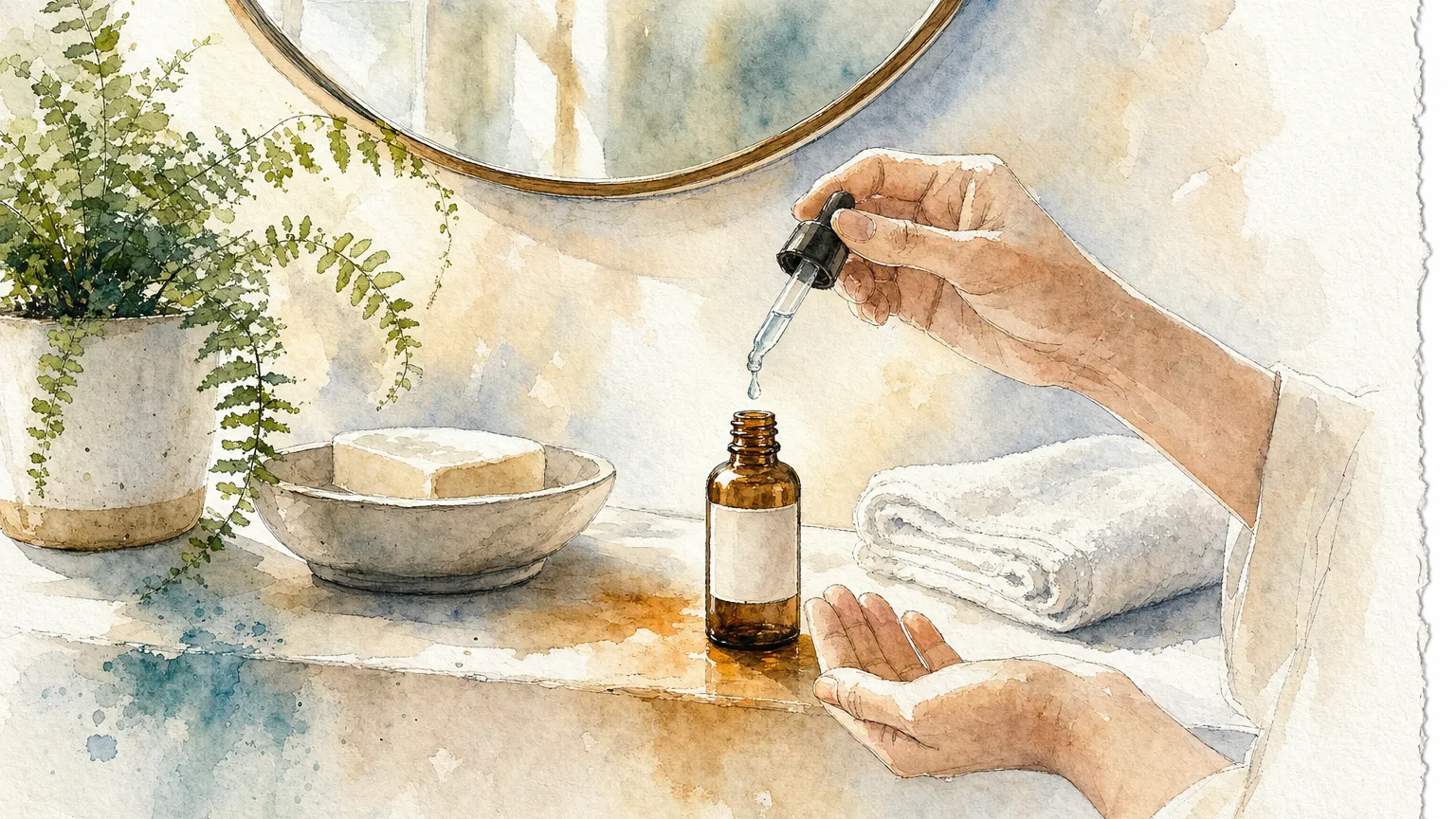
- Use a pea-sized amount, or 2 to 3 drops, for the whole face and neck. More product doesn’t mean more benefit.
- Follow with moisturizer, and in the morning, sunscreen. Daily sunscreen has far stronger evidence against skin aging than any peptide: in a 4.5-year randomized trial, daily users showed no detectable increase in skin aging.[9]
- Start once a day. If your skin tolerates it after 1 to 2 weeks, you can move to twice daily if the product directions allow.
- Give it time and judge fairly. Take photos in the same light at the start and after about 12 weeks, the length of most cosmetic peptide studies.[5]
For a full morning and evening plan, see our peptide skincare routine.
What to mix, and what to keep apart
| Ingredient | Use with copper peptides? | Why |
|---|---|---|
| Hyaluronic acid, ceramides, moisturizers | Yes | No known interactions; they support the skin barrier |
| Niacinamide | Generally yes | No evidence of a problem in finished products |
| Retinol or retinoids | Often paired; introduce separately | No evidence of interference; both can irritate. See copper peptides vs retinol |
| Vitamin C (L-ascorbic acid) | Use at a different time of day | Copper speeds ascorbic acid oxidation; no skin trials of the combination |
| AHA/BHA exfoliants, strong peels | Use at a different time or day | Low pH and added irritation; untested together |
| Other peptides (e.g. Matrixyl) | Yes | Commonly combined; see GHK-Cu vs Matrixyl |
These separations are cautious practice based on chemistry, not results from clinical trials, which haven’t tested these combinations.
What the evidence shows
- Lab studies: GHK-Cu increased collagen synthesis in fibroblasts and influenced many skin-repair pathways.[1][2]
- After laser resurfacing: in a randomized study of 13 patients, GHK-Cu skincare didn’t reduce redness or measurably improve wrinkles at 12 weeks, though patients using it reported higher satisfaction.[3]
- Skin penetration: GHK-Cu is small and relatively skin-permeable, but researchers are still testing ways, such as microneedling, to get more of it into the skin.[4]
- Peptides overall: a 2026 meta-analysis of 19 randomized trials found a modest pooled effect on wrinkles, driven mainly by oral peptide supplements rather than topical products.[6]
Our overview of cosmetic peptide evidence puts copper peptides alongside other skincare peptides.
How to choose a copper peptide product
Labels rarely state how much GHK-Cu a product contains, so judge what you can:
- Look for the INCI name. It should list copper tripeptide-1. A vague “peptide complex” tells you nothing. Our guide to reading skincare peptide labels explains the naming.
- Don’t judge by color alone. Copper complexes are often blue, but tint depends on the formula and isn’t a reliable measure of how much peptide is inside.
- Prefer airtight, opaque packaging, and follow any storage directions on the box.
- Choose fragrance-free if your skin is sensitive, since fragrance is a more common irritant than the peptide.
- Skip DIY powders. Raw “research” GHK-Cu sold for mixing at home isn’t made or tested for skin use, and you can’t verify its purity.
Microneedling and injections: extra caution
Researchers are studying microneedles as a way to push GHK-Cu deeper into skin, and a 2026 review argued that properly designed clinical trials are still needed.[11] At home, microneedling breaks the skin barrier and raises the risk of infection, so it is best done by a trained professional with products made for that use. Injecting cosmetic peptides carries real risks: one published case described a serious mycobacterial skin infection in a woman after injections of argireline, another cosmetic peptide, into her forehead and temples.[12]
Copper peptides for hair
Copper peptides are also sold in scalp serums. Evidence there is mostly from lab and animal studies; our guide to copper peptides for hair covers it.
Safety and regulation
- Cosmetics vs drugs: in the U.S., a skincare product marketed to improve appearance is a cosmetic, while one claiming to change the skin’s structure or function is a drug.[7] Copper peptide skincare is sold as a cosmetic, so it isn’t FDA-approved for any effect.
- Injections are different: FDA has flagged compounded injectable GHK-Cu as a possible risk for immune reactions and impurities.[8] Don’t inject skincare products or “research” vials.
- Stop if irritated, and talk to a dermatologist if you have eczema, rosacea or a known metal allergy.
If you’re weighing copper peptides against other options, ask a dermatologist which approach fits your skin. Retinoids and daily sunscreen remain the best-studied tools for photoaging.[9][10]