Quick answer: GLP-1 pancreatitis is rare but serious. In clinical trials, confirmed acute pancreatitis occurred at about 0.2 to 0.3 cases per 100 patient-years on Ozempic, Wegovy, Mounjaro and Zepbound, and in the Zepbound weight-loss trials the rate was 0.2% on both the drug and placebo.[1][3][4] Every label still warns about it, because fatal and non-fatal cases have been reported.[1][3] Severe belly pain that spreads to the back means stop the drug and get care.
This guide is part of our GLP-1 basics hub. For all side effects at a glance, see the GLP-1 side effects guide.
What is pancreatitis?
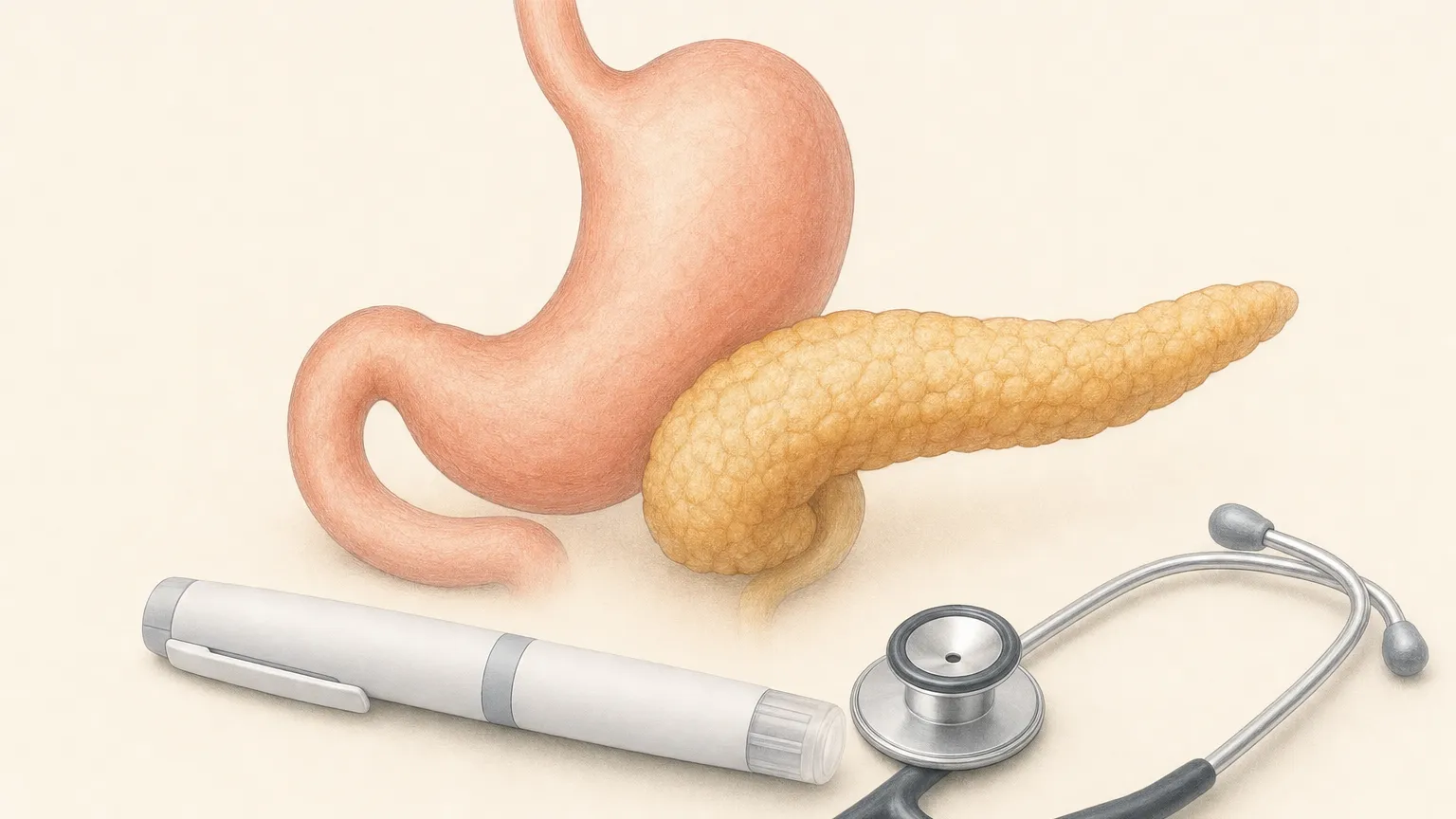
The pancreas makes digestive enzymes and hormones such as insulin. Acute pancreatitis is sudden inflammation of the pancreas, and it can be serious. The labels describe hemorrhagic (bleeding) and necrotizing (tissue-damaging) forms among the reported cases, some fatal.[1][3]
GLP-1 pancreatitis rates in trials
These are adjudicated cases, meaning an independent committee confirmed each diagnosis.
| Drug | Trial setting | GLP-1 group | Comparison group |
|---|---|---|---|
| Zepbound | Weight-loss trials | 0.2% (0.14 per 100 patient-years) | Placebo 0.2% (0.15) |
| Zepbound | Sleep apnea trials | 0.84 per 100 patient-years | Placebo 0 |
| Mounjaro | Diabetes trials | 13 patients (0.23 per 100 patient-years) | Comparators 3 patients (0.11) |
| Wegovy | Weight-loss trials | 4 patients (0.2 per 100 patient-years) | Placebo 1 patient (under 0.1) |
| Ozempic | Diabetes trials | 7 patients (0.3 per 100 patient-years) | Comparators 3 patients (0.2) |
Sources: Zepbound, Mounjaro, Wegovy and Ozempic prescribing information.[1][2][3][4]
A “patient-year” is one person treated for one year. A rate of 0.2 per 100 patient-years means about 2 cases for every 1,000 people treated for a year. Numbers in these trials were small, so a handful of cases can move the rate a lot, as the sleep apnea figure shows.
What larger analyses found
Single trials are too small to settle the question, so researchers pool them.
-
GLP-1 drugs in type 2 diabetes: a meta-analysis of 43 randomized trials lasting at least a year (covering exenatide, liraglutide, lixisenatide, albiglutide, dulaglutide and semaglutide) found no significant association with pancreatitis (odds ratio 1.24, 95% CI 0.94 to 1.64).[5]
-
Tirzepatide by dose: a 2026 meta-analysis of 19 trials with 15,471 people found acute pancreatitis was rare (0.22%) and showed no clear dose effect between 5, 10 and 15 mg. The authors noted limited precision and industry funding of all trials.[6]
-
Weight-loss users in real-world data: a 2023 study of US health records compared people using semaglutide or liraglutide for weight loss with people using bupropion-naltrexone. GLP-1 use was linked to more pancreatitis (adjusted hazard ratio 9.09), but with very few cases the confidence interval was extremely wide (1.25 to 66.00).[7] Observational studies like this can show links but not prove cause.
-
Pancreatic cancer: the same 43-trial meta-analysis found no significant link (odds ratio 1.28, 95% CI 0.87 to 1.89), but the authors said the data were too scarce to draw any conclusion.[5] Our semaglutide cancer risk guide covers cancer questions in more depth.
Taken together, trial data point to a low absolute risk, while the label warning and post-marketing reports mean it cannot be ruled out.
Ozempic, Wegovy, Mounjaro and Zepbound pancreatitis
People often search by brand. The warning text is essentially the same across all four labels: acute pancreatitis, including fatal and non-fatal hemorrhagic or necrotizing pancreatitis, has been observed in people treated with GLP-1 drugs.[1][2][3][4]
- Ozempic and Wegovy contain semaglutide. See our semaglutide profile.
- Mounjaro and Zepbound contain tirzepatide, which also acts on the GIP receptor. See our tirzepatide profile.
The trials behind each label differ, so the numbers above cannot rank one drug as safer than another.
Symptoms to watch for
The labels describe signs of acute pancreatitis as:[1][3]
- persistent or severe abdominal pain, sometimes spreading to the back
- with or without nausea or vomiting
The labels tell prescribers to stop the drug if pancreatitis is suspected and to start appropriate management.[1] If you have this kind of pain, do not take your next dose and seek medical care the same day.
Ordinary GLP-1 stomach upset is usually milder, comes and goes, and eases over days. See our GLP-1 nausea guide for typical side effects. Pain under the right ribs with fever or yellow skin can signal a gallbladder problem instead; see GLP-1 gallbladder problems.
Lipase and amylase on GLP-1 drugs
Lipase and amylase are pancreatic enzymes that doctors measure when pancreatitis is suspected. In the Zepbound trials, average lipase rose 28% to 35% and pancreatic amylase 20% to 25% from baseline, versus 5.8% and 2.1% on placebo.[1] The label says the meaning of these rises is unknown without other signs of pancreatitis.[1] So a mildly raised result on a routine blood test, with no pain, is not the same as pancreatitis. Your clinician will interpret it with your symptoms.
Prior pancreatitis: can you take a GLP-1?
The Zepbound patient guide asks you to tell your prescriber if you have or have had problems with your pancreas.[1] For people with prior pancreatitis, the evidence comes mainly from health-record studies.
A 2026 systematic review of four such studies (10,624 people) found GLP-1 use was not linked to more recurrent pancreatitis. In the two studies with comparison groups, GLP-1 users had lower odds of recurrence than SGLT2 inhibitor users (OR 0.57). Among GLP-1 users with prior pancreatitis, recurrence rates of 9.9% and 11.9% were reported in two other studies.[8] The authors urged caution because the comparative evidence was limited.
This is a decision for you and your clinician, weighing why you had pancreatitis, how long ago, and the benefits of treatment.
Questions to ask your clinician
- Do I have other risk factors for pancreatitis that we should address first?
- Given my history, is a GLP-1 drug reasonable for me?
- Should I have lipase checked, and how will we interpret it?
- What exactly should I do if I get severe belly pain?
Our GLP-1 and alcohol guide covers drinking while on treatment. This guide is general information, not medical advice.