SNAP-8 (acetyl octapeptide-3) is a lab-made peptide used in anti-wrinkle creams and serums. Its maker, Lipotec (now part of Lubrizol), markets it as a topical alternative to Botox for expression lines.[1] It is an eight-amino-acid version of the better-known argireline.[2] Most evidence that it reduces wrinkles comes from the manufacturer, and it is a cosmetic ingredient, not an approved drug.[3][13]
What is SNAP-8?
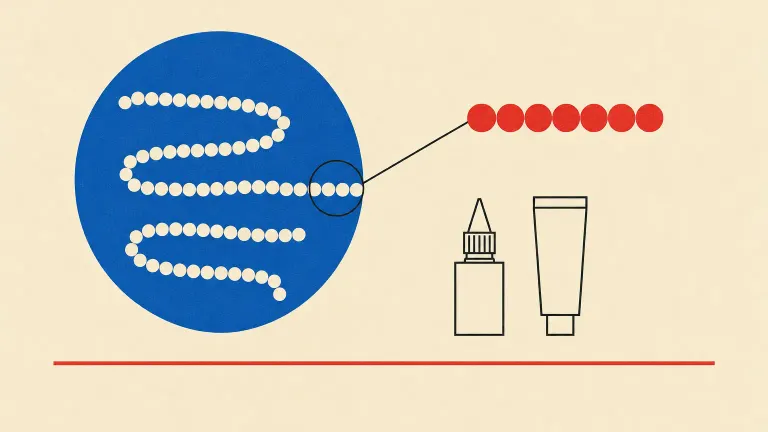
SNAP-8 is argireline’s six-amino-acid chain with two more added. Both peptides copy the tip of SNAP-25, a protein nerve cells use to release chemical messengers.[2][3] On ingredient lists it appears as acetyl octapeptide-3, and the manufacturer recommends using its SNAP-8 solution at 3% to 10% of a product.[1]
How SNAP-8 is supposed to work
Nerves need a group of proteins called the SNARE complex to release the chemical signal that makes a muscle contract. SNAP-8 and argireline are designed to compete with SNAP-25 for a place in that complex, making it less stable and, in theory, relaxing the muscle a little, the effect Botox produces much more strongly.[3][4]
In lab tests, argireline reduced neurotransmitter release with a potency similar to Botox type A but a much smaller maximum effect.[4] For SNAP-8, manufacturer lab data cited in a 2020 review reported a 43% drop in glutamate release at 1.5 mM.[3]
A key open question is whether these peptides reach the muscle at all. A 2025 review concluded that argireline penetrates skin poorly because it is water-loving and relatively large, and that its ability to reach nerve-muscle junctions remains uncertain.[8] In one lab test cited by the review, about 0.22% of applied argireline entered the outer skin layer and none passed through the skin.[8] SNAP-8 is larger still, with two more amino acids.[2]
SNAP-8 benefits: what the research shows
Manufacturer data (company claims)
- Lubrizol product page: “up to 72%” reduction in maximum wrinkle depth, with no study details given.[1]
- Lipotec feature (2016): a 63% reduction in maximum wrinkle depth after 28 days with a 10% SNAP-8 cream in women volunteers. No group size, control group or statistics were described.[2]
- As summarized in a 2020 review: a maximum wrinkle reduction of about 62% and an average of about 35%, taken from the manufacturer’s website.[3]
- Combined with Leuphasyl: in a lab assay described alongside the manufacturer data, SNAP-8 alone gave 38% inhibition and Leuphasyl (another cosmetic peptide) 7%, while the two together (0.75 mM each) gave 47%. This suggests the two may work together in a lab dish; the combination has not been tested in people.[3]
These figures are company data, not peer-reviewed trials, and they vary from source to source.
Independent studies
We found no published, independent trial of SNAP-8 on its own. Two clinical studies used it in mixed products:
- Korea (2024): 24 adults wore a dissolving microneedle patch containing acetyl octapeptide-3, a vitamin C derivative and another active under one eye, and a plain hyaluronic acid patch under the other, for 28 days. Wrinkles improved more on the active side, with no adverse effects reported.[10]
- Single-center study (2020): a 12-week study of a microneedle patch with acetyl octapeptide-3 and four other actives reported a 25.8% decrease in fine lines, but no placebo comparison was described.[9]
Neither study can show how much SNAP-8 itself contributed.
Argireline, the closest relative
Argireline has more independent research, with mixed results:
- 2002 (Spain): a 10% emulsion reduced wrinkle depth by up to 30% after 30 days in women volunteers, in a study by its developers.[4]
- 2013 (China): in a randomized trial of 60 people, 48.9% improved with argireline vs 0% with placebo after 4 weeks.[5]
- 2017 (Greece): a 24-person randomized study supported argireline’s anti-wrinkle effect.[6]
- 2023 (Germany): a double-blind split-face study of 19 women found no significant difference between a serum with argireline and one without.[7]
SNAP-8 vs Botox
| SNAP-8 | Botox Cosmetic (onabotulinumtoxinA) | |
|---|---|---|
| Regulatory status | Cosmetic ingredient[13] | FDA-approved prescription drug[12] |
| How used | Cream or serum on the skin[1] | Injected into specific muscles[12] |
| Approved for | Nothing (cosmetic) | Frown lines, crow’s feet, forehead lines and neck bands[12] |
| Evidence | Manufacturer data, small mixed-product studies[2][10] | Approved on clinical trial data[12] |
| Key risk | Mainly unknown; little long-term data | Boxed warning: toxin effects can spread and cause breathing or swallowing problems[12] |
No study has compared SNAP-8 with Botox directly.
SNAP-8 vs argireline and copper peptides
SNAP-8 and argireline target muscle-driven expression lines. Copper peptides such as GHK-Cu and AHK-Cu work differently and are promoted for skin repair and hair. For an overview, see our skin peptides page.
How to use SNAP-8
There is no studied “dose” in the medical sense. The manufacturer suggests 3% to 10% of its SNAP-8 solution in a finished product,[1] and its reported wrinkle test lasted 28 days.[2] Because penetration is limited, formulas and delivery methods such as microneedle patches have been explored.[8][10]
SNAP-8 side effects
- Topical use: no adverse effects or skin reactions were reported in the two mixed-product studies.[9][10] Argireline showed no irritation in its developers’ tests and no significant skin reactions in the 2023 German study.[4][7]
- Injection: injecting SNAP-8 has never been studied. A 45-year-old woman injected with argireline in the forehead and temples developed nodules and abscesses from Mycobacterium abscessus and needed 5 months of antibiotics.[11]
Is SNAP-8 legal?
- Cosmetic: cosmetics and their ingredients do not need FDA approval before sale.[13]
- Drug claims: FDA treats products intended to affect the structure or function of the body as drugs, even when sold as cosmetics.[13] A 2025 review noted that if a “Botox-like” peptide really did change muscle function, it could stop qualifying as a cosmetic.[8]
- Not an approved drug: SNAP-8 has not been approved by FDA to treat wrinkles or any condition.[13]
This is general information, not legal advice.