Peptide cream vs serum is mostly a question of texture and formula, not of which one “works.” No published study has put the same peptide in a cream and a serum and compared results. The largest placebo-controlled peptide trial used an ordinary moisturizer.[6] The peptide, its concentration and whether it can get into skin matter more than the format.[1][2]
This guide is part of our peptide basics hub. For specific ingredients, see Matrixyl vs argireline, GHK-Cu vs Matrixyl and our GHK-Cu profile.
Peptide cream vs serum at a glance
| Peptide serum | Peptide cream | |
|---|---|---|
| Typical base | Mostly water or water-based gel, little oil | Emulsion of water and oils, with emollients |
| Feel | Light, absorbs quickly | Richer, leaves a film |
| Main extra job | Delivers actives in a thin layer | Moisturizes and seals in water |
| Peptide concentration | Varies by product; not inherently higher | Varies by product |
| Example in trials | Argireline in a hyaluronic acid serum (null result)[7] | Pal-KTTKS in a moisturizer (positive result)[6] |
| Best suited to (by feel) | Oily skin, layering, under makeup | Dry skin, night use |
What actually decides whether a peptide gets in
Size and solubility
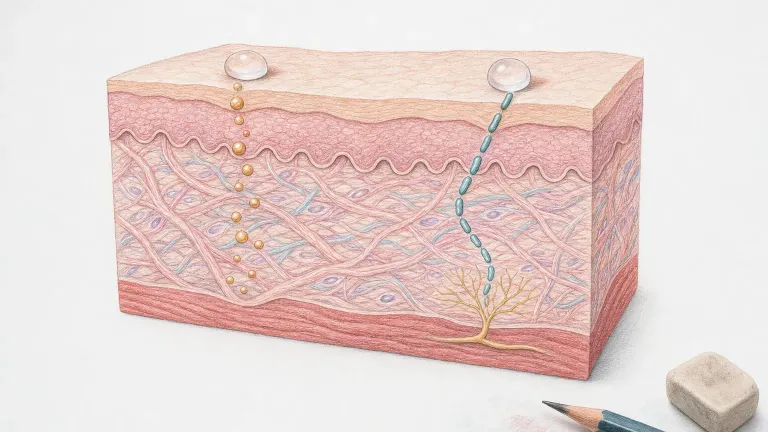
The skin’s outer layer, the stratum corneum, blocks most large molecules. A widely cited rule of thumb says compounds generally need a molecular weight under about 500 daltons to cross it.[1] Many cosmetic peptides are bigger. A 2025 review concluded argireline penetrates skin poorly because it is relatively large and water-loving; in one lab test it cited, about 0.22% entered the outer layer and none crossed it.[2]
Chemists work around this by modifying the peptide rather than the format. Plain KTTKS barely crosses skin because it dissolves so readily in water, so a palmitoyl (fatty acid) tail is added to make the Matrixyl peptide more skin-friendly.[4]
What the base can add
The base can help or hinder. In a lab study, pal-KTTKS packaged in tiny fat bubbles called liposomes stimulated more collagen in mouse fibroblasts than the free peptide, and the authors suggested liposomes could improve stability and skin delivery.[5] That was a cell-culture result, not a human one. Delivery devices go further: in a 2024 Korean study, a dissolving microneedle patch carrying acetyl octapeptide-3 and other actives improved under-eye wrinkles more than a plain patch over 28 days.[9]
Where peptides end up
A 2026 study tested serums containing Matrixyl 3000 peptides on three volunteers and tracked them with advanced mass spectrometry. Both peptides were found throughout the stratum corneum, at levels that dropped with depth, mostly between skin cells rather than inside them, and longer exposure did not increase penetration.[3] A serum, in other words, got peptides into the outer layer, but that doesn’t show how much reaches the living skin below.
What the trials show about format
- Cream with a positive result: a moisturizer containing 3 ppm pal-KTTKS improved wrinkles vs the same moisturizer without it in 93 women over 12 weeks.[6]
- Creams in a head-to-head: in a 21-woman trial, a palmitoyl pentapeptide-4 cream outperformed an argireline cream and placebo for crow’s feet.[11]
- Serum with a null result: a German split-face study in 19 women found no difference between a hyaluronic acid serum with argireline and the same serum without it.[7]
- Serum plus cream: in a 12-week study, 17 women used a hyaluronic acid serum and a peptide-rich cream twice daily, and reported improvements in texture and lines, with no product-related adverse events. There was no control group, and the study was linked to the products’ maker.[8]
These results reflect the specific peptides tested, not the format. A positive cream trial and a null serum trial don’t mean creams beat serums.
Beyond creams and serums: patches, eye products and devices
Peptides also come in eye creams, sheet masks and microneedle patches. Eye creams are usually just smaller, richer versions of face creams, and we found no evidence that peptides behave differently in them.
Microneedle patches are a genuinely different delivery method. They carry the active ingredients on tiny dissolving needles that pierce the outer skin layer, sidestepping the barrier that limits creams and serums. In the 2024 Korean study, 24 adults wore a patch containing acetyl octapeptide-3 (SNAP-8) and other actives under one eye overnight, and a plain hyaluronic acid patch under the other, for 28 days; wrinkles improved more on the active side, with no adverse effects reported.[9] Because the patch also contained other ingredients, the peptide’s own contribution can’t be isolated. For more on SNAP-8, see SNAP-8 vs argireline.
If you are choosing between formats for a specific peptide, the question to ask is whether that exact peptide has been tested in that type of product. Usually the answer is no, for creams and serums alike.[6][7]
Side effects
Topical peptides have been well tolerated in published trials of both formats.[6][7] Irritation, when it happens, often comes from other ingredients such as fragrance, preservatives or acids in the base. Patch-test new products on a small area for a few days.
Labels, claims and cost
Peptide creams and serums are cosmetics. They don’t need FDA approval before sale, but a product that claims to change the skin’s structure or function can legally be a drug.[10] Labels rarely list peptide percentages, so price is a poor guide to dose. Serums often cost more per milliliter; that reflects branding and concentration choices, not proven extra benefit.
How to choose and layer
Questions to consider, ideally with a dermatologist:
- What is your skin type? Dry skin often prefers a cream; oily skin often prefers a serum.
- Which peptide is in it, and is it near the top of the ingredient list? That tells you more than the format.
- Are you using other actives? If you also use retinol, see copper peptides vs retinol.
A common convention is to apply products from thinnest to thickest: serum first, then cream, then sunscreen in the morning. It hasn’t been tested specifically for peptides, but it keeps a heavier cream from sitting under a lighter serum.
The verdict
Choose the format you’ll use consistently and that suits your skin. Then judge the product by the peptide it contains, how much, and whether there is any human evidence for it.[6][11] A serum isn’t automatically stronger, and a cream isn’t automatically weaker.