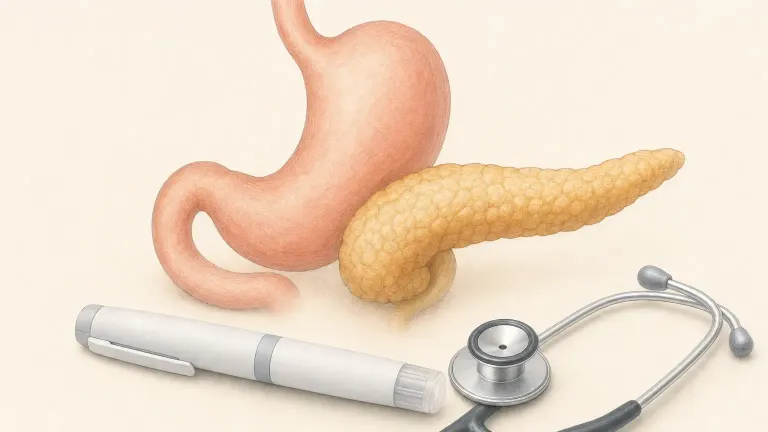
Semaglutide cancer risk in people is not established. The drug caused thyroid C-cell tumors in rats and mice, so Ozempic and Wegovy carry a boxed warning, but it is unknown whether this happens in humans.[1][2] Human studies on thyroid cancer are mixed, pancreatic cancer has not been linked to it, and several large studies associate GLP-1 drugs with lower rates of some obesity-related cancers.[3][4][7][8]
This guide covers what each type of evidence shows and what is still unknown. For the drug’s approvals and main trials, see our semaglutide profile.
Why semaglutide has a cancer warning
Every semaglutide product sold in the US has the same boxed warning, the FDA’s strongest label warning:
- The finding: in rodents, semaglutide caused thyroid C-cell tumors that increased with dose and duration, at exposures relevant to people.[1]
- The uncertainty: it is unknown whether it causes these tumors, including medullary thyroid carcinoma (MTC), in humans.[1]
- Who should not use it: anyone with a personal or family history of MTC, or with multiple endocrine neoplasia syndrome type 2 (MEN 2), an inherited condition that raises MTC risk.[1][2]
The label also notes postmarketing reports of MTC in people taking liraglutide, an older GLP-1 drug, but says the data are insufficient to establish or exclude a causal link.[1]
Medullary thyroid cancer starts in the thyroid C-cells, which make the hormone calcitonin. It is a rare type; the more common thyroid cancers start in other thyroid cells. The label notes that routine calcitonin testing can lead to unnecessary procedures because thyroid disease is common in general.[1]
Thyroid cancer: what human studies found
The human data point in different directions.
| Study | Population | Finding |
|---|---|---|
| French national database (2023) | 2,562 thyroid cancer cases vs 45,184 controls with type 2 diabetes | 1–3 years of GLP-1 use linked to higher risk of all thyroid cancer (HR 1.58) and MTC (HR 1.78)[3] |
| Scandinavian cohort (2024) | 145,410 GLP-1 users vs 291,667 DPP-4 inhibitor users | No increased risk (HR 0.93); MTC estimate 1.19 with a wide confidence interval[4] |
| Meta-analysis of 50 randomized trials (2025) | Trials of 52+ weeks | Thyroid cancer risk higher (odds ratio 1.55), more visible in longer trials[5] |
A hazard ratio (HR) or odds ratio above 1 means more cases in the drug group. The French study compared people within one diabetes population; the Scandinavian study compared GLP-1 users with users of a different diabetes drug, which helps reduce bias. The trial meta-analysis covered all GLP-1 drugs, not semaglutide alone.
Pancreatic cancer
Early reports of pancreatitis with GLP-1 drugs raised concern about pancreatic cancer. The Wegovy label lists acute pancreatitis as a warning but does not list pancreatic cancer.[1]
- An Israeli study followed 543,595 adults with type 2 diabetes for up to 9 years. Compared with basal insulin, GLP-1 drugs were not linked to higher pancreatic cancer rates over 7 years of follow-up (HR 0.50, with a wide confidence interval).[8]
- A US study of 1.65 million people with type 2 diabetes found a lower pancreatic cancer rate with GLP-1 drugs than with insulin (HR 0.41).[6]
The Israeli authors said monitoring beyond 7 years is still needed.[8]
Could semaglutide lower some cancer risks?
Excess body fat is linked to 13 cancers, known as obesity-associated cancers.[6] Because GLP-1 drugs cause substantial weight loss, researchers have looked for a protective effect.
- Type 2 diabetes: compared with insulin, GLP-1 drugs were linked to lower risk of 10 of 13 obesity-associated cancers, including colorectal, liver, ovarian and endometrial cancer. Compared with metformin, there was no reduction.[6]
- Adults with obesity: in 86,632 matched adults with obesity in Florida, GLP-1 users had fewer of 14 tracked cancers (13.6 vs 16.4 per 1,000 person-years; HR 0.83), with the clearest drops in endometrial and ovarian cancer and meningioma.[7]
- Randomized trials: a pooled analysis of 50 trials found no overall change in cancer risk (odds ratio 1.05). Uterine cancer was lower in obesity trials.[5]
These are mostly observational studies that track health records. They show associations and cannot prove that the drug caused the change.
How to read these studies
Two kinds of evidence appear in this guide. Randomized trials assign people to the drug or a comparison by chance, which makes the groups alike, but they usually last only one to three years and are not designed to count rare cancers.[5] Observational studies use insurance or health-record data from hundreds of thousands of people over longer periods, but the people who get GLP-1 drugs may differ in ways the researchers cannot fully adjust for.[4][6] When both kinds of evidence agree, confidence is higher. For semaglutide and cancer, they do not yet agree on thyroid cancer.
Signals that need more study
Not every signal is reassuring:
- Kidney cancer: both US record studies found higher kidney cancer rates with GLP-1 drugs in some comparisons, including an HR of 1.54 versus metformin.[6][7]
- Colorectal cancer: the trial meta-analysis found a small increase in shorter trials only. The authors suggested this may reflect more colonoscopies in people with stomach side effects.[5]
What is still unknown
- Long-term exposure: most studies follow people for 4 to 7 years. Cancer can take longer to appear.
- Semaglutide specifically: many studies pool all GLP-1 drugs, including older ones such as liraglutide and exenatide.
- People without diabetes: most long-term data come from people with type 2 diabetes. Use for weight loss alone is newer.
- Higher doses: the 7.2 mg Wegovy dose and the 25 mg pill are recent and have little long-term safety data.[1]
What to do if you are worried
- Share your history: tell your prescriber about any personal or family history of thyroid cancer, MTC or MEN 2.[1]
- Know the symptoms: the label tells patients to report a lump or swelling in the neck, trouble swallowing, shortness of breath or persistent hoarseness.[1]
- Screening: the label says routine calcitonin blood tests or thyroid ultrasound have uncertain value for catching MTC early in people taking semaglutide.[1]
The cancer question is one of several long-term safety topics. Our guides to semaglutide and kidney disease and semaglutide weight loss results cover others. For how semaglutide’s safety compares with tirzepatide, which carries the same boxed warning, see semaglutide vs tirzepatide.