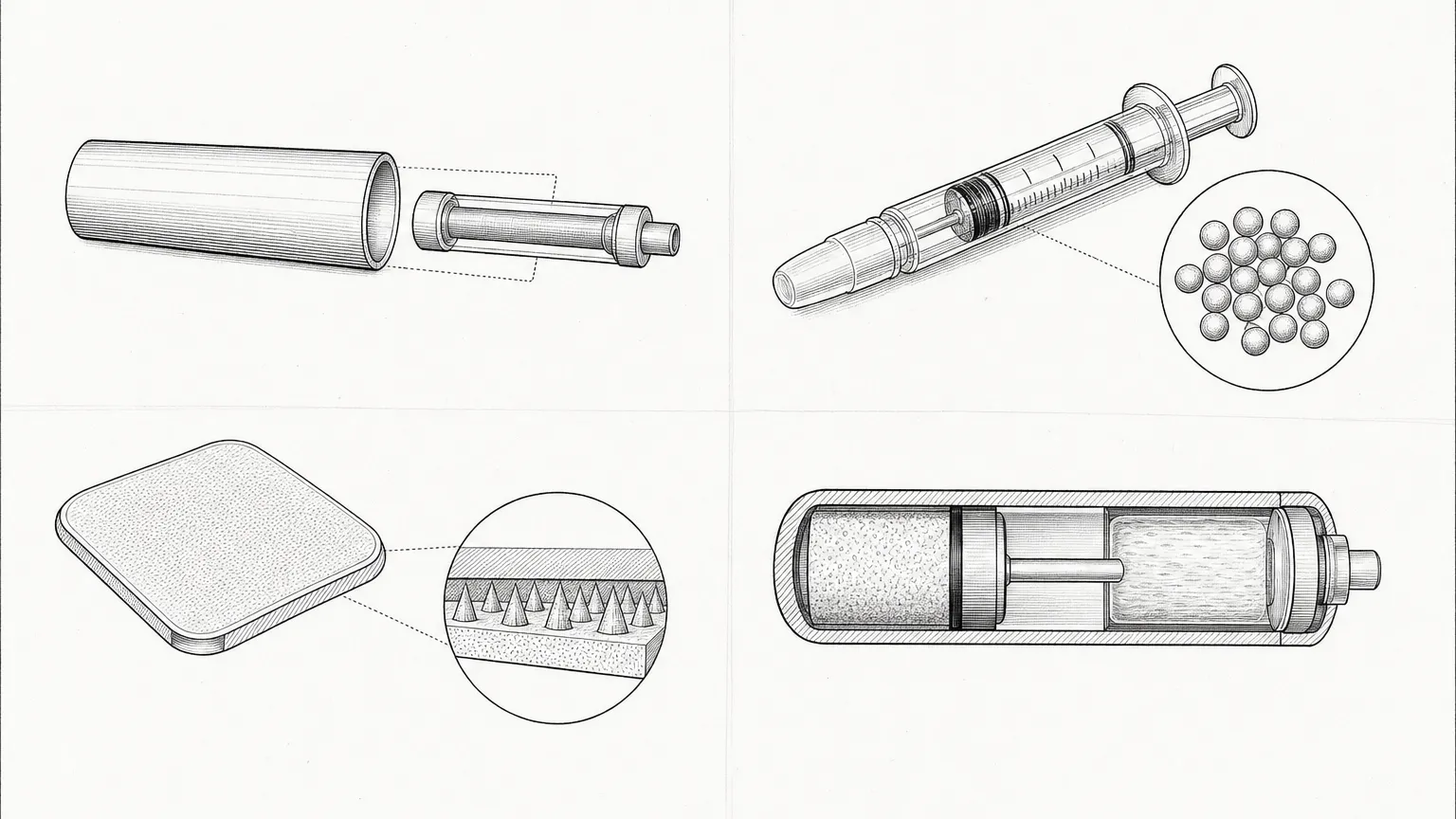
Peptide delivery technologies aim to replace frequent injections with something longer-lasting or less invasive. The proven options today are implants that release drug for up to 12 months, depot injections lasting 1 to 6 months, and chemically modified peptides that last a week.[1][4][10] Microneedle patches and implantable pumps have been tested in people but have not reached patients as peptide drugs.
This guide walks through each technology, the trial evidence and what is still experimental. For the basics, start at the peptide basics hub.
At a glance
| Technology | How long one dose lasts | Approved peptide examples | Status |
|---|---|---|---|
| Non-biodegradable implant | Up to 12 months | Histrelin (Supprelin LA) | Approved[1] |
| Biodegradable implant | 28 days per 3.6 mg implant | Goserelin (Zoladex) | Approved[2] |
| Microsphere depot injection | 1 to 6 months | Leuprolide (Lupron Depot), octreotide (Sandostatin LAR) | Approved[4][6] |
| In-situ gel depot | 1 to 6 months | Leuprolide (Eligard) | Approved[5] |
| Albumin-binding peptide | About 1 week | Semaglutide | Approved[10] |
| Osmotic mini-pump | 3 to 6 months | Exenatide (ITCA 650) | Not approved[7][8] |
| Microneedle patch | Daily | PTH and abaloparatide patches | Experimental[11][12] |
Implants: months of steady release
Histrelin implant. Supprelin LA is a small hydrogel reservoir placed under the skin of the inner upper arm. Each implant contains 50 mg of histrelin and releases about 65 mcg a day for 12 months, treating central precocious puberty in children. It does not dissolve and must be removed after 12 months.[1]
Goserelin implant. Zoladex takes a different approach. The peptide is mixed into a fully biodegradable polymer of lactic and glycolic acids, injected under the skin of the abdomen. The 3.6 mg dose is given every 28 days and dissolves on its own.[2]
Exenatide pump (ITCA 650). This matchstick-size osmotic pump was designed to release the GLP-1 drug exenatide continuously for 3 to 6 months. In the FREEDOM-1 phase 3 trial of 460 people with type 2 diabetes, HbA1c fell 1.1% to 1.2% versus 0.1% with placebo over 39 weeks. Nausea was the most common side effect.[7] The FDA declined to approve it. In 2023 the agency held an advisory committee hearing on its proposal to refuse approval, and the product is not available.[8] Our exenatide profile covers the drug itself.
Depot injections: one shot, weeks to months
Depots trap a peptide in a material that releases it slowly.
- Microspheres. Leuprolide was the first GnRH agonist developed after natural GnRH was discovered, and its depot forms now range from 1-month to 6-month injections.[3] Lupron Depot for prostate cancer comes in doses given every 4, 12, 16 or 24 weeks.[4] Sandostatin LAR delivers octreotide into the buttock muscle every 4 weeks.[6]
- In-situ gels. Eligard is injected as a liquid polymer (PLGA dissolved in a solvent) that hardens under the skin into a solid depot, releasing leuprolide over 1, 3, 4 or 6 months.[5]
The trade-off is that a depot cannot be taken back once injected. Side effects last as long as the drug does.
Chemistry instead of devices: weekly peptides
Natural GLP-1 lasts only minutes in the blood. Semaglutide’s designers attached a fatty-acid chain that makes it bind to albumin, the most common blood protein.[9] More than 99% is albumin-bound, which slows breakdown and kidney clearance and gives a half-life of about 1 week.[10] That is why semaglutide and tirzepatide are dosed weekly.
Microneedle patches: promising, not proven
A microneedle patch has hundreds of tiny projections that pierce only the outer skin layer. The drug is coated on or dissolved in the needles.
- PTH patch. In early trials, a teriparatide-coated patch produced a faster, shorter blood pulse than Forteo injections and increased spine bone density in a phase 2 study of postmenopausal women with osteoporosis.[11]
- Abaloparatide patch. In a phase 3 trial of 511 women, spine bone density rose 7.14% with the patch versus 10.86% with the injection after 12 months, missing the noninferiority goal. Application-site reactions affected 94.4% of patch users.[12]
A 2025 white paper from international experts called the regulatory science for microneedle products “immature,” with limited explicit regulatory guidance.[13] See our teriparatide and abaloparatide profiles for the injected drugs.
Weighing the options
Each technology trades one problem for another:
- Implants give the steadiest levels and the fewest decisions for patients, but need a minor procedure, and non-dissolving types must be removed.[1]
- Depots cut injections to a few per year, but are given by a health professional and cannot be stopped once injected.[4][5]
- Weekly albumin-binding peptides can be self-injected at home and stopped at any time, but their effects fade over weeks because of the long half-life.[10]
- Patches avoid needles, but so far deliver less effect and cause more skin reactions than injections.[12]
Needle-free routes that are already approved, such as nasal sprays and tablets, have their own trade-off: far less of the dose gets absorbed.
What’s established vs preliminary
Established:
- Implants and depots can maintain steady peptide levels for 1 to 12 months.[1][4]
- Chemical modification can extend a peptide’s half-life from minutes to about a week.[9][10]
Preliminary:
- Microneedle patches as a substitute for peptide injections.[12]
- Long-term implantable pumps for GLP-1 drugs, which faced safety and manufacturing questions.[8]
Limitations
- Many trials were funded by the companies developing the product.[7][12]
- Implants require a minor procedure to place and, for non-biodegradable types, to remove.[1]
- Long-acting forms make it harder to stop quickly if side effects occur.
What’s next
Research is focused on longer-acting peptides, better patches and swallowable forms. Pills are covered in oral peptide delivery, how much drug each route absorbs in peptide bioavailability, and nose-to-blood delivery in peptide nasal sprays vs injections.
Questions to discuss with a clinician
- Is there a longer-acting form of my medicine, and would it suit me?
- What happens if I have side effects after a depot shot or implant?
- Does an implant need a procedure to place and remove, and who does it?
- Are any patch or needle-free options in clinical trials I could join?