Oral peptide delivery is hard because the gut is built to digest peptides: swallowed unprotected, almost none survives to reach the blood. The approved workaround is an absorption enhancer packed into the tablet. Even with SNAC, oral semaglutide’s absolute bioavailability is only about 0.4% to 2%, compared with 89% for the weekly injection.[3][4] That is why a daily Wegovy tablet holds 25 mg of semaglutide while the weekly shot holds 2.4 mg.
This guide covers how the technology works, which peptide pills the FDA has approved, and what is still in development. For the basics of peptides, start at the peptide basics hub.
Why peptides and pills don’t mix
A peptide is a short chain of amino acids. The digestive system faces three barriers, a 2020 review in Nature Reviews Drug Discovery explains:[1]
- Acid. Stomach pH can unfold or damage peptides.
- Enzymes. Pepsin, trypsin and other proteases cut peptides into pieces.
- The gut wall. Peptides are large and water-loving, so they cannot easily slip through cell membranes or the tight junctions between cells.
Most peptide drugs are therefore injected. Our guide to peptide bioavailability by route compares the numbers for each route.
The main oral delivery strategies
| Strategy | How it helps | Example |
|---|---|---|
| Absorption (permeation) enhancers | Temporarily make the gut lining easier to cross | SNAC in oral semaglutide; sodium caprate in enlicitide |
| Enteric coatings | Protect the drug until it reaches the intestine | Mycapssa capsules |
| Chemical redesign | Make the peptide resistant to enzymes, often by cyclizing it | Enlicitide and icotrokinra |
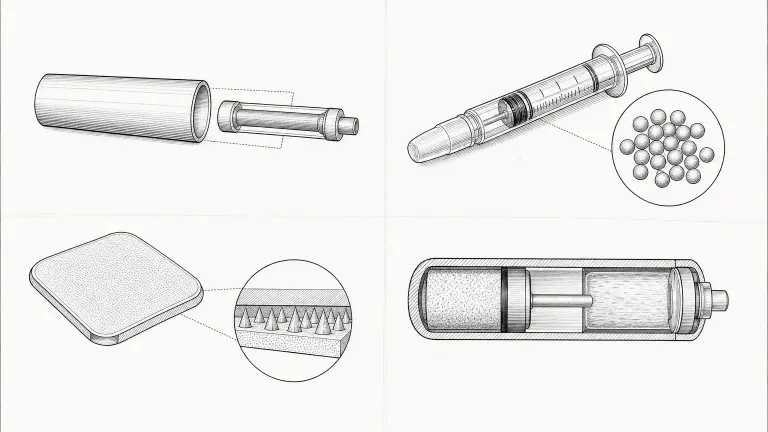
| Device-based delivery | Ingestible devices that inject inside the gut | Still experimental |
Most products combine several of these.[1]
How SNAC works in oral semaglutide
SNAC (salcaprozate sodium) is the enhancer in every oral semaglutide tablet. A 2018 study in people and dogs found something unusual. Absorption happens in the stomach, in a small zone right next to the dissolving tablet. SNAC buffers the local acid, protects semaglutide from enzymes and briefly helps it pass through stomach cells, without opening the gaps between them.[2]
That mechanism explains the strict instructions. Wegovy tablets are taken once daily on an empty stomach with up to 4 ounces of plain water. Patients then wait at least 30 minutes before eating, drinking or taking other oral medicines.[4]
The newer semaglutide tablets reach higher exposure per milligram. The label estimates bioavailability at 0.4% to 1% for Rybelsus 3, 7 and 14 mg, and at 1% to 2% for the newer Ozempic tablets (1.5, 4 and 9 mg) and Wegovy tablets.[3][4]
Does it work as well as the shot? In the OASIS 4 trial, 307 adults with obesity took oral semaglutide 25 mg or placebo for 64 weeks. Weight fell 13.6% on the tablet versus 2.2% on placebo. Gastrointestinal side effects affected 74.0% of the tablet group versus 42.2% on placebo.[5] For a full comparison with injections, see oral vs injectable semaglutide and our semaglutide profile.
Other approved peptide pills
Oral octreotide (Mycapssa). This somatostatin analog uses a delayed-release capsule with a sodium caprylate-based formula. It is approved for long-term maintenance in acromegaly patients who have already responded to injected octreotide or lanreotide. The starting dose is 40 mg a day, taken at least 1 hour before or 2 hours after a meal. Acid-reducing drugs can lower its absorption.[6]
Icotrokinra (Icotyde). A 13-amino-acid peptide that blocks the interleukin-23 receptor, approved for plaque psoriasis in March 2026.[10] In a phase 3 trial of 684 adults and adolescents, 65% on 200 mg daily reached clear or almost clear skin at week 16, versus 8% on placebo. Adverse events occurred in 49% of each group.[9] A high-fat meal cut its absorption by 43%.[10]
Enlicitide (Lipfendra). A macrocyclic (ring-shaped) peptide that blocks PCSK9 to lower LDL cholesterol, approved in July 2026. It is formulated with the enhancer sodium caprate, and its oral bioavailability is about 1%.[7] In CORALreef Lipids, 2,909 people at high heart risk took 20 mg daily or placebo. LDL cholesterol fell 57.1% on enlicitide and rose 3.0% on placebo at 24 weeks. Adverse events did not appear to differ between groups.[8]
Orforglipron (Foundayo), Lilly’s GLP-1 pill, is often grouped with these but is a small molecule, not a peptide. See our orforglipron profile.
What’s established vs preliminary
Established:
- Absorption enhancers can make a once-daily peptide pill work, but only a small fraction of each dose is absorbed.[3][7]
- Oral peptides need strict fasting and water rules, and food can sharply cut absorption.[4][10]
- Redesigning the peptide itself, as with the ring-shaped enlicitide and icotrokinra, makes oral dosing more practical.[1]
Preliminary:
- Oral amycretin, a combined GLP-1 and amylin agonist. A 144-person phase 1 study found mostly mild to moderate stomach side effects. Larger trials are needed to show weight loss.[11]
- Ingestible injection devices and nanoparticle carriers, which remain at early stages.[1]
Limitations and open questions
- Waste and cost. Absorbing about 1% means about 99% of the drug is never used, which raises the amount of peptide that has to be manufactured.[1]
- Variability. Absorption differs between people and from day to day. The Wegovy label notes higher variability in blood levels with tablets than with the injection.[4]
- Adherence. Daily fasting rules are harder for some people than one weekly shot.
- Unregulated products. Oral capsules of research peptides such as BPC-157 do not use tested enhancers, and no human study has measured how much reaches the blood. Our BPC-157 oral vs injectable comparison covers what is known.
What’s next
CORALreef Outcomes is testing whether enlicitide lowers heart attacks and strokes in 14,550 participants. It is active but not recruiting, with primary completion expected in November 2029.[12] Icotrokinra is also in late-stage trials for ulcerative colitis and Crohn’s disease. Peptides that don’t survive the gut may still reach patients by other routes. See peptide delivery technologies for implants, depots and patches, and peptide nasal sprays vs injections.
Questions to discuss with a clinician
- Would a daily pill or a weekly injection fit my routine better?
- Can I follow the fasting and water rules around my other morning medicines?
- Do any of my medicines, such as acid reducers, affect absorption?
- Is the oral form covered by my insurance at the dose I need?