Matrixyl vs argireline compares two skincare peptides that take different routes to the same goal. Matrixyl (palmitoyl pentapeptide-4) is a collagen-signaling peptide, and argireline (acetyl hexapeptide-8) is meant to relax expression muscles like a very mild Botox.[7][3] In the only head-to-head trial, a tiny one with 21 women, the Matrixyl peptide gave better results for crow’s feet over 8 weeks.[1]
This guide is part of our peptide basics hub. For argireline’s longer cousin, see SNAP-8 vs argireline and our SNAP-8 profile.
Matrixyl vs argireline at a glance
| Matrixyl (palmitoyl pentapeptide-4) | Argireline (acetyl hexapeptide-8) | |
|---|---|---|
| Peptide family | Signal peptide[7] | Neurotransmitter-inhibitor peptide[7] |
| Target | Skin cells that make collagen[2] | Nerve signals to expression muscles[3] |
| Best for (as marketed) | Overall fine lines and texture | Expression lines (crow’s feet, forehead) |
| Key placebo-controlled trial | 93 women, 12 weeks, positive[2] | 60 adults, 4 weeks, positive[4] |
| Negative or null trial | None published that we found | 19-woman split-face study, no difference[5] |
| Head-to-head result | Better in a 21-woman trial[1] | Less effective in that trial[1] |
| Status | Cosmetic ingredient[11] | Cosmetic ingredient[11] |
How each one works
Matrixyl: a collagen “repair” signal
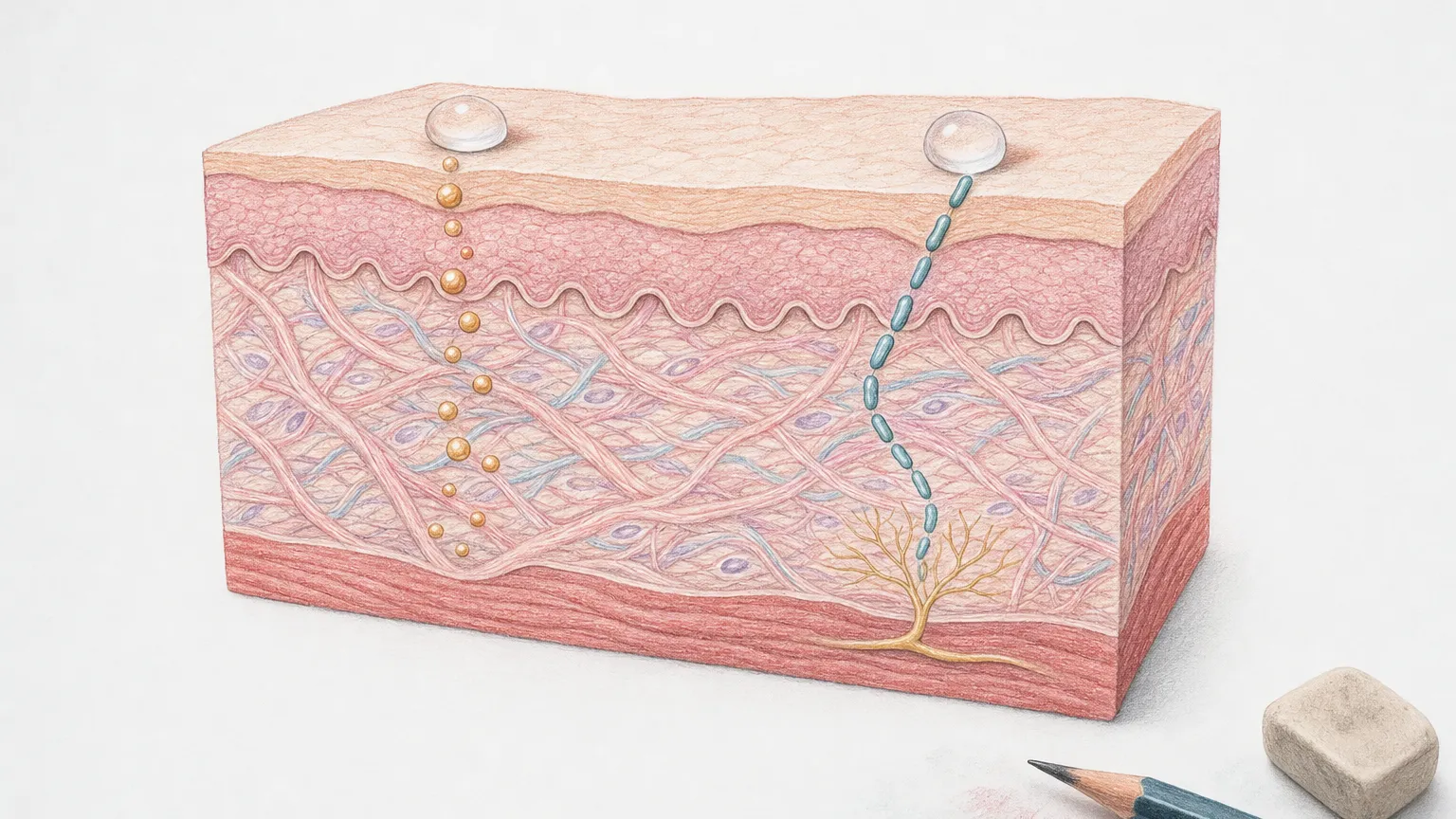
Matrixyl’s active is KTTKS, a five-amino-acid piece of collagen’s precursor, with a palmitic acid tail.[2] The theory is that collagen fragments signal skin cells that the matrix needs repair. Plain KTTKS barely crosses skin because it dissolves so easily in water; the fatty tail was added to help it into skin.[8]
Argireline: a weak muscle-signal blocker
Argireline copies part of SNAP-25, a protein nerve endings use to release the chemical that makes muscles contract. By competing with it, argireline is meant to dampen that signal.[3][10] In lab tests its potency resembled botulinum toxin type A, but with a much smaller maximum effect.[3]
The shared hurdle: getting through skin
A widely cited rule of thumb holds that compounds need a molecular weight under about 500 daltons to cross the outer skin layer.[13] Many cosmetic peptides are larger. A 2025 review concluded argireline penetrates poorly, citing a lab test in which about 0.22% entered the outer skin layer and none crossed it.[6] For Matrixyl-type peptides, a 2026 study detected palmitoylated peptides from Matrixyl 3000 throughout the outer skin layer in volunteers, falling off with depth.[9] Neither result proves the peptides reach collagen-making cells or muscle in meaningful amounts.
What human trials found
The head-to-head trial
In 2023, dermatologists in Jakarta randomized 21 Indonesian women aged 26 to 55 with crow’s feet to an acetyl hexapeptide-3 (argireline) cream, a palmitoyl pentapeptide-4 cream or placebo, applied twice daily for 8 weeks. Using skin instruments, photos and self-assessment, the Matrixyl peptide showed better results than argireline and placebo.[1] With about seven women per group, the authors described it as an initial study.
Matrixyl
The main Matrixyl trial, run by Procter & Gamble, enrolled 93 white women aged 35 to 55. Each used a moisturizer with 3 ppm pal-KTTKS on one side of the face and the same moisturizer without it on the other for 12 weeks. Wrinkles and fine lines improved significantly more on the peptide side.[2]
Argireline
- 2002: a 10% argireline emulsion reduced wrinkle depth by up to 30% after 30 days in its developers’ study.[3]
- 2013: in 60 Chinese adults with eye wrinkles, 48.9% improved with argireline vs 0% on placebo after 4 weeks.[4]
- 2023: a double-blind German split-face study of 19 women found no significant difference between a serum with argireline and one without.[5]
Why these trials are hard to compare
Even the positive studies leave gaps, and it is worth knowing why before trusting any headline number:
- Different people. The Matrixyl trial enrolled white women in the US,[2] the positive argireline trial enrolled Chinese adults,[4] and the head-to-head trial enrolled Indonesian women.[1] Skin type and sun exposure differ.
- Different measures. Studies used image analysis, expert grading, skin instruments and self-assessment, which don’t translate into one another.[1][2][5]
- Different bases. The Matrixyl peptide was tested in a moisturizer, while the null argireline study used a hyaluronic acid serum, so the vehicle may have mattered as much as the peptide.[2][5]
- Short durations. Trials ran 4 to 12 weeks.[2][4] Nobody has published results from years of use.
- Sponsorship. The Matrixyl trial was run by its developer, and argireline’s first study by its developers.[2][3]
None of this means the peptides don’t work. It means the results are best read as “may help a little” rather than as precise percentages.
Side effects and safety
- Matrixyl: pal-KTTKS was well tolerated in the 93-woman trial.[2]
- Argireline: no irritation in its developers’ tests and no significant skin reactions in the 2023 German study.[3][5]
- Never inject cosmetic peptides. A woman injected with argireline in the forehead and temples developed a Mycobacterium abscessus skin infection requiring 5 months of antibiotics.[12]
Legal status and cost
Both are cosmetic ingredients. Cosmetics do not need FDA approval before sale, but products intended to affect the body’s structure or function are legally drugs.[11] A 2025 review pointed out that a peptide that truly relaxed muscles might no longer qualify as a cosmetic.[6] Product prices vary widely, and percentages are rarely listed. Formulation matters too; see peptide cream vs serum.
Which might suit you?
Points to discuss with a dermatologist:
- Are your lines mostly static (present at rest) or dynamic (only when you move)? Matrixyl is aimed at the former, argireline at the latter.
- Would you like the ingredient with the bigger controlled trial? That is Matrixyl.[2]
- Are you also weighing copper peptides? See GHK-Cu vs Matrixyl.
The verdict
On current evidence, Matrixyl has a modest edge: a larger placebo-controlled trial, no published null result that we found, and a win in the one small head-to-head study.[1][2] Argireline’s results are more mixed, and its central idea, relaxing muscles through the skin, runs into a real penetration problem.[6] Many products combine the two, which is reasonable, but untested as a pairing.