AI-designed peptides are real and moving fast in the lab, but they are early in the clinic. As of October 2026, at least one has reached human testing: PQ203, a cancer peptide conjugate in a phase 1 trial with a target of 80 patients since September 2025.[7] No AI-designed peptide has been approved, and none has published human efficacy results.
This guide explains how the tools work, the strongest published results and where hype runs ahead of evidence. New to peptides? Start at the peptide basics hub.
How AI designs peptides
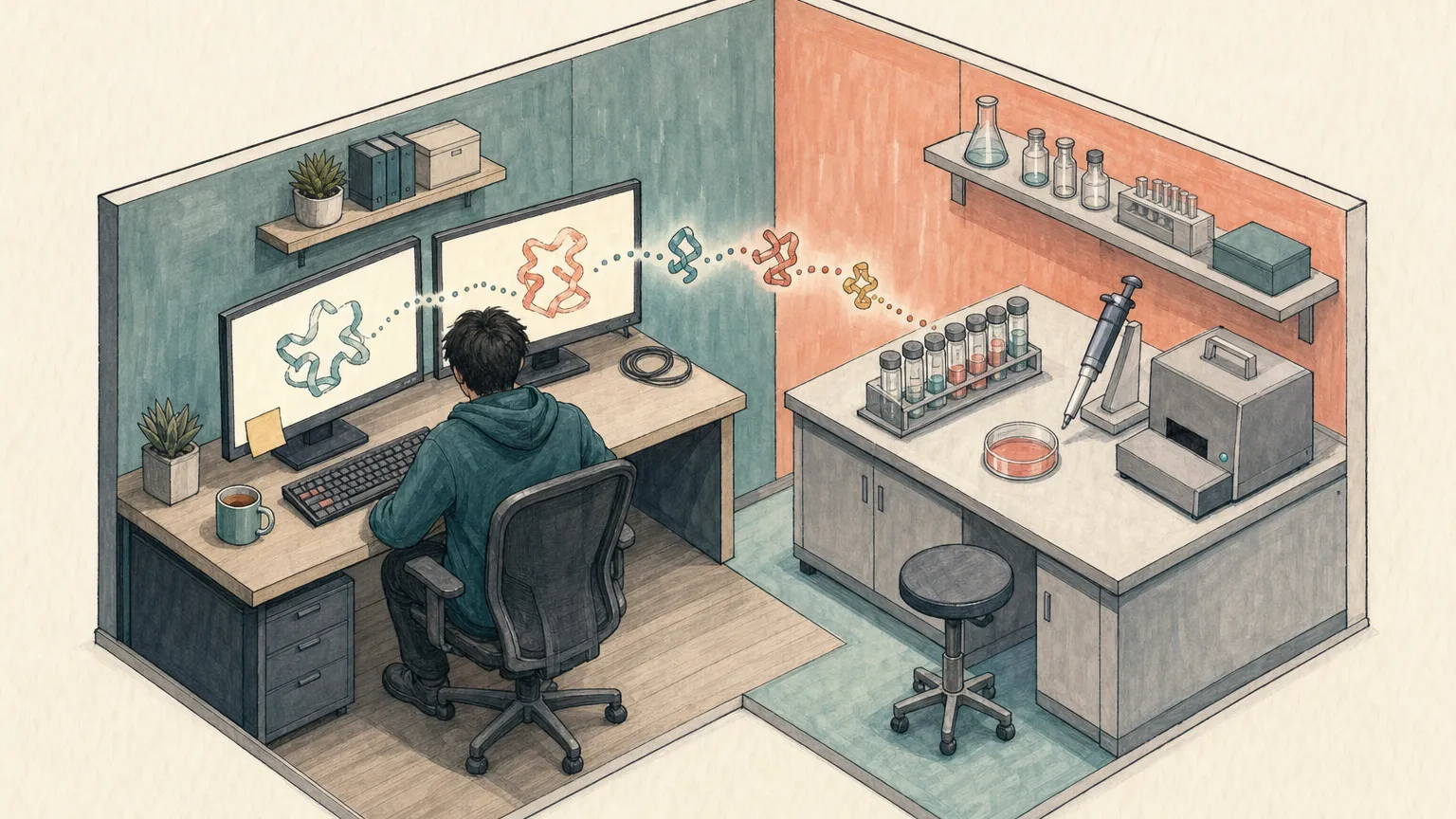
Three kinds of models do most of the work:
| Approach | What it does | Example |
|---|---|---|
| Structure prediction | Predicts the 3D shape a sequence will fold into | AlphaFold, RoseTTAFold |
| Generative design | Creates new backbones or sequences that should bind a target | RFdiffusion, RFpeptides |
| Activity prediction | Scores sequences for a property, such as killing bacteria | Deep-learning antimicrobial models |
Structure prediction is covered in our guide to AlphaFold and peptide structure. The 2024 Nobel Prize in Chemistry recognized both sides: David Baker for computational protein design, and Demis Hassabis and John Jumper for structure prediction.[9]
A 2026 review counted 39 therapeutic peptide databases and 62 computational tools. It noted an urgent need to close the gap between computer predictions and lab validation.[10]
Why peptides suit AI design
Peptides are a natural fit for computer design. They are short, so models can handle them quickly, and they can be made by chemical synthesis within days, which makes it practical to test a shortlist. The number of possible sequences is enormous, though. With 20 natural amino acids, a 10-residue peptide alone has 20 to the 10th power, or about 10 trillion, possible sequences, far too many to test by hand. AI narrows that space to a few dozen candidates worth making.
The catch is that peptides are also floppy and easily broken down in the body. That is why so much recent work focuses on ring-shaped peptides and on binders that lock a target in place.[3]
Key studies
RFdiffusion (2023). Baker’s lab adapted image-generation “diffusion” methods to proteins. Starting from random noise, the model builds protein backbones to order, including binders for chosen targets, which were then confirmed in the lab.[1]
Binders for peptide hormones (2024). The team extended RFdiffusion to design proteins that grab flexible, helix-forming peptide hormones. Some bound with picomolar affinity, extremely tight, without further lab optimization. They were used to detect parathyroid hormone and glucagon.[2] This is a diagnostic tool, not a treatment.
Ring-shaped peptide binders (2025). RFpeptides designs macrocycles, ring-shaped peptides valued as drug candidates because they resist breakdown. Testing 20 or fewer designs per target produced binders against all four proteins tried. X-ray structures closely matched the computer models.[3] Cyclic peptides are the same family as the newly approved oral drugs covered in oral peptide delivery.
Hard targets (2024). A diffusion approach produced picomolar binders for TNFR1, a receptor whose flat surface had defeated earlier design attempts. Designs could act as blockers or activators.[4]
Antibiotics from extinct species (2024). A deep-learning model screened 10.3 million peptide sequences from the proteomes of extinct organisms. Of 69 synthesized, several killed bacteria, and leads such as mammuthusin-2 (from the woolly mammoth) worked against infections in mice.[5]
Antibiotics from archaea (2025). The same approach mined 233 archaeal proteomes and flagged 12,623 candidates. Of 80 synthesized “archaeasins,” 93% showed antibacterial activity in the lab. One reduced drug-resistant Acinetobacter baumannii in mice about as well as polymyxin B.[6] For natural antimicrobial peptides, see LL-37 vs defensins vs magainin and our LL-37 profile.
The first AI-designed peptide in a clinical trial
ProteinQure says PQ203 is the first AI-designed peptide therapeutic to enter the clinic. It targets sortilin, a receptor overexpressed in many solid tumors, and carries a cancer drug payload. The company says it was designed with a platform combining machine learning, structural biology and atomic simulations.[8]
ClinicalTrials.gov lists a phase 1 study in advanced solid tumors, including triple-negative breast cancer. It started September 16, 2025, aims to enroll 80 people and is recruiting.[7] The “first” label is the company’s own claim. Other teams use AI at some stage of most modern drug programs, so “AI-designed” has no fixed definition. It can mean a model generated the sequence from scratch, or that software helped rank options a chemist proposed. When you see the label, ask which steps the AI did and what human testing followed.
What’s established vs preliminary
Established:
- Deep-learning models can generate peptide and protein binders that work in lab tests, sometimes from fewer than 20 tries.[3]
- AI screening can rapidly flag antimicrobial candidates from huge sequence databases.[5][6]
Preliminary:
- Whether AI-designed peptides are safer or more effective in people than conventionally designed ones.
- Whether AI shortens the overall time to approval, since clinical trials, not design, take the most time.
Limitations
- Lab success isn’t clinical success. Most candidates that work in mice never become drugs.
- Predictions miss things. Models predict binding and shape, not full effects in the body, such as immune reactions or off-target effects.[10]
- Regulatory path. A 2026 review of AI-designed antibiotics flagged reporting standards and regulatory hurdles as major barriers to reaching patients.[11]
- Marketing. “AI-designed” on a product sold for personal use is not evidence of anything. Our guide on how to read peptide research covers red flags.
What’s next
Watch for safety data from the PQ203 phase 1 trial and for AI-designed antimicrobials moving from mice into human testing. Future treatments may also be matched to a person’s biology; see personalized peptide therapy.
Questions to discuss with a clinician
- Is a product’s “AI-designed” claim backed by any human trial?
- Are there AI-designed peptide trials I might qualify for, and what phase are they?
- How would an experimental drug fit with my current treatments?