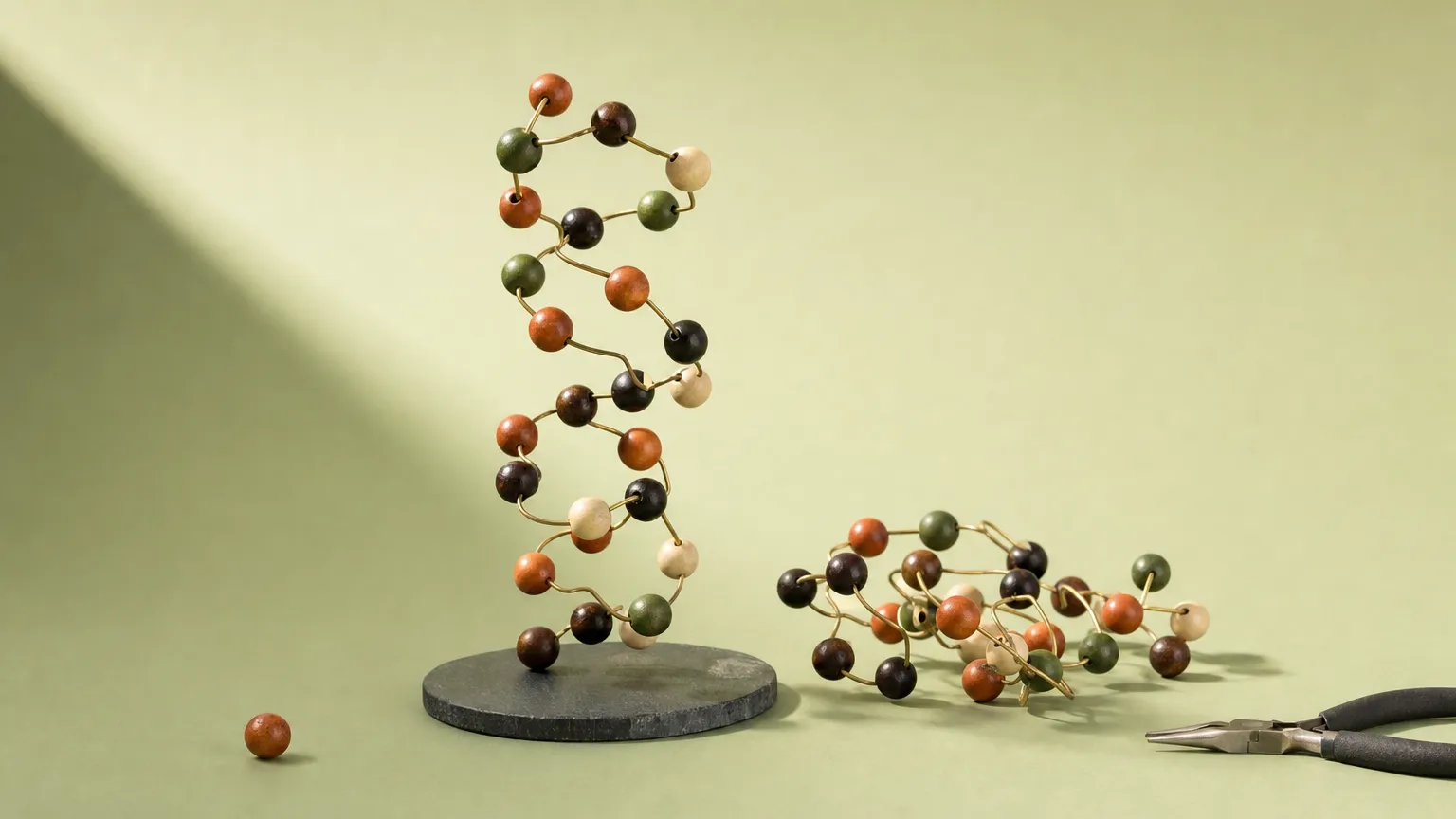
AlphaFold peptide structure prediction works better than many expected: in a 2023 test of 588 peptides 10 to 40 amino acids long, AlphaFold2 predicted helical, beta-hairpin and disulfide-rich peptides with high accuracy, at least as well as tools built specifically for peptides.[2] It still made errors in fine backbone angles and disulfide bond patterns, and its confidence scores didn’t reliably flag its best models.
This guide covers what AlphaFold is, what the peptide studies found and where predictions fall short. New to peptides? Start at the peptide basics hub.
What AlphaFold does
A protein or peptide is a chain of amino acids that folds into a 3D shape, and the shape largely decides what it does. Experimentally solving one structure can take months or years.[1]
AlphaFold2, from Google DeepMind, predicted protein structures with accuracy competitive with experiments in most cases at the CASP14 assessment in 2020.[1] Its public database now holds more than 214 million predicted structures.[5] The 2024 Nobel Prize in Chemistry went half to Demis Hassabis and John Jumper for AlphaFold and half to David Baker for computational protein design.[9]
Key studies on peptides
| Study | What was tested | Main finding |
|---|---|---|
| McDonald et al., 2023[2] | AlphaFold2 on 588 peptides (10 to 40 amino acids) vs NMR structures | High accuracy for helical, hairpin and disulfide-rich peptides; errors in angles and disulfide patterns |
| Tsaban et al., 2022[3] | AlphaFold2 for peptide-protein docking | Fast, accurate models of many complexes without peptide evolutionary data |
| Abramson et al., 2024[4] | AlphaFold 3 on mixed complexes | Handles proteins, nucleic acids, small molecules, ions and modified residues |
| HighFold3, 2025[7] | Cyclic peptides with unnatural amino acids | AlphaFold 3 alone fell short; a cyclic-specific adaptation did better |
Single peptides. The 2023 benchmark compared predictions against structures solved by NMR, a lab method suited to small molecules in solution. AlphaFold2 matched or beat peptide-specific programs. The authors cautioned that “additional steps may be necessary” to validate results, because the model ranked as most confident was not always the most accurate.[2]
Peptides bound to proteins. Many peptide drugs, such as semaglutide, work by binding a receptor. A 2022 study showed AlphaFold2 could model peptide-protein complexes and capture shape changes in the receptor on binding, offering a starting point for drug design.[3]
Modified and ring-shaped peptides. Therapeutic peptides are often chemically altered or cyclized to last longer. AlphaFold 3 can include modified residues.[4] A 2025 study found its reliance on training data still limited accuracy for cyclic peptides with unnatural amino acids, and built a specialized version, HighFold3, that performed better.[7]
How to read an AlphaFold model
If you open a prediction in the AlphaFold database or a paper, two outputs matter most:
- Per-residue confidence (pLDDT). Each amino acid is colored by how confident the model is about its position. Low-confidence regions are often flexible or disordered, which is common in short peptides.
- Predicted aligned error (PAE). A heat-map plot showing how confident the model is about the positions of parts relative to each other. The AlphaFold database added an improved PAE viewer to make this easier to check.[5]
High confidence is not proof of accuracy for peptides. In the 2023 benchmark, the model ranked most confident was not reliably the closest to the experimental structure.[2] Treat a model as a hypothesis to test.
Where AlphaFold helps peptide drug discovery
Peptide drugs usually need a particular shape to bind their receptor, and AlphaFold can model many peptide-receptor complexes.[3] Structure prediction lets researchers screen ideas on a computer before making anything. Examples include checking whether a modified analog keeps its helical shape, or modeling how a ring-shaped peptide sits in a target’s binding pocket. That reduces the number of molecules that need to be synthesized and tested. It does not reduce the need for animal safety studies and human trials, which remain the slowest and most expensive steps.
Other tools
- ESMFold predicts structure from a single sequence using a protein language model, about an order of magnitude faster, and has mapped more than 617 million metagenomic proteins.[6]
- Design tools such as RFpeptides run the process in reverse, generating new peptides to fit a target. In one 2025 study, X-ray structures of designed macrocycles closely matched the computer models.[8] See AI-designed peptides.
What’s established vs preliminary
Established:
- AlphaFold predicts the shapes of many structured peptides accurately.[2]
- It can model many peptide-protein complexes.[3]
Preliminary:
- Accurate prediction for cyclic peptides with unnatural building blocks.[7]
- Predicting how flexible peptides move and switch shapes, rather than a single static model.
Limitations to know
- One snapshot. AlphaFold outputs a static model. Short peptides in the body are often flexible and shift between shapes.
- Confidence isn’t accuracy. In the peptide benchmark, the best-scoring models were not always the closest to reality.[2]
- Chemistry gaps. D-amino acids, unusual rings and other changes common in drug peptides remain challenging.[7]
- Structure isn’t function. A model can’t show dose, safety, absorption or effect. That needs lab work and clinical trials. Our guide on how to read peptide research explains the evidence ladder.
Why this matters to patients
Structure prediction speeds early drug discovery, which may shorten how long new peptide medicines take to reach trials. It does not replace testing. If a seller cites an AlphaFold model of an unapproved peptide, such as BPC-157, as proof it works, that is a red flag. For the difference between lab-made and natural peptides, see natural vs synthetic peptides.
What’s next
Expect tools that predict a range of shapes rather than one, better handling of modified and cyclic peptides, and tighter links between prediction and design. Whether this produces better medicines will be measured in clinical trials, not in benchmark scores.
Questions to discuss with a clinician
- Has the peptide I’m reading about been tested in humans, or only modeled on a computer?
- Are there clinical trials of computer-designed peptides relevant to my condition?
- How should I weigh lab and computer findings against human data?