Quick answer: TB-500 side effects in people are unknown, because TB-500 has never been given to people in a published study. FDA found no human studies, no animal toxicity studies and no adverse event reports for it, and says the potential risks in humans “are unknown.”[1] Its main concerns are immune reactions to impurities or clumped peptide, unknown product contents, and theoretical long-term risks such as cancer.[2][10]
This guide separates what has been measured from what is assumed. For TB-500’s background and research, see our TB-500 profile and the healing peptides hub.
What TB-500 is
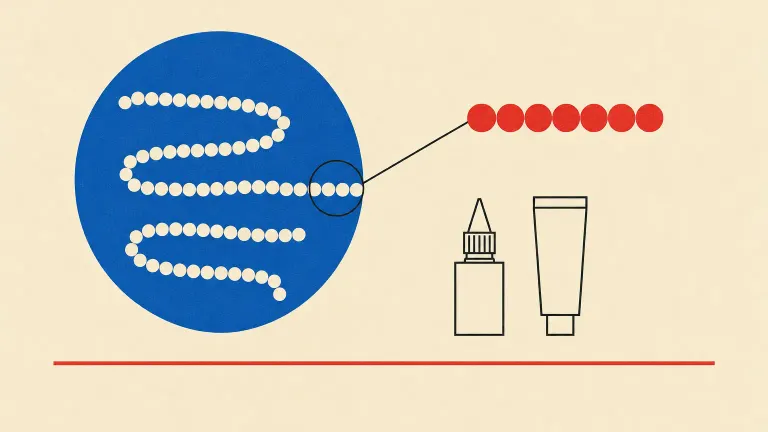
TB-500 is a synthetic peptide made of seven amino acids (Ac-LKKTETQ), copied from the part of the natural protein thymosin beta-4 that binds actin, a building block of the cell’s skeleton.[3] It is sold for injury recovery, often with BPC-157. It is a small fragment, not the whole thymosin beta-4 protein, and safety data for one do not automatically apply to the other.
What is known about TB-500 side effects
FDA reviewed TB-500 for its July 2026 compounding advisory meeting and found:[1]
- No human studies. FDA found no published study in which TB-500 was given to people for any condition, and no human pharmacokinetic data.
- No toxicity studies. Neither the nominator nor FDA found animal toxicity studies to inform safety.
- No adverse event reports. FDA’s adverse event database had no reports for TB-500. FDA notes this does not mean it is safe: reporting is voluntary, and reports for compounded and gray-market products are often missing.
- Quality gaps. FDA judged both forms of TB-500 it reviewed “not well-characterized,” with no data on impurities, aggregates or bacterial contamination.
Possible TB-500 side effects and risks
| Concern | What the evidence is | Strength of evidence |
|---|---|---|
| Immune reactions | FDA concern based on impurities and peptide clumping in injectables[2] | Theoretical |
| Injection-site redness, swelling | Common with injected peptides; one FDA report in a BPC-157 user also using injected thymosin[1] | Case report |
| Skin and gum darkening | One FDA report in a person using BPC-157 with TB-500; it returned on rechallenge[1] | Case report, cause unclear |
| Infection, wrong dose | Online TB-500 products often did not match their labels[8] | Lab analysis |
| Cancer growth | Beta-thymosins are involved in tumor spread in research models[9][10] | Theoretical |
Reported reactions
The only specific human report tied to TB-500 in FDA’s review involved a 40-year-old woman who injected BPC-157 and TB-500 twice daily. She developed widespread skin darkening and darkening of the gums, which came back when she used them again.[1] Because she used both peptides, FDA could not say which one, if either, caused it.[1]
What thymosin beta-4 trials can and can’t tell us
Full-length thymosin beta-4 has been tested in people, and the results are often quoted as evidence that TB-500 is safe:
- IV infusions: healthy volunteers received 42 to 1,260 mg by IV, as single doses and then daily for 14 days. Adverse events were infrequent and mild or moderate, with no dose-limiting toxicity or serious adverse events.[4]
- Recombinant version (China): in 84 healthy volunteers across single- and multiple-dose groups, side effects were mild to moderate with no serious adverse events.[5]
- Eye drops: a 9-patient dry eye trial found the drops safe and well tolerated,[6] and a small trial in a corneal healing disorder reported no significant adverse effects.[7]
TB-500 also breaks down quickly into smaller fragments. A 2024 study found its main breakdown products in rats within hours, with one fragment detectable for up to 72 hours. In cell tests, only one fragment, not TB-500 itself, showed wound-healing activity.[11] The effects and side effects of these fragments in people are unknown.
Does TB-500 cause cancer?
There is no human evidence that TB-500 causes cancer, and none that it doesn’t. The concern comes from biology: beta-thymosins, including thymosin beta-4, help cells move, and research links them to tumor spread (metastasis).[9] A 2026 review of unregulated injectable peptides lists cancer promotion and abnormal blood vessel growth among the potential risks.[10] People with a current or past cancer are the group most often advised to avoid growth-promoting peptides for this reason.
Product quality: often the biggest risk
When a drug has no approved manufacturer, the product itself becomes a risk. A French horse-racing lab analyzed online products sold as “TB500” and “TB1000” and found their contents were not consistently what earlier descriptions said they contained.[8] FDA raised the same problem: missing impurity data and no tests for bacterial toxins.[1] See our guide to counterfeit peptides.
TB-500 and sport
TB-500 is prohibited at all times by the World Anti-Doping Agency, under growth factors.[1] A 2026 orthopedic review noted that both thymosin beta-4 and TB-500 remain banned in sport.[12] Anti-doping labs have published methods to detect it.[3] See peptides on the WADA prohibited list.
Legal status in 2026
TB-500 is not part of any FDA-approved drug. FDA staff recommended in July 2026 that it not be added to the list of substances pharmacies may compound. The advisory committee voted 8 to 6 the other way, but the vote is not binding, and as of a July 31, 2026 report TB-500 had not been added.[1][13]
Who should avoid TB-500
- People with a current or past cancer
- People who are pregnant or breastfeeding
- Competitive athletes subject to drug testing
- People with autoimmune or allergic conditions, given the immune-reaction concern[2]
- Anyone who cannot confirm where a product was made and what is in it
Questions to ask a clinician
- Is there an approved treatment for my injury that I should try first?
- What would we watch for if I had a reaction?
- Should I stop TB-500 before surgery or other treatment?
If you develop fever, spreading redness, a hard painful lump, hives or shortness of breath after an injection, seek medical care and bring the product with you.
You or your clinician can also report a suspected reaction to FDA through its MedWatch program. FDA’s TB-500 review found no reports at all, so each report adds to what is known.[1] Tell your doctor exactly what you injected, how much, how often and where it came from; that history matters more than the label on the vial.