Quick answer: there is no established TB-500 dosage. TB-500 is a short fragment of thymosin beta-4 that has never been tested in a human trial; FDA says it found no human exposure data.[1][2] The doses people cite come from trials of the full thymosin beta-4 protein: 0.1% eye drops, 0.01% to 0.1% wound gels, and 42 to 1,260 mg a day by IV in a safety study.[4][8][3] Those results don’t transfer to TB-500, and no dose has been approved for any use.
For background on the compound, see our TB-500 profile and the healing peptides hub. For how it compares with its common partner, see BPC-157 vs TB-500.
TB-500 vs thymosin beta-4: why the difference matters for dosing
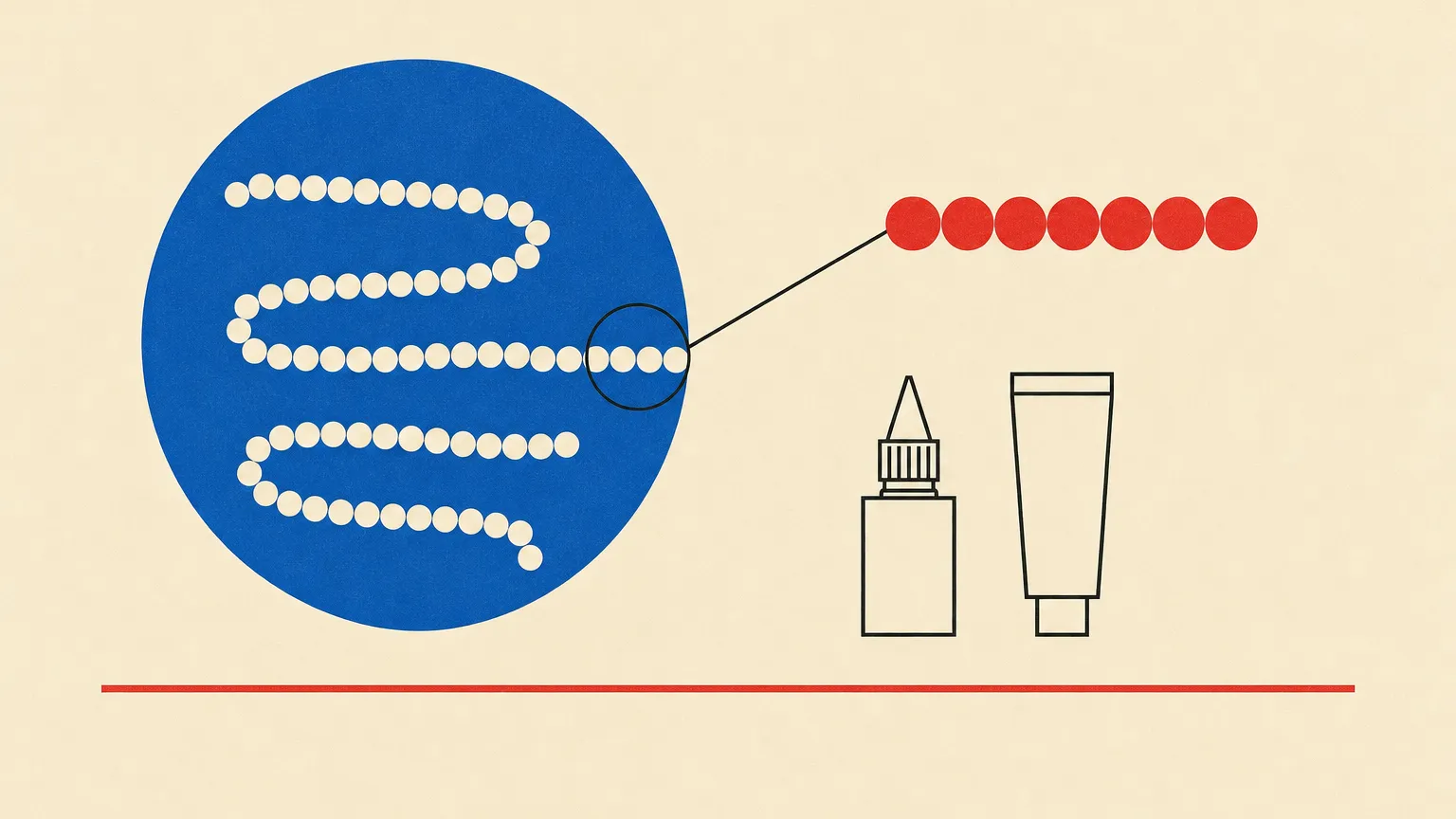
Thymosin beta-4 (Tβ4) is a natural 43-amino-acid protein involved in cell movement and tissue repair.[8][11] TB-500 is a name used for products sold for “healing,” and lab analysis of these products found an acetylated fragment of just 7 amino acids (positions 17 to 23, sequence LKKTETQ).[2] FDA lists it as “thymosin beta-4, fragment (LKKTETQ), also known as TB-500.”[1]
A fragment can behave very differently from the whole protein in how it’s absorbed, how long it lasts and what it does. So the thymosin beta-4 doses below describe the parent protein, not TB-500.
Where TB-500 came from
TB-500 first drew attention as a veterinary preparation used in horse racing. A Hong Kong racing laboratory described it as containing a synthetic, acetylated version of LKKTETQ, the stretch of thymosin beta-4 responsible for binding actin, a protein that lets cells move, and developed a test to catch its use in racehorses.[15] The idea that this small piece might carry the healing effects of the whole protein traces to a 2003 mouse study: a synthetic seven-amino-acid peptide matching that region helped wounds heal in aged mice about as well as full thymosin beta-4 did.[14]
That study tested wound healing in animals, not doses for people. No published study has worked out how much of the fragment a human would need, how long it lasts in the body or what side effects it causes. That gap is why FDA says it has no human exposure data for TB-500.[1]
Thymosin beta-4 doses tested in human trials
| Product and route | Condition | Dose and schedule | Result |
|---|---|---|---|
| RGN-259 eye drops | Moderate to severe dry eye (72 people) | 0.1% for 28 days | Missed main goals; some secondary measures improved[4] |
| RGN-259 eye drops | Severe dry eye (9 people) | 0.1%, 6 times daily for 28 days | Less discomfort and staining vs vehicle[5] |
| RGN-259 eye drops (ARISE-3) | Dry eye (700 planned) | Drops 4 times daily for 14 days | Completed; results not posted in the registry[6] |
| RGN-259 eye drops (SEER-2) | Neurotrophic keratopathy (70 planned) | 0.1%, 5 times daily for 28 days | Recruiting at last update (December 2025)[7] |
| Topical gel | Venous leg ulcers (73 people) | 0.01%, 0.03% or 0.1% gel | 0.03% may speed healing; safety similar to placebo[8][13] |
| Topical gel | Pressure ulcers (72 people) | 0.01%, 0.02% or 0.1%, once daily up to 84 days | Healing faster in those who healed, per a later review[9][11] |
| IV synthetic thymosin beta-4 | Healthy volunteers (40 people) | 42, 140, 420 or 1,260 mg, single dose then daily for 14 days | Well tolerated; no dose-limiting toxicity[3] |
| RGN-352 IV injection | Heart attack (phase 2) | Planned 450 mg or 1,200 mg daily by IV | Withdrawn before enrollment[10] |
Newer trials of injected thymosin beta-4
The most active human research on injected thymosin beta-4 now comes from China, using a recombinant (lab-grown) version of the full protein called NL005, given by IV after a heart attack. These doses are tiny compared with the older U.S. safety study:
- A completed phase 2 trial in 62 patients tested 0.25, 0.5 or 2.0 µg/kg by IV once daily for 7 days after a stent procedure, against placebo.[16]
- A second completed phase 2 trial in 90 patients compared 0.5 and 1.5 µg/kg daily for 7 days with placebo.[17]
- A larger phase 2 trial of 189 patients, planned at 10 or 20 µg/kg, was not yet recruiting at its last update.[18]
No results from these trials had been posted to the registry as of October 2026. Even so, they show what careful dose-finding looks like: several fixed doses, a placebo group, a defined condition and a short, monitored course. Nothing comparable exists for TB-500.
A review of the two wound-ulcer phase 2 trials reported that thymosin beta-4 sped healing by almost a month in patients whose wounds did heal, but most ulcers did not fully heal in the study period.[11][8]
What these doses tell you, and what they don’t
- Topical and eye doses are tiny and local. A 0.1% solution means 1 mg per mL, applied to the eye or a wound surface. These don’t translate to an injected systemic dose.
- The IV safety study used very large doses of the full protein, up to 1,260 mg a day, for only 14 days in healthy volunteers.[3] It measured safety and blood levels, not healing.
- No trial tested injections under the skin, the route most TB-500 users choose.
- No trial tested TB-500 itself in any form.[1]
- Short courses only. The longest thymosin beta-4 treatment periods in these trials were about 12 weeks for wound gels and 28 days for eye drops, so nothing is known about months of repeated injections.[9][7]
Safety and legal status
FDA says compounded TB-500 may carry a risk of immune reactions and peptide-related impurities, and that it lacks key information on whether it would cause harm in people.[1] It is not on the list of substances pharmacies may compound; our BPC-157 legal status guide tracks FDA’s 2026 advisory committee review, which covered TB-500 as well.
The World Anti-Doping Agency bans thymosin beta-4 and its derivatives, including TB-500, at all times.[12] Products sold as “research use only” aren’t made for human use, and their contents may not match the label; see counterfeit peptides.
Questions to ask a clinician
- Is there an approved therapy with proven results for my injury?
- Since TB-500 has no human data, how would we monitor for side effects?
- How would we know if it’s working, and when would we stop?
- Am I subject to drug testing in sport or at work?
For a parallel look at the other popular healing peptide, see our BPC-157 dosage guide and the combined BPC-157 and TB-500 stack review.