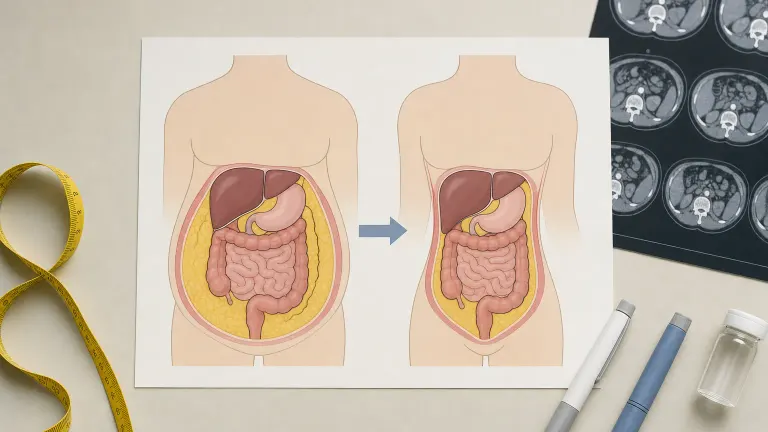
Tesamorelin vs sermorelin: both are lab-made versions of growth hormone-releasing hormone (GHRH), but only tesamorelin is currently FDA-approved, as Egrifta, to reduce excess abdominal fat in adults with HIV-associated lipodystrophy.[1] In its first phase 3 trial, tesamorelin cut deep belly fat by 15.2% in 26 weeks versus a 5.0% rise on placebo.[3] Sermorelin (Geref) was approved for growth hormone deficiency in children but discontinued in 2008, and its evidence in adults is limited to small studies.[2][4]
See the full tesamorelin and sermorelin profiles, or browse our growth hormone peptides hub.
Tesamorelin vs sermorelin at a glance
| Tesamorelin | Sermorelin | |
|---|---|---|
| What it is | Full GHRH (44 amino acids) with a stabilizing fatty chain[1] | First 29 amino acids of GHRH[4] |
| Brand | Egrifta (SV, WR)[1][7] | Geref (discontinued)[2] |
| FDA status | Approved 2010; currently marketed[5] | Approved 1990 and 1997; discontinued 2008[2][6] |
| Approved use | Excess abdominal fat in adults with HIV and lipodystrophy[1] | Formerly: diagnosis and treatment of growth hormone deficiency in children[4] |
| Largest trials | Two phase 3 trials, 412 and 404 patients[3][8] | 110 children, open label[12] |
| Half-life | About 8 to 11 minutes[1][7] | Short; dosed daily in studies[4] |
| Labeled dose | 1.4 mg daily (SV) or 1.28 mg daily (WR)[1][7] | Formerly 30 mcg/kg nightly in children[4] |
| Regulated as | Biologic since March 2020[17] | Drug (shorter peptide) |
| Banned in sport | Yes[20] | Yes[20] |
How they work
Both mimic GHRH, the hypothalamic hormone that tells the pituitary gland to release growth hormone in pulses, which then raises IGF-1 (insulin-like growth factor 1).[1][4] Because they rely on the pituitary’s own output, neither works if the pituitary has been removed or damaged; tesamorelin is contraindicated in that situation.[1]
The structural difference matters. Natural GHRH has 44 amino acids, but the first 29 carry its full activity, which is what sermorelin is.[4] Tesamorelin keeps all 44 and adds a fatty chain that protects it from rapid breakdown.[1]
FDA approval history
Tesamorelin
- November 2010: Egrifta approved for reducing excess abdominal fat in HIV-infected adults with lipodystrophy.[5]
- March 2020: after a change in the law on what counts as a protein, Egrifta was among three synthetic peptide products moved from drug to biologic regulation.[17]
- Current labels: Egrifta SV (1.4 mg daily) and Egrifta WR (1.28 mg daily); the two are not substitutable.[1][7]
Sermorelin
- 1990: Geref approved as a diagnostic test of pituitary growth hormone release.[2]
- 1997: approved to treat idiopathic growth hormone deficiency in children with growth failure.[6]
- 2008: discontinued by its maker. In 2013, FDA determined it was not withdrawn for safety or effectiveness reasons.[2]
Evidence compared
Tesamorelin
- Belly fat in HIV: visceral fat fell 15.2% versus a 5.0% rise on placebo over 26 weeks in 412 patients; triglycerides fell 50 mg/dL and IGF-1 rose 81%.[3] A second trial of 404 patients found a 10.9% versus 0.6% reduction, reaching about 18% at 12 months, but the fat returned quickly in people switched to placebo.[8]
- Liver fat: in 61 people with HIV and fatty liver disease, a year of tesamorelin reduced liver fat by 37% relative to baseline, and 35% reached normal liver fat versus 4% on placebo.[9]
- Without HIV: in 60 adults with abdominal obesity and low growth hormone, tesamorelin reduced visceral fat and triglycerides over a year without worsening blood sugar.[10]
- Thinking and memory: in 152 adults aged 55 to 87, 20 weeks of tesamorelin 1 mg improved executive function scores.[11]
Sermorelin
- Children: in 110 children with growth hormone deficiency, nightly sermorelin raised growth rate from 4.1 to 8.0 cm a year at 6 months.[12] In a 60-child comparison, growth hormone itself worked better (14.6 vs about 9.2 cm a year).[15]
- Older men: two weeks of 1 mg twice daily restored growth hormone and IGF-1 to young-adult levels in 10 men.[13] Six weeks of 2 mg nightly in 11 men raised nighttime growth hormone but did not change IGF-1; two of six strength measures improved.[14]
Side effects compared
Tesamorelin (label, 26-week pooled trials):[1]
| Side effect | Tesamorelin | Placebo |
|---|---|---|
| Injection-site reactions | 17% | 6% |
| Joint pain | 13% | 11% |
| Muscle pain | 6% | 2% |
| Leg or ankle swelling | 6% | 2% |
| Pain in arms or legs | 6% | 5% |
The label also warns about raised IGF-1, fluid retention, carpal tunnel symptoms and blood sugar: 5% developed an HbA1c of 6.5% or higher versus 1% on placebo. It should not be used in pregnancy or with active cancer.[1]
Sermorelin: the most common effects reported were temporary facial flushing and pain at the injection site.[4] In one pediatric study, 39 of 40 children developed antibodies to GHRH, which faded after stopping.[15]
Compounding and legal status
- Tesamorelin: because it is a 44-amino-acid peptide, it is now regulated as a biologic.[17] The Alliance for Pharmacy Compounding says it can therefore no longer be compounded.[18] Egrifta requires a prescription.[5]
- Sermorelin: FDA allows 503A pharmacies to compound with bulk substances that are components of FDA-approved drugs, among other routes.[19] Sermorelin was a component of the approved Geref, and the Alliance for Pharmacy Compounding lists it among peptides that meet the legal criteria for compounding.[18]
- Sport: WADA prohibits both at all times as growth hormone-releasing factors.[20]
This is general information, not legal advice. Compounded products are not FDA-reviewed for quality or effectiveness.
Dosing compared
Tesamorelin is injected under the skin of the abdomen once a day. Egrifta SV is 1.4 mg daily from a single-dose vial; Egrifta WR is 1.28 mg daily from a vial that is mixed once and used for 7 days. The two are not interchangeable.[1][7] The original phase 3 trials used 2 mg daily of the first formulation.[3] Sermorelin has no current approved dose; Geref was given at 30 mcg per kg nightly to children.[4] A clinician sets any dose.
Which one is used for what?
- Excess belly fat in HIV: tesamorelin is the only approved option of the two.[1]
- Anti-aging or muscle claims: neither is approved for these uses, and the evidence is limited.[16]
Tesamorelin is also often paired with ipamorelin; see our tesamorelin + ipamorelin guide. For how sermorelin compares with a ghrelin-type peptide, read sermorelin vs ipamorelin.