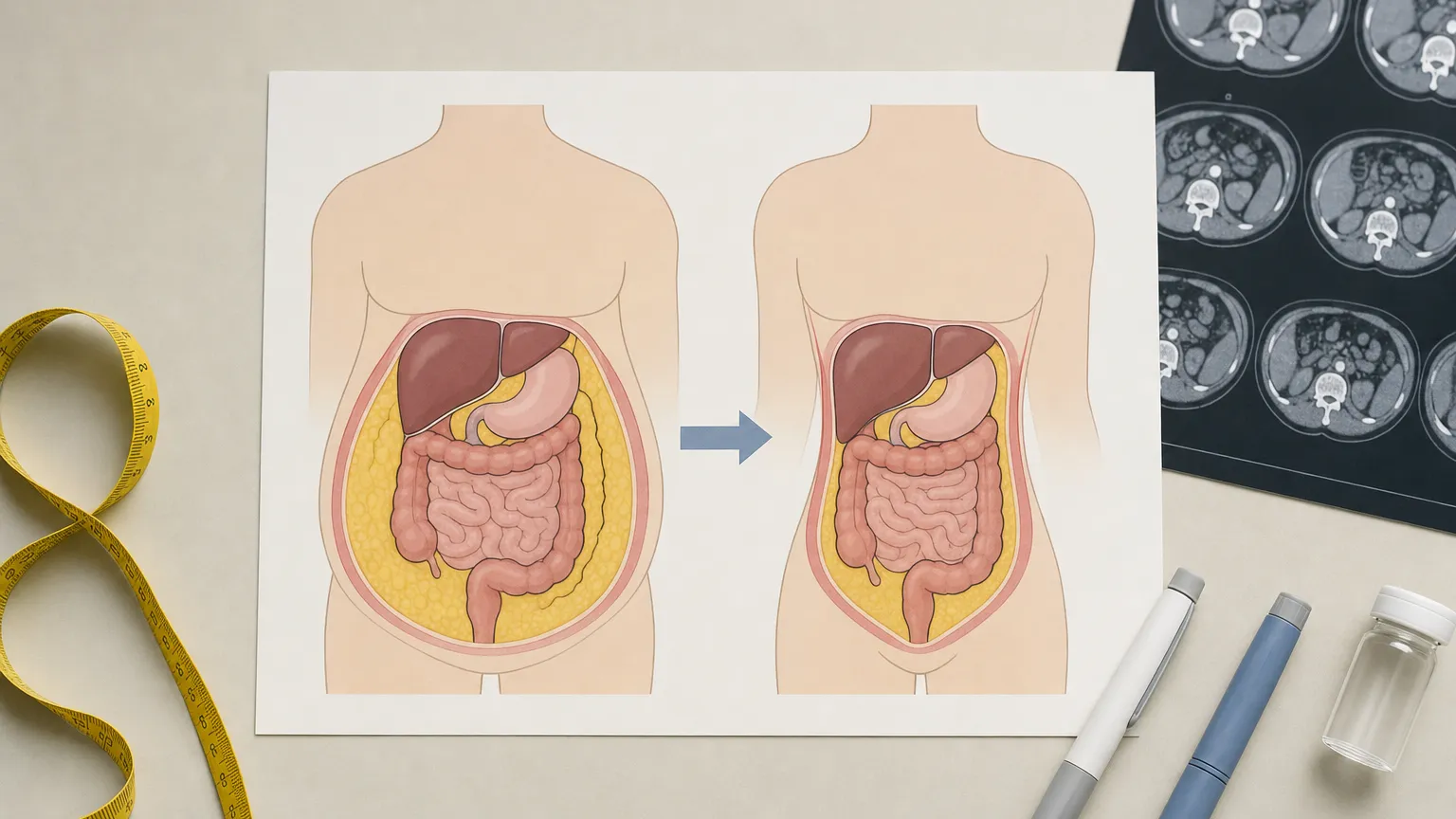
Quick answer: the main tesamorelin results come from two phase 3 trials in adults with HIV: daily 2 mg injections cut deep belly (visceral) fat by 15.2% and 10.9% over 26 weeks, versus a 5.0% rise and a 0.6% fall on placebo.[1][3] With a year of treatment the reduction reached about 18%, but the fat returned within months of stopping.[2][3] Smaller trials found a 37% relative drop in liver fat, while body weight barely changed.[7][4]
Tesamorelin (Egrifta) is FDA-approved only to reduce excess abdominal fat in adults with HIV who have lipodystrophy.[4] This page goes through what each trial measured, what changed and what did not, and what “before and after” really looks like in the data. For the drug itself, see our tesamorelin profile, and for doses, our tesamorelin dosage guide.
Belly fat: the phase 3 trials
Both trials enrolled adults aged 18 to 65 with HIV, stable antiretroviral treatment and a large waist. Two-thirds were assigned to tesamorelin 2 mg daily and one-third to placebo. Visceral fat was measured by CT scan at the level of the lower spine.[4]
| Trial | People | Visceral fat, tesamorelin | Visceral fat, placebo | Triglycerides | IGF-1 |
|---|---|---|---|---|---|
| Trial 1 (26 weeks) | 412 | −15.2% | +5.0% | −50 mg/dL vs +9 | +81% vs −5% |
| Trial 2 (26 weeks) | 404 | −10.9% | −0.6% | Not reported in the summary | Rose significantly |
Sources: trial 1[1] and trial 2.[3]
In square centimeters on the scan, visceral fat fell by 27 and 21 cm² on tesamorelin, from starting averages of about 178 and 186 cm².[4] Cholesterol ratios also improved in trial 1, and neither trial found a significant change in blood sugar measures.[1][3]
People also noticed a difference. In trial 2, patients reported less distress about their belly appearance, and doctors rated the belly profile as improved compared with placebo.[3]
Weight, waist and lean mass: the “before and after”
Most “before and after” searches expect a slimmer body. The trial data show a more specific change:[4]
- Weight: almost no change. Average weight moved −0.4 kg and +0.5 kg on tesamorelin, close to placebo.
- Waist: about 2 to 3 cm smaller on tesamorelin, but only 1 to 2 cm more than on placebo.
- Trunk fat: down about 0.8 to 1.0 kg, versus small gains on placebo.
- Lean body mass: up about 1.2 to 1.3 kg.
- Fat under the skin: belly fat under the skin did not change. Trial 2 found no change in limb fat,[3] though a 2026 meta-analysis found a small average drop of about 0.2 kg.[12]
That fits what tesamorelin does. It raises the body’s own growth hormone, which targets the deep fat around the organs rather than overall weight.[4] A 2026 meta-analysis of five randomized trials confirmed the pattern: on average 28 cm² less visceral fat, 1.2 kg less trunk fat, 4.3 percentage points less liver fat and a 1.6 cm smaller waist, with 1.4 kg more lean mass and no significant change in BMI or belly fat under the skin.[12]
How fast results show
The phase 3 trials measured their main result at 26 weeks.[4] In a smaller 12-week dose-ranging trial, trunk fat fell 9.2% on 2 mg daily, and visceral fat fell 15.7%, but that visceral change was not statistically different from placebo in a study of only 61 people.[13] IGF-1 rises within weeks; the label notes high levels as early as week 13.[4]
Who responds best
Not everyone responds. In a pooled analysis of 402 people on tesamorelin, those whose visceral fat fell by at least 8% were defined as responders.[5] Compared with non-responders, responders had:
- larger drops in triglycerides at 26 and 52 weeks
- steadier fasting glucose and HbA1c over a year
- better levels of adiponectin, a hormone linked to insulin sensitivity
The authors found that the size of the visceral fat drop tracked with these metabolic changes.[5] The label suggests considering stopping in people whose IGF-1 stays very high or whose blood sugar worsens without a clear fat response.[4]
What happens after stopping
Both trials re-randomized people after 26 weeks. Those who stayed on tesamorelin kept their reduction, which reached about 18% at 52 weeks. Those switched to placebo regained visceral fat quickly.[2][3]
In the label’s extension data, visceral fat rose 22% and 16% over the next 26 weeks in people switched to placebo, compared with 0% and −5% in those who continued.[4] Trunk fat and lean mass also drifted back. In practical terms, tesamorelin works only while it is being taken.
Liver fat results
| Trial | People | Duration | Result |
|---|---|---|---|
| Massachusetts General Hospital | 50 adults with HIV and belly fat | 6 months | Visceral fat −42 cm² and liver fat lower vs placebo; net liver fat effect −2.9 percentage points[6] |
| Multicenter fatty liver trial | 61 adults with HIV and fatty liver | 12 months | Liver fat −37% relative to placebo; 35% reached normal liver fat vs 4%[7] |
| Subgroup on integrase inhibitors | 38 adults from the fatty liver trial | 12 months | Visceral and liver fat fell vs placebo; side effects similar[8] |
In the 6-month trial, fasting glucose rose briefly at 2 weeks but was not different from placebo at 6 months.[6] In the 12-month trial, glucose and HbA1c did not differ between groups, though injection-site complaints were more common on tesamorelin. The authors called for longer studies of liver tissue.[7] Liver fat is not an approved use. For context on other options, see peptides for fatty liver.
The integrase inhibitor analysis matters because the original trials ran before these HIV drugs became standard, and they are linked to weight gain.[8]
Results outside HIV
- Obesity with low growth hormone: in 60 adults without HIV, 12 months of 2 mg daily reduced visceral fat by 35 cm² and triglycerides by 37 mg/dL compared with placebo, slightly thinned the carotid artery wall and did not change blood sugar.[9]
- Memory and thinking: in 152 adults aged 55 to 87, 20 weeks of 1 mg nightly improved executive function scores versus placebo. Mild side effects were reported by 68% on tesamorelin and 36% on placebo.[10]
- Thinking in people with HIV: a 6-month open-label trial of 73 people with HIV and belly fat found no significant difference in cognition between tesamorelin and usual care, although waist size fell more.[11]
Side effects seen in the trials
In trial 1, overall side effects did not differ significantly from placebo, but more people on tesamorelin withdrew because of one.[1] Across the trials, the label lists joint pain, injection-site redness and itching, limb pain, swelling and muscle pain as most common, plus raised IGF-1 and a higher chance of developing diabetes-range HbA1c (5% vs 1%).[4]
How it compares with related peptides
Tesamorelin has far more trial data than other growth hormone-releasing peptides. See tesamorelin vs sermorelin and tesamorelin with ipamorelin for how they compare, and the growth hormone peptides hub for the full group.
Questions to ask your clinician
- Do I have the kind of deep belly fat tesamorelin was tested for, and how would we measure it?
- How long should I try it before we decide whether it is working?
- What happens to my results if I stop, and is long-term use right for me?
- How often will you check IGF-1 and blood sugar?