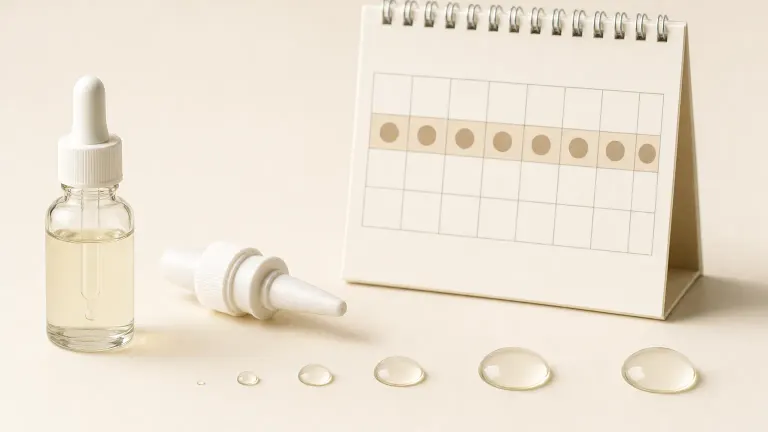
Quick answer: the Russian label Selank dosage is 2 drops of the 0.15% nasal solution in each nostril, 3 times a day, for 14 days, and the course can be repeated after 1 to 3 weeks if a doctor agrees.[2] The official label adds that a doctor sets the dose individually.[1] The published anxiety trials do not report their doses in their English abstracts, and no human study has tested Selank by injection. Selank is not FDA-approved.
This guide covers the label dose, what it works out to in micrograms, what the trials used, and why “injection dosage charts” online have no human data behind them. For Selank’s overall research, see our Selank profile and the nootropic peptides hub.
Selank dosage on the Russian label
Selank is sold over the counter in Russia as 0.15% nasal drops in a 3 mL bottle.[1][2]
| Detail | Russian instructions |
|---|---|
| Strength | 1.5 mg of Selank per mL[2] |
| Dose | 2 drops in each nostril[2] |
| How often | 3 times a day[2] |
| Course | 14 days[2] |
| Repeat course | After 1 to 3 weeks, after consulting a doctor[2] |
| Who it’s for | Adults 18 and older[2] |
| Storage | 2 to 8 °C; after opening, up to 25 °C for no more than 15 days[2] |
The Vidal reference version of the label says only that the dose is individual and depends on the condition, the patient’s age and the clinical situation.[1] The fuller instructions on the Russian drug register give the 2-drops, 3-times-a-day schedule.[2]
The label is for anxiety states, panic attacks, nervous exhaustion, unstable mood, stress-related sleep problems, adjustment disorders and the prevention and treatment of stress-related disorders.[1][2]
How much Selank is in a drop?
The label states the strength (1.5 mg per mL) but not the amount per drop.[2] A rough estimate is possible:
- The Russian Semax 1% label counts 4 drops as 0.2 mL, or about 0.05 mL per drop.[3]
- At that drop size, one drop of Selank 0.15% would hold about 75 mcg.
- The label’s 12 drops a day (2 drops × 2 nostrils × 3 times) would be about 900 mcg a day, or roughly 0.6 mL.
- A 3 mL bottle would then last about 5 days, so a 14-day course would need about three bottles.
These figures are our calculation, not label numbers. Real drop size depends on the pipette and how it is held. Our peptide dosage calculation guide and calculator explain how to convert mg per mL into drops or units for a dose your clinician sets.
What the human studies used
| Study | People | Dose and course |
|---|---|---|
| Selank vs medazepam, 2008 | 62 adults with generalized anxiety disorder or neurasthenia | Dose not stated in abstract[4] |
| Selank vs phenazepam, 2014 | 60 adults with anxiety and somatoform disorders | Dose not stated in abstract[5] |
| Phenazepam with or without Selank, 2015 | 70 adults with anxiety disorders | Dose not stated in abstract[6] |
| Immune markers, 2008 | Patients with generalized anxiety or neurasthenia | 14-day course; dose not stated[7] |
So the trials confirm a two-week course length but not a specific dose. The results, in brief:
- Versus medazepam: both drugs relieved anxiety to a similar degree, and Selank also reduced fatigue.[4]
- Versus phenazepam: Selank had a clear anti-anxiety effect that lasted about a week after the last dose.[5]
- Added to phenazepam: the benzodiazepine worked sooner, with less sedation, memory trouble and other side effects.[6]
We found no Selank trials registered on ClinicalTrials.gov.[12]
Why Selank is dosed three times a day
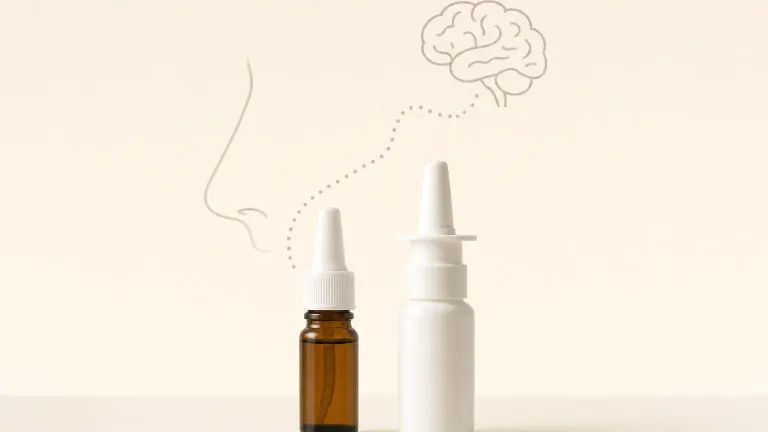
The manufacturer reports that 92.8% of a nasal dose is absorbed, that Selank appears in the blood within 30 seconds, and that its blood level falls over about 5 to 5.5 minutes as tissue enzymes break it down.[1][2] No independent human pharmacokinetic study has been published. The short time in the blood is one reason the label splits the dose through the day rather than giving it once.
The instructions also say:[2]
- clear the nose first, because mucus reduces absorption
- sit with the head slightly tilted back or to the side, then press each nostril closed for a moment
- drops that run into the throat leave an unpleasant taste
Selank injection dosage: no human data
Searches for a “Selank peptide injection dosage chart” turn up research-chemical sites. Here is what is actually known:
- There is no approved injectable Selank. The Russian product is nasal drops only.[1]
- We found no published human study of injected Selank.
- FDA says compounded selank acetate may carry a risk of immune reactions because of clumping and peptide impurities, and that it lacks important information on Selank’s safety in humans. The compounding nomination was withdrawn.[10]
- Belgian regulators found Selank in seized unlabeled products and noted that these peptides are sold online as powders for injection or in nasal sprays.[11]
Any injection chart is therefore guesswork, applied to a product of unknown purity.
Combining Selank with other medicines
- Benzodiazepines and sedatives: the 2015 trial added Selank to phenazepam,[6] and the label says Selank may be used alongside other psychiatric and neurological treatment.[2] In rats, Selank strengthened diazepam’s anti-anxiety effect.[8] A US review warned that GABA-acting sedatives in high doses or with other sedatives have caused dangerous breathing problems, though it did not report such cases with Selank.[9]
- Other drugs: the label says no interaction was found with haloperidol, pentobarbital, hexobarbital, stimulant drugs (analeptics) or alcohol.[2]
- Dependence: the manufacturer states Selank does not cause dependence and that no overdose cases have been recorded.[2] No independent study has tested this.
Who should not use Selank
The label rules out people who are pregnant or breastfeeding, anyone under 18, and anyone allergic to Selank. The preservative, methyl parahydroxybenzoate, can also cause allergic reactions, including delayed ones.[1][2]
Questions to ask your clinician
- Have I tried treatments for anxiety with stronger evidence, such as therapy or approved medicines?
- Could Selank interact with any sleep aid, benzodiazepine or other sedative I take?
- How would we judge whether it is helping after a 14-day course?
- If I am looking at a product sold online, how would I know what is in it?
A clinician should set any dose. These are the Russian label instructions and study details, not a treatment plan.