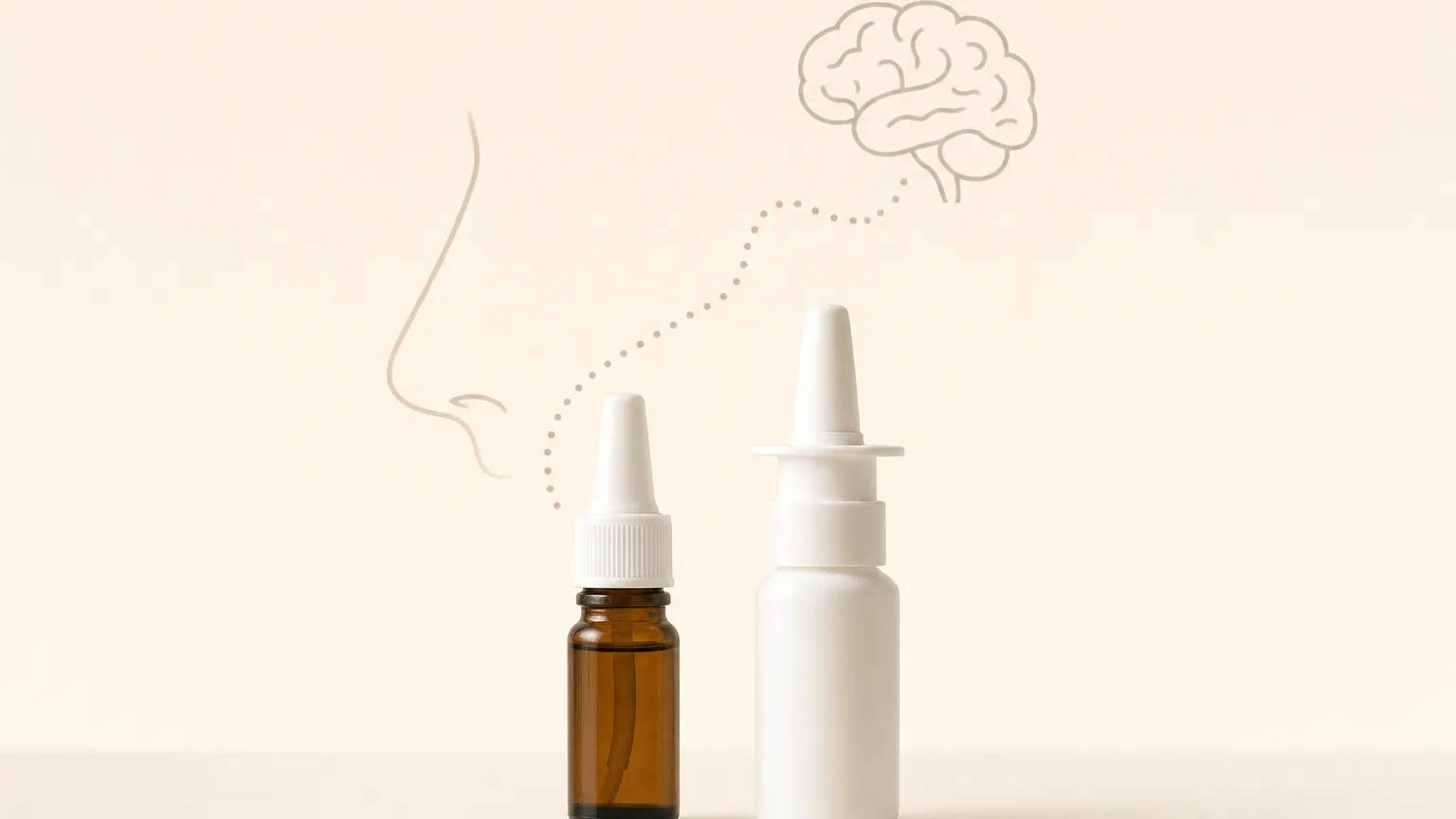
Quick answer: a Semax nasal spray is usually an unapproved product. The licensed Semax sold in Russia comes as nasal drops (0.1% and 1%) for stroke, memory problems after vascular brain disease, mental fatigue and optic nerve disease.[1][2] Human evidence comes from small Russian studies, and FDA in 2026 found no human pharmacokinetic data and raised specific concerns about nasal spray products.[3] Semax is not FDA-approved.
This page covers why Semax is given through the nose, what is known about how it gets to the brain, what the studies found, and how the sprays sold online differ from the licensed drops. For the bigger picture, see our Semax profile and the nootropic peptides hub.
Nasal drops vs nasal spray
| Licensed Russian Semax | Semax “nasal spray” sold online | |
|---|---|---|
| Form | Nasal drops with a pipette or dropper cap[1] | Spray bottles, for example at 1.25 mg/mL[3] |
| Strength | 0.1% (50 mcg per drop) or 1% (500 mcg per drop)[1][2] | Varies; FDA found products labeled as 30 mg per bottle[3] |
| Regulator | Registered prescription medicine in Russia[1] | Not FDA-approved; quality not verified[3] |
| Studied in people? | Yes, small Russian studies[6] | No studies of these products |
FDA pointed out that for a spray, the bottle and pump are part of the medicine. They control how much comes out per spray, how evenly the peptide is spread, the shape of the plume and the droplet size. FDA said no information exists about the devices used for Semax sprays, and it would have “strong concerns” about compounded Semax spray for that reason.[3]
What Semax nasal drops are used for
In Russia, the 0.1% drops are prescribed for:[1]
- memory and thinking problems caused by vascular brain disease, and transient ischemic attacks
- recovery after stroke, head injury, brain surgery or anesthesia
- mental fatigue and work under stressful or monotonous conditions
- optic nerve atrophy and optic neuritis
- children aged 7 and older with minimal brain dysfunction, including ADHD
The 1% drops are only for the acute phase of moderate or severe ischemic stroke, added to standard care.[2]
In the US, FDA found Semax products marketed for a much longer list, including anxiety, depression, memory, ADHD, opioid withdrawal, Parkinson’s disease and Alzheimer’s disease.[3] Most of those uses have never been tested in people.
Why it’s given through the nose
Semax is a 7-amino-acid peptide given as nasal drops. The label says it is absorbed through the nasal lining, with 60% to 70% taken up, then spreads quickly through the body, crosses the blood-brain barrier, breaks down fast in the blood and leaves in the urine.[1] Those are manufacturer statements; FDA found no human pharmacokinetic studies by any route.[3]
The animal data give a rough picture:
- In rats, a labeled nasal dose of Semax reached the brain within 2 minutes, but only about 0.093% of the dose per gram of brain was detected there. The peptide was broken down quickly, mostly into its Pro-Gly-Pro tail.[4]
- FDA noted that more Semax reached the rat brain after nasal dosing than after an IV injection, which fits the idea that peptides can travel along nerve pathways from the nose to the brain.[3]
- A single nasal dose in rats raised the brain growth factor BDNF about 1.4-fold in the hippocampus.[5]
What the human studies found
| Study | People | Result |
|---|---|---|
| Stroke rehabilitation, 2018 | 110 adults; Semax 6,000 mcg a day in two 10-day courses | Higher blood BDNF and better daily-living scores; smaller effect on weakness[6] |
| Healthy volunteers, 2018 | 14 on nasal 1% Semax, 10 on placebo | Changes in a resting brain network on scans 5 and 20 minutes later[7] |
We found no Semax trials on ClinicalTrials.gov.[11] FDA judged the evidence for cerebral ischemia, migraine and trigeminal neuralgia insufficient, though it did not review the full Russian-language stroke papers.[3]
For the label doses and the doses used in each study, see Semax dosage.
Safety of Semax nasal products
- Label: mild irritation of the nasal lining with long-term use is the only listed side effect.[1]
- Not for: acute psychiatric conditions, disorders with anxiety, a history of seizures, pregnancy and breastfeeding, and younger children.[1][2]
- Decongestants: the label advises against using nasal sprays that narrow blood vessels at the same time.[1]
- Online products: FDA’s only adverse event report was eye pain and burning, with a hospital stay, after a consumer used Semax 0.1% drops bought online.[3] Belgian regulators found Semax in seized unlabeled products and noted these peptides are sold online as injection powders or in nasal sprays.[8]
- Immune reactions: FDA was concerned that impurities and clumping in compounded spray or injection products could trigger an immune response.[3]
Our Semax side effects guide covers these in more detail. For a general comparison of routes, see peptide nasal spray vs injection.
How the licensed drops are packaged and given
The Russian 0.1% product comes in a 3 mL bottle, either with a screw cap and a separate pipette or with a built-in dropper cap.[1] The label says to put no more than 2 to 3 drops in each nostril at a time. When a larger dose is prescribed, it is split into several applications 10 to 15 minutes apart rather than given all at once.[1] A spray pump replaces that drop counting with a fixed spray volume, which is exactly the part FDA said has never been characterized for Semax products.[3]
Semax and Selank combination sprays
FDA found US websites selling “50:50” Semax and Selank combinations as injections and nasal sprays.[3] No clinical trial has tested the two together. The Semax label lists disorders accompanied by anxiety as a contraindication,[1] while Selank is used for anxiety, so the people drawn to the combination may be the ones the Semax label excludes. See Selank vs Semax and Selank nasal spray for more.
Legal status in 2026
- Russia: prescription medicine; the drops should be kept at 2 to 8 °C.[1]
- US: not FDA-approved. FDA lists Semax among bulk substances that may pose safety risks in compounding.[9] In July 2026, FDA’s advisory committee voted 8 to 5 to recommend allowing it in compounding, against FDA staff advice. FDA has not issued a final decision.[10]
This is general information, not legal advice. Read more in the FDA peptide ban in 2026.
Questions to ask your clinician
- Is there an approved treatment with stronger evidence for my symptoms?
- Do I have anxiety, seizures or another condition the label rules out?
- If a product is a spray rather than the licensed drops, how would we know the dose per spray?
- What would tell us it is helping, and when should I stop?