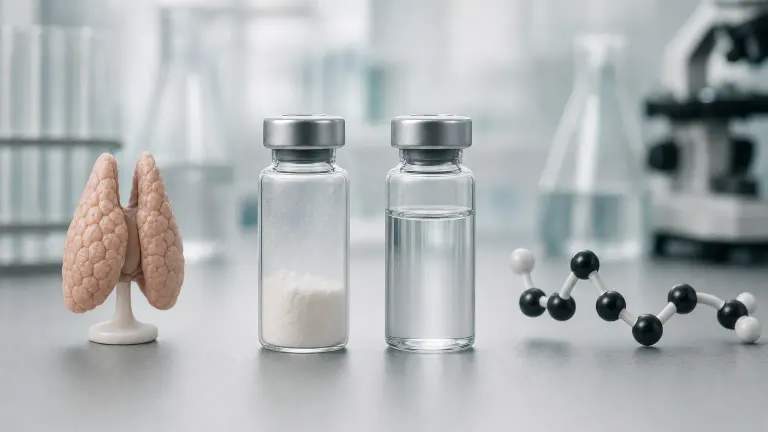
Thymalin is a mixture of peptides extracted from the thymus glands of calves, registered in Russia as a prescription injection for weakened immunity.[1] It was developed by Vladimir Morozov and Vladimir Khavinson, later of the St. Petersburg Institute of Bioregulation and Gerontology, the group behind epitalon.[7] Russian studies report fewer infections and deaths in older adults and better lab markers in COVID-19 patients.[2][4] But those studies come almost entirely from the developers’ network, and key design details are missing.[2][5] It is not FDA-approved.[16]
What is thymalin?
The thymus is a gland behind the breastbone where T cells, a key type of immune cell, mature. It shrinks with age. Thymalin was made by gently acid-extracting small peptides from calf thymus and was put into medical practice as an “immunocorrector”.[7]
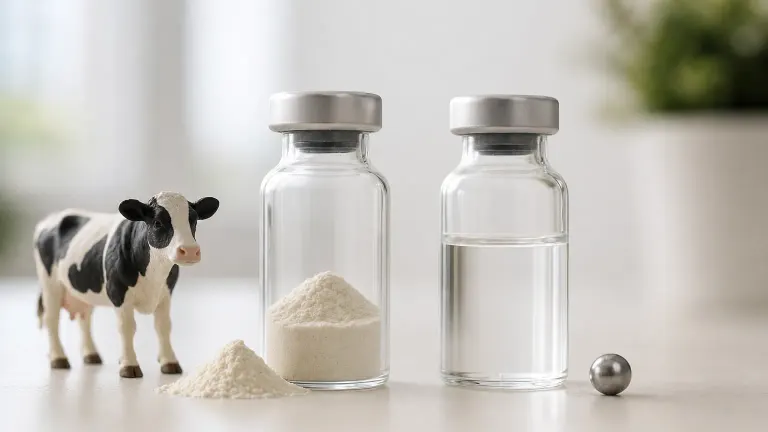
Today’s Russian product is a freeze-dried powder: 10 mg of thymus extract from cattle under one year old, plus glycine, in a vial that is dissolved and injected into muscle.[1] The label describes it as restoring immune balance by regulating T and B lymphocytes, boosting cell-mediated immunity and phagocytosis (the clearing of microbes by white blood cells), and supporting blood-cell formation.[1] Khavinson has called immune stimulation thymalin’s most prominent effect and folds it into his broader “peptide theory of aging”, which holds that aging involves falling production of tissue-specific regulatory peptides.[11]
Khavinson’s group later isolated one dipeptide, Glu-Trp, from thymalin; a synthetic version became the separate Russian drug Thymogen.[7][8] A 2023 paper names Lys-Glu (sold as vilon) and Glu-Trp as active substances of thymalin.[6] For the wider family, see our guide to Khavinson peptide bioregulators.
Thymalin uses on the Russian label
The Russian label lists immune deficiency in adults and in children from 6 months to 14 years, including:[1]
- severe bacterial infections, including those with pus or sepsis
- lasting thymus problems, for example after radiation sickness, thymus tumors or thymus removal
- acute and chronic viral and bacterial infections
- poor tissue healing
- suppressed immunity and blood-cell production after chemotherapy or radiation for cancer
Over decades, Soviet and Russian doctors also tested it in many conditions, from influenza in young people (reported in a military medical journal) and as a booster for flu vaccination to endometrial cancer, mostly in small, older reports.[12][13][14][20]
Thymalin benefits: what the research shows
The elderly mortality study
The most cited thymalin study is a 2003 report by Khavinson and Morozov, also published in Russian in 2002.[2][3] Researchers in St. Petersburg and Kyiv followed 266 older adults for 6 to 8 years. Thymalin, the pineal extract epithalamin, or both were given during the first 2 to 3 years. Compared with a control group, the authors reported:[2]
| Group | Reported reduction in death rate |
|---|---|
| Thymalin | 2.0 to 2.1-fold |
| Epithalamin | 1.6 to 1.8-fold |
| Thymalin plus epithalamin | 2.5-fold |
| Both peptides every year for 6 years (separate group) | 4.1-fold |
They also reported 2.0 to 2.4 times fewer acute respiratory illnesses and fewer signs of heart disease, high blood pressure, osteoarthritis and osteoporosis.[2]
COVID-19 studies
- St. Petersburg, 2020 (published 2021): in a single-center, open-label trial, 92 hospital patients with moderate or severe COVID-19 pneumonia were randomized by the envelope method to standard care alone (50) or plus thymalin 10 mg into muscle daily for 5 days (42). The authors reported faster falls in IL-6, CRP and D-dimer and better T-cell counts with thymalin. No one died in either group; CT scans worsened in 2 thymalin patients and 5 controls.[4]
- Chita, 2022: in middle-aged and older adults with severe COVID-19, hospital mortality was reported as 40.9% with standard care and lower with tocilizumab or thymalin. But the English abstract gives 28.4% for tocilizumab and 20.6% for thymalin, while the Russian abstract gives 28.8% and 16.2%. Neither states patient numbers or how patients were divided into groups.[5]
Animal and lab studies
- Mice, 1989: a thymus peptide factor from the same developers lengthened life and cut tumors (breast tumors 1.8-fold) when started in young female mice, but did not lengthen life or reduce tumors when started at 12 months of age.[10]
- Stem cells: in human blood-forming stem cells, thymalin raised a mature T-cell marker (CD28) 6.8-fold.[9]
- Inflammation: thymalin and its dipeptides lowered IL-1 beta, IL-6 and TNF in human immune cells exposed to bacterial toxin,[6] and an Italian-Russian study found similar effects in a monocyte cell line.[15]
Thymalin vs thymosin alpha-1 and Thymogen
| Thymalin | Thymogen | Thymosin alpha-1 | |
|---|---|---|---|
| What it is | Calf thymus peptide extract[1] | Synthetic dipeptide, Glu-Trp[8] | 28-amino-acid thymic peptide, now made synthetically[22][21] |
| Where approved | Russia, prescription[1] | Russia, prescription[8] | Sold as Zadaxin in other countries; not FDA-approved[21] |
| Main evidence | Russian clinical reports[20] | Russian clinical reports[20] | Randomized trials, for example in hepatitis B[23] |
Thymosin alpha-1 has been tested in randomized trials outside Russia, such as a Taiwanese hepatitis B trial.[23] Thymalin’s evidence is older and almost entirely Russian.
Thymalin dosage (Russian label)
Thymalin is injected into muscle once a day:[1]
- Adults: 5 to 20 mg per dose, 30 to 100 mg per course
- Children: 1 mg (6 to 12 months), 1.5 to 2 mg (1 to 3 years), 2 to 3 mg (4 to 6 years), 3 to 5 mg (7 to 14 years)
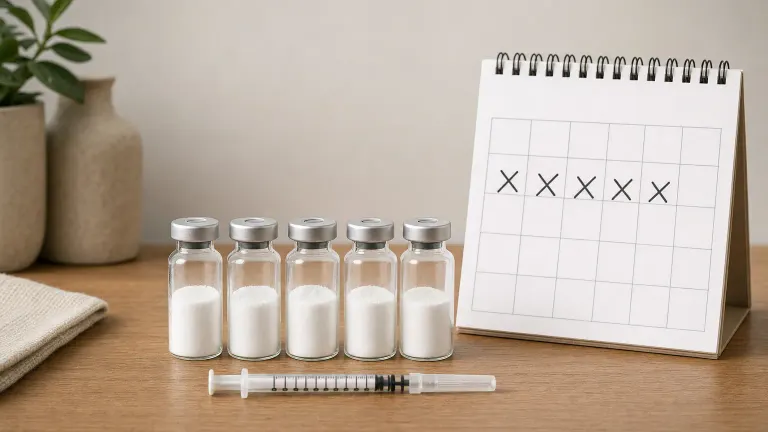
- Course: 3 to 10 days depending on the immune problem; a repeat course after 1 to 6 months if needed
- Prevention: adults 5 to 10 mg, children 1 to 5 mg daily for 3 to 5 days
The label leaves the exact schedule to a doctor, and it gives no dosing data for kidney or liver disease or for older adults.[1] The COVID-19 trial used 10 mg daily for 5 days.[4] Each vial holds a fixed 10 mg, so vial math is simpler than for most research peptides, but our peptide calculator can help if you need to check concentrations.
Thymalin side effects
- Allergic reactions are the only side effect listed on the Russian label; it advises caution in people with a history of allergies.[1]
- Not for pregnancy, breastfeeding or anyone allergic to the ingredients.[1]
- Other cautions: the label lists the days around menstruation and some hormone conditions (pituitary adenoma, acromegaly) as relative contraindications. It notes side effects may be more frequent in people with severe hormone disorders and in women in the second half of the menstrual cycle, and it advises against alcohol during treatment.[1]
- Evidence gaps: there are no large modern safety trials. The COVID-19 paper did not report side effects at all.[4] As a product made from cattle tissue, sourcing and manufacturing quality matter.
Is thymalin legal?
- Russia: registered as a prescription medicine; its current registration certificate, which replaced an earlier one, is dated June 21, 2024.[1]
- US: not FDA-approved. Thymalin does not appear on any of FDA’s 503A bulk substance lists as of May 14, 2026; the only similarly named item is thymulin acetate, a different thymic peptide placed in the “nominated without adequate support” category.[16] Thymalin is also absent from FDA’s list of compounding substances with significant safety risks.[17] In our reading, that leaves no legal route for US pharmacies to compound it.
- Sports: thymalin is not named on WADA’s 2026 list. Because it is approved in Russia, in our reading the S0 category for unapproved substances may not apply, but athletes should check with their anti-doping organization.[18]
This is general information, not legal advice.
What users report
For other compounds promoted for aging and immunity, see our immune peptides and longevity peptides pages, plus Khavinson’s synthetic thymus dipeptide vilon.