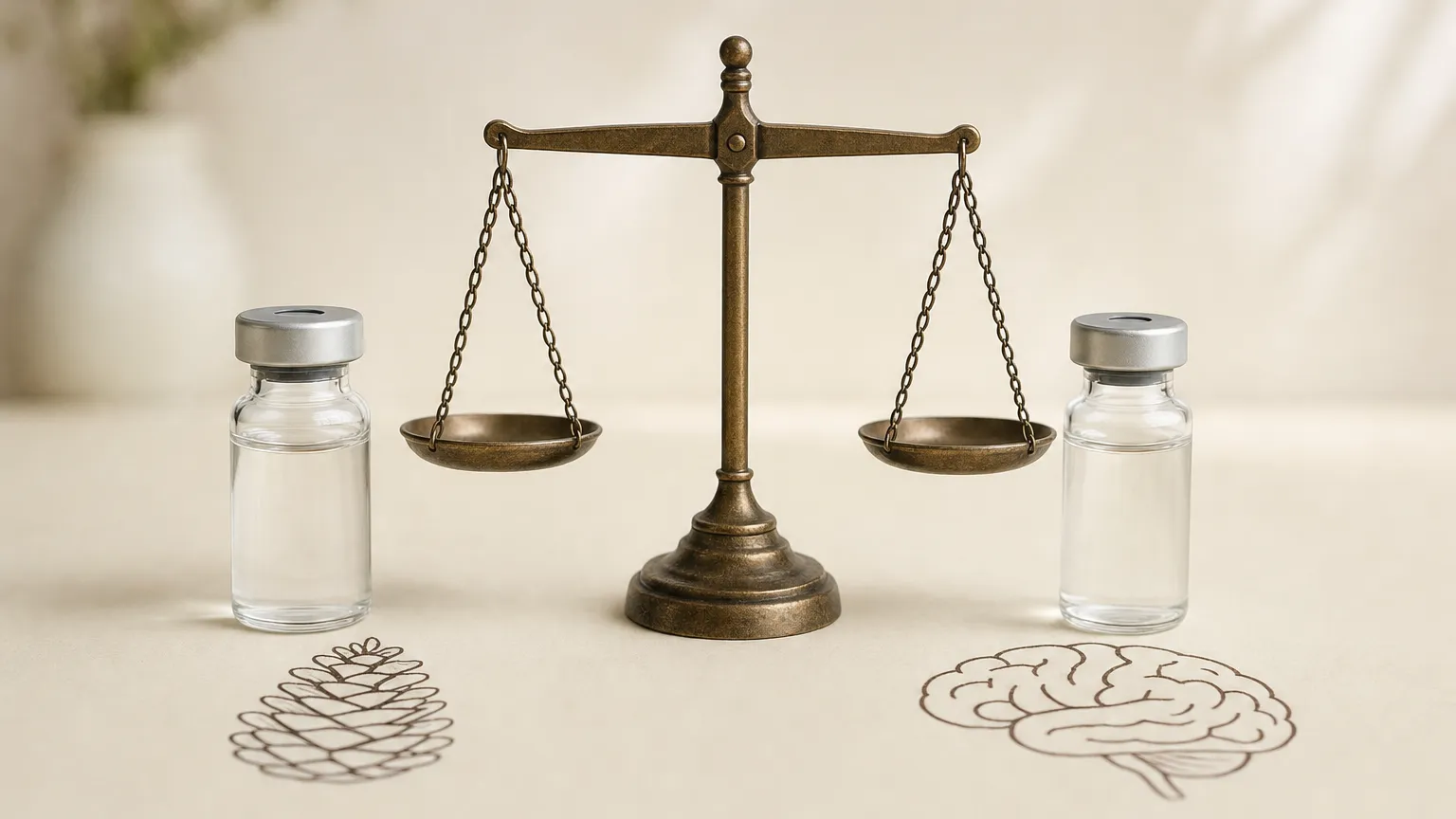
Epitalon vs pinealon: both are tiny synthetic peptides from Vladimir Khavinson’s institute in St. Petersburg, but they are studied for different things. Epitalon (4 amino acids) is researched mainly for telomeres and the pineal gland, while pinealon (3 amino acids) is researched mainly for protecting brain cells.[1][3] Neither has strong human evidence, and neither is FDA-approved; FDA advisers backed epitalon for compounding in July 2026, while pinealon has never been nominated.[12][13]
Both belong to the family of Khavinson peptide bioregulators. For full reviews, see our epitalon profile, pinealon profile and the longevity peptides hub.
Epitalon vs pinealon at a glance
| Epitalon | Pinealon | |
|---|---|---|
| Structure | Ala-Glu-Asp-Gly (AEDG), 4 amino acids[1] | Glu-Asp-Arg (EDR), 3 amino acids[3] |
| Origin | Designed from epithalamin, a cattle pineal extract[1] | Synthetic short peptide from the same institute[3] |
| Main research focus | Telomeres, pineal gland, melatonin[4][1] | Brain cells under oxidative stress and low oxygen[3][6] |
| Effect on rat pineal tissue | Raised growth and secretion markers[2] | No effect on those markers[2] |
| Human studies | Two small sublingual studies; one eye-disease report[1] | A few short Russian “biological age” studies[9][10] |
| Studied human dose | About 0.5 mg a day as a sublingual spray for 20 days[1] | 100 mcg capsule twice a day for 2 weeks[9] |
| FDA review | Reviewed by advisers in July 2026[1] | Not on any FDA compounding list[13] |
How each is supposed to work
Khavinson’s group proposes that these very short peptides enter cells, reach the nucleus and bind DNA to switch genes on or off. In a dish study, labeled epitalon and pinealon both entered the nuclei of human cancer cells and bound DNA fragments with a preference for certain sequences.[8] That is a lab finding; it does not show what happens in a living person.
The names suggest more overlap than the data show. In a Russian study of rat pineal tissue, epitalon raised markers of pineal cell growth and of secretion, while pinealon did not.[2] So despite its name, pinealon is a brain peptide in the research, and epitalon is the pineal one.
Evidence: what each has shown
Epitalon
- Telomeres in cells: epitalon switched on telomerase and lengthened telomeres in human cells in a 2003 Russian study.[4] An independent 2025 UK study found longer telomeres in normal cells via telomerase, and in breast cancer cells mainly through a different mechanism called ALT.[5]
- Melatonin in people: 40 women working night shifts with low melatonin output were split between a sublingual epitalon spray and placebo for 20 days. The urinary melatonin marker rose 1.7-fold with epitalon and did not change with placebo. Sleep was not measured, and the publication did not specify blinding.[1]
- Safety: FDA found no clinical safety studies and no human pharmacokinetic data.[1]
Pinealon
- Brain cells: pinealon reduced harmful reactive oxygen species and cell death in rat brain cells and other cell types, in a dose-dependent way.[3]
- Low oxygen: among four Khavinson peptides tested in a low-air-pressure model, including epitalon, pinealon had the strongest protective effect.[6]
- Alzheimer’s model: in mice bred to develop Alzheimer’s-like changes, pinealon prevented the loss of dendritic spines, the contact points between nerve cells.[11]
- People: small Russian studies reported better “biological age” scores, sometimes with a drop in a blood stem cell marker and pro-oxidant activity.[9][10]
One shared caution: a Russian lab study found that pinealon, epitalon and two related peptides had no direct antioxidant activity and raised steady levels of reactive oxygen species inside nerve cells. All except epitalon reduced nerve cell death.[7]
A common mix-up: epitalon vs epithalamin
Much of what is said online about epitalon actually comes from epithalamin, a crude extract of cattle pineal glands used in older Russian studies. Epitalon is a synthetic peptide designed from epithalamin’s makeup, and FDA treats the two as different substances.[1] When FDA reviewed epitalon in 2026, it noted that several of the human studies submitted in support used epithalamin, not epitalon.[1]
FDA found only three studies in which epitalon itself was given to people: two sublingual studies in night-shift workers and one report in which it was injected next to the eye in people with retinitis pigmentosa, an inherited eye disease.[1] Epitalon received a US orphan drug designation for retinitis pigmentosa in 2010, but it was withdrawn or revoked in 2016.[1]
Pinealon has no extract “parent” with a long clinical record, so there is less room for that confusion, but also less human data overall.
Dosing compared
There is no approved dose of either. The only published human doses are small:
- Epitalon: a sublingual spray providing about 0.5 mg a day for 20 days in night-shift workers.[1] Clinic and seller websites describe 5 to 10 mg a day by injection or by mouth, but those amounts do not come from trials, and FDA found no studies of epitalon injected under the skin.[1]
- Pinealon: one 100 mcg capsule twice a day for two weeks in railway workers.[9] See our pinealon dosage guide for animal doses and the gaps.
A clinician should guide any decision, and vial math from our peptide calculator cannot make an untested dose safe.
Safety compared
| Epitalon | Pinealon | |
|---|---|---|
| Human safety studies | None found by FDA[1] | None designed for safety |
| Adverse event reports | None in FDA’s database through December 2025[1] | Not reviewed by FDA |
| Theoretical concerns | Immune reactions, impurities, and cancer risk from switching on telomerase[1] | Pro-oxidant activity and lower blood stem cell marker in one small study[10] |
| Long-term or cancer studies | No standard 2-year cancer studies[1] | None published |
Legal status in 2026
- Epitalon: not FDA-approved. On July 24, 2026, FDA’s compounding advisers voted 7 to 5, with one abstention, to add it to the list of substances pharmacies may use for insomnia, overriding FDA staff, who had cited a lack of evidence.[12] FDA has not issued a final decision.
- Pinealon: not FDA-approved and not in any of FDA’s 503A compounding categories as of May 14, 2026.[13] In our reading, that leaves no legal US pharmacy route.
This is general information, not legal advice.
Which one fits which question?
- Asking about telomeres or “anti-aging”: epitalon is the one studied for that, but only in cells and animals; see also epitalon vs TA-65.
- Asking about memory or brain fog: pinealon is the one studied for brain cells, but human memory has never been tested. Other options are covered in the best peptides for cognition.
- Asking about sleep: neither has sleep data in people. Melatonin, CBT-I and approved medicines have far more evidence; see the best peptides for sleep.
Questions to ask a clinician
- What is driving my symptoms, and has it been checked properly?
- Which approved or well-studied treatments should come first?
- If I am considering either peptide, how would we monitor for side effects?
- Do I have a history of cancer or an immune condition that changes the risk?
For a broader look at aging-focused compounds, see the best peptides for longevity.
This is general information, not medical advice.