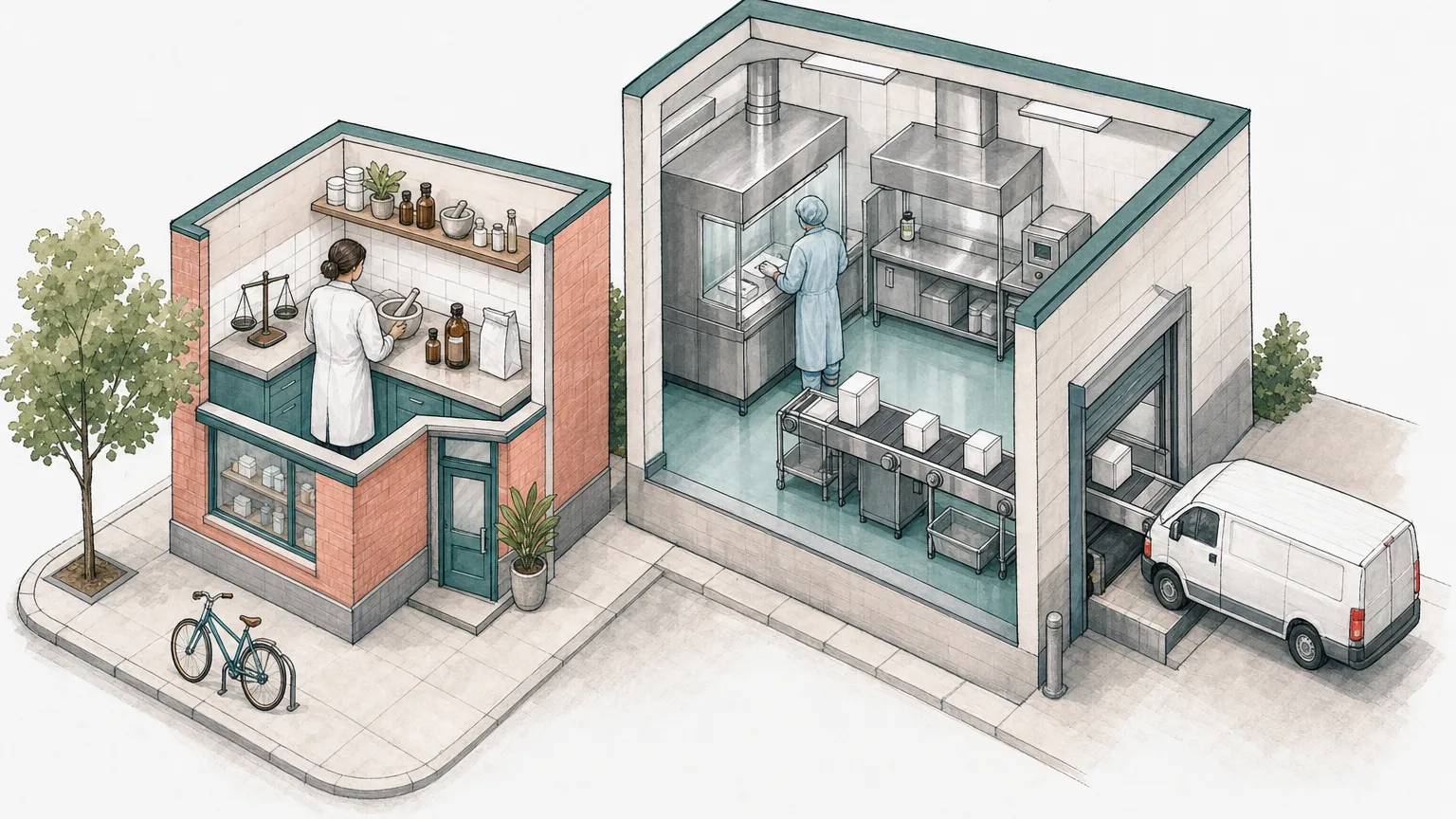
503A vs 503B: a Section 503A compounder is a state-licensed pharmacy or physician that makes drugs for an identified patient on a valid prescription, is exempt from federal cGMP rules and is overseen mainly by state boards. A Section 503B outsourcing facility voluntarily registers with FDA, must follow current good manufacturing practice (cGMP), and can make batches for office use without a patient-specific prescription.[1][2][3] Neither route produces an FDA-approved drug.
Both sections come from the Federal Food, Drug, and Cosmetic (FD&C) Act. Section 503A dates to 1997; Section 503B was added by the Drug Quality and Security Act of 2013, after the 2012 fungal meningitis outbreak linked to a compounding pharmacy. For the wider picture, see our FDA and regulation hub and the FDA peptide compounding crackdown.
503A vs 503B side by side
| Section 503A compounder | Section 503B outsourcing facility | |
|---|---|---|
| Who | State-licensed pharmacist or physician[1] | Facility at one address that compounds sterile drugs and elects to register[2] |
| Prescription | Required for an identified individual patient (limited anticipatory compounding allowed)[1] | Patient-specific prescription or provider order for office stock[3] |
| Main regulator | State board of pharmacy (FDA can still inspect and act) | FDA, with risk-based inspections[3] |
| cGMP (21 CFR parts 210–211) | Exempt[3] | Required[2][3] |
| Bulk ingredients | USP/NF monograph, component of an approved drug, or on the 503A bulks list[1] | On the 503B bulks list (clinical need) or the drug is on FDA’s shortage list[2] |
| Copies of approved drugs | Not “essentially copies” regularly or in inordinate amounts[1] | Not essentially a copy of an approved drug[2] |
| Interstate shipping | 5% cap unless the state signs an FDA MOU[1] | No statutory cap[2] |
| Registration and fees | No FDA registration | Annual FDA registration and fee[2] |
| Reporting | No federal adverse event reporting duty | Product reports twice a year and adverse event reports[2][3] |
| Resale | Dispensed to the patient | Cannot be sold to wholesalers for resale[2] |
Patient-specific prescriptions vs office stock
Under Section 503A, the compounder must have a valid prescription for an identified individual patient, or a documented history of such prescriptions if it compounds a limited amount in advance.[1] That is why a 503A pharmacy fills orders one patient at a time.
Section 503B removes that requirement. A clinic or hospital can order batches of a compounded drug for office use, which is the main reason hospitals use outsourcing facilities for sterile products such as ready-to-use syringes.[3] In exchange, the facility accepts cGMP rules, FDA inspections, twice-yearly product reports and adverse event reporting.[2]
The bulks lists and Categories 1–3
A bulk drug substance is the raw active ingredient, usually a powder. Each section has its own list of bulk ingredients that compounders may use.
- 503A bulks list: codified at 21 CFR 216.23. FDA adds ingredients through notice-and-comment rulemaking, usually after its Pharmacy Compounding Advisory Committee (PCAC) weighs in.[7]
- 503B bulks list: ingredients for which FDA finds a clinical need. Outsourcing facilities can otherwise use a bulk ingredient only when the drug is on FDA’s shortage list at the time of compounding, distribution and dispensing.[2][9]
While the lists are built, FDA sorts nominated ingredients into three interim categories, for both 503A and 503B:[4][5]
| Category | Meaning | Practical effect |
|---|---|---|
| 1 | Under evaluation | FDA generally does not intend to act against compounding with it while it decides (503A interim policy) |
| 2 | Raises significant safety risks | No enforcement discretion |
| 3 | Nominated without adequate support | No enforcement discretion; can be renominated |
FDA’s January 2025 final guidance kept these categories for older nominations but stopped sorting ingredients nominated on or after its publication; those go straight into evaluation for the statutory list.[6]
Interstate limits and the MOU
Section 503A caps the share of compounded drugs a pharmacy can send across state lines at 5% of its prescriptions, unless its state signs a memorandum of understanding (MOU) with FDA.[1] FDA published a standard MOU in October 2020, but it now considers that MOU suspended while it writes a rule, and it has extended the period before it enforces the 5% cap until a final rule and updated MOU take effect.[8] The cap and the MOU do not apply to 503B outsourcing facilities.[2]
“Essentially copies” and GLP-1 drugs
Both sections limit copying approved drugs. FDA treats a 503A drug as essentially a copy when it has the same active ingredient as a commercially available product in a similar strength and the same route. The exception is when a prescriber documents that a change makes a significant difference for an identified patient. FDA says it generally won’t act against a 503A compounder that fills four or fewer such prescriptions in a calendar month.[9]
During the GLP-1 shortages, the drugs counted as not commercially available, which opened both routes. Since the shortages ended, FDA has said semaglutide and tirzepatide are on neither the 503B bulks list nor the shortage list.[9] On April 30, 2026, FDA also proposed excluding semaglutide, tirzepatide and liraglutide from the 503B bulks list for lack of clinical need.[10] See the GLP-1 compounding ban and compounded tirzepatide for that story.
What 503A vs 503B means for peptides
Most research peptides have no USP monograph and are not part of an approved drug, so a 503A pharmacy can use them only if they reach the 503A bulks list or sit in Category 1.
- Category 1 (May 14, 2026 list): includes vasoactive intestinal peptide (VIP), glutathione, NAD and GHK-Cu for non-injectable routes.[4] See our profiles of VIP, GHK-Cu and NAD+.
- Category 2 (May 14, 2026 list): six substances, including kisspeptin-10 and ibutamoren mesylate (MK-677).[4] See our kisspeptin-10 profile.
- Withdrawn nominations: 17 substances, including BPC-157, TB-500, CJC-1295, ipamorelin and thymosin alpha-1, are listed by FDA as “nominated but withdrawn.” FDA still summarizes its safety concerns for them.[11] Withdrawn substances do not appear in Category 1, so leaving Category 2 this way does not make them compoundable.[4]
For 503B, a peptide would need a clinical-need finding for the 503B bulks list, or the finished drug would have to be on FDA’s shortage list.[2] The BPC-157 legal status guide follows one peptide through this process, including the July 2026 advisory committee vote.
How to tell which one you’re dealing with
- Outsourcing facilities appear on FDA’s public list of registered 503B facilities, and their labels say the product is compounded.[2]
- 503A pharmacies are licensed by the state board of pharmacy where they operate; check the board’s license lookup.
- Ask the pharmacy which section it compounds under, where its bulk ingredient comes from, and whether it has a certificate of analysis.
This is general information, not legal advice. Compounding rules change often, and state law can be stricter than federal law.