Oxytocin is a 9-amino-acid hormone released by the pituitary gland. As Pitocin and generic injections, it is FDA-approved to start or strengthen labor when there is a medical reason and to control bleeding after birth.[1] As a nasal spray it has been tested for autism, social behavior and sex, but large trials and replication studies have mostly come up empty.[5][9] No nasal oxytocin is currently marketed in the US.[3]
What is oxytocin?
Oxytocin acts on receptors in the uterus, where receptor numbers rise sharply in late pregnancy.[1] In animals, oxytocin in the brain shapes parenting and social bonding, which inspired the human nasal spray research.[11] Vincent du Vigneaud worked out its structure and made it in the lab, the first synthesis of a polypeptide hormone, work recognized with the 1955 Nobel Prize in Chemistry.[4] Oxytocin differs from vasopressin, the body’s water-retaining hormone, at only two amino acids, which the label says is thought to explain its blood pressure and water-retention effects at large doses.[1]
Pitocin: approved uses
The Pitocin label covers:[1]
- Labor induction with a medical reason, such as preeclampsia, maternal diabetes, Rh problems or ruptured membranes.
- Stimulating labor that has stalled.
- Incomplete or inevitable miscarriage, as an add-on treatment.
- After delivery, to contract the uterus and control bleeding.
Drugs@FDA lists the original approval of the current Pitocin application (NDA 018261) as November 19, 1980, though the Pitocin brand itself is older; generic oxytocin injections are also sold.[2]
How fast does oxytocin work?
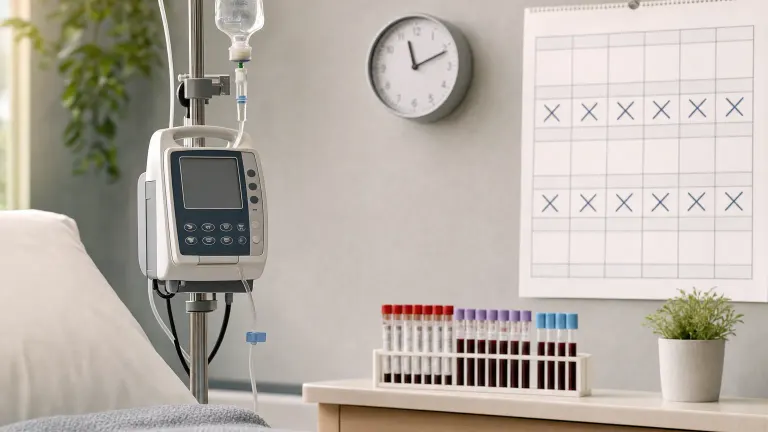
Very fast, and briefly. After an IV dose the uterus responds almost immediately and the effect fades within an hour; after an injection into muscle it starts in 3 to 5 minutes and lasts 2 to 3 hours. The hormone itself has a plasma half-life of about 1 to 6 minutes and is removed mostly by the kidneys and liver.[1] For labor, the label calls for a continuous, pump-controlled drip that can be stopped at once if contractions become too strong.[1]
Oxytocin dosage
| Use | Pitocin label dosing[1] |
|---|---|
| Labor induction | IV infusion starting at 0.5 to 1 milliunit per minute, raised by 1 to 2 milliunits every 30 to 60 minutes; rates above 9 to 10 milliunits per minute are rarely needed at term |
| Postpartum bleeding (IV) | 10 to 40 units added to a running IV, maximum 40 units per 1,000 mL |
| Postpartum bleeding (IM) | 10 units after the placenta is delivered |
Nasal research doses ranged from 18 to 40 IU,[13] and the large autism trial targeted 48 IU a day.[5] These are research doses, not approved ones. Nasal sprays are measured in international units, not milligrams, so the vial math in our peptide calculator does not translate directly.
Oxytocin nasal spray research
Autism
| Study | Result |
|---|---|
| 31 young children, 5 weeks, crossover (2016) | Improved caregiver-rated social responsiveness[6] |
| 87 children aged 3 to 12, 12 weeks (2023) | No overall benefit; possible effect in ages 3 to 5[7] |
| SOARS-B, 290 children and teens, 24 weeks (NEJM 2021) | No difference from placebo on social or cognitive measures[5] |
The NEJM trial was the largest and longest. Its authors noted that oxytocin had already been given to many children with autism in clinical practice before this trial.[5]
Trust and social behavior
A 2005 Nature study reported that nasal oxytocin made people more trusting with money.[8] A large preregistered replication in 2020, powered at more than 95%, found no effect on trust.[9] A 2015 review concluded the trust finding “has not replicated well.”[10]
Sex and libido
- Women with sexual dysfunction (30 women, 8 weeks per arm): sexual function improved about equally on 32 IU of oxytocin and on placebo.[14]
- Couples (29 couples, single 24 IU dose): no change in desire, arousal, erection or lubrication, but more intense orgasm and contentment afterward, with small to moderate effects.[15]
- Men (10 men, single dose): no change in sexual behavior scores, though 8 of 10 correctly guessed they had received oxytocin.[16]
For approved and studied sexual health peptides, see PT-141 and kisspeptin-10.
Oxytocin side effects
Pitocin (IV or IM):[1]
- Overly strong or prolonged contractions and uterine rupture
- Nausea, vomiting, abnormal heart rhythms, high blood pressure episodes and postpartum bleeding
- Water intoxication with seizures and coma, especially with high doses over long periods; maternal deaths have been reported
- In the baby: slow heart rate, low Apgar scores, jaundice, retinal bleeding, seizures, brain damage and death
Nasal spray (research): a review of 38 trials with 1,529 participants found side effects were no different from placebo at 18 to 40 IU for short-term use, but noted three case reports of problems with misuse or longer-term use.[13]
Who should not receive Pitocin
The label lists these situations, among others, where Pitocin should not be used before delivery:[1]
- The baby cannot fit through the pelvis, or is lying in a position that cannot be delivered vaginally
- Fetal distress when delivery is not imminent, or an emergency that calls for surgery
- A uterus that is already overactive
- Conditions where vaginal birth is unsafe, such as total placenta previa, vasa previa, cord prolapse or active genital herpes
- Allergy to the drug
The label also warns that severe high blood pressure has occurred when oxytocin was given a few hours after certain blood vessel-narrowing drugs used with caudal anesthesia.[1]
Is oxytocin legal?
- US: prescription only. Approved products are injections for hospital obstetric use.[1][2] Syntocinon nasal solution appears in FDA’s database as discontinued.[3] Under federal law, pharmacies may compound with bulk ingredients that have a USP monograph or are components of FDA-approved drugs, subject to other conditions.[17] In our reading, oxytocin meets that test because it is in approved injections, but compounded nasal sprays are still not FDA-approved products.
- Sports: oxytocin is not named on WADA’s 2026 Prohibited List.[18]
This is general information, not legal advice.
Oxytocin vs kisspeptin and PT-141
All three act on the brain’s hormone or reward systems, but only PT-141 (Vyleesi) is approved for a sexual problem, and only in premenopausal women. Kisspeptin is an experimental peptide that triggers reproductive hormones. Oxytocin’s approval is limited to labor and delivery. Browse more in the hormonal, sexual and cognitive categories.