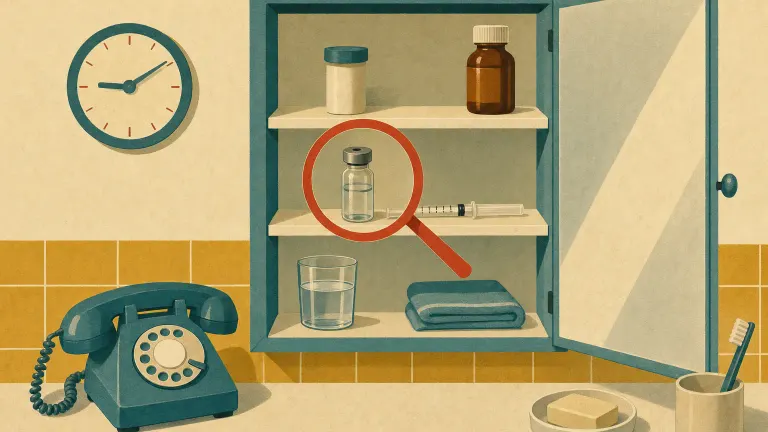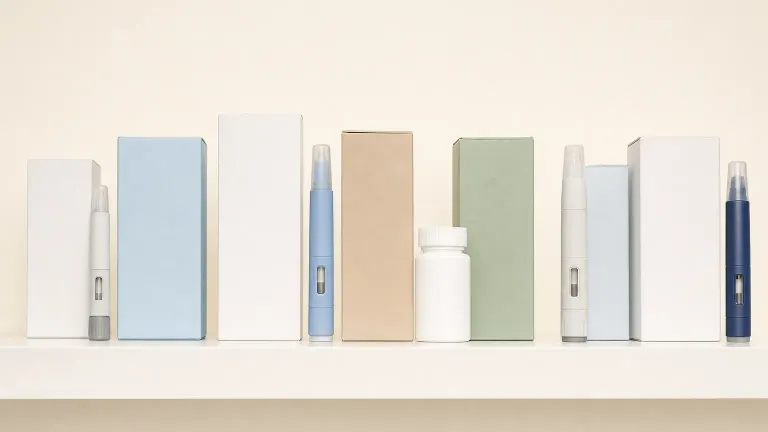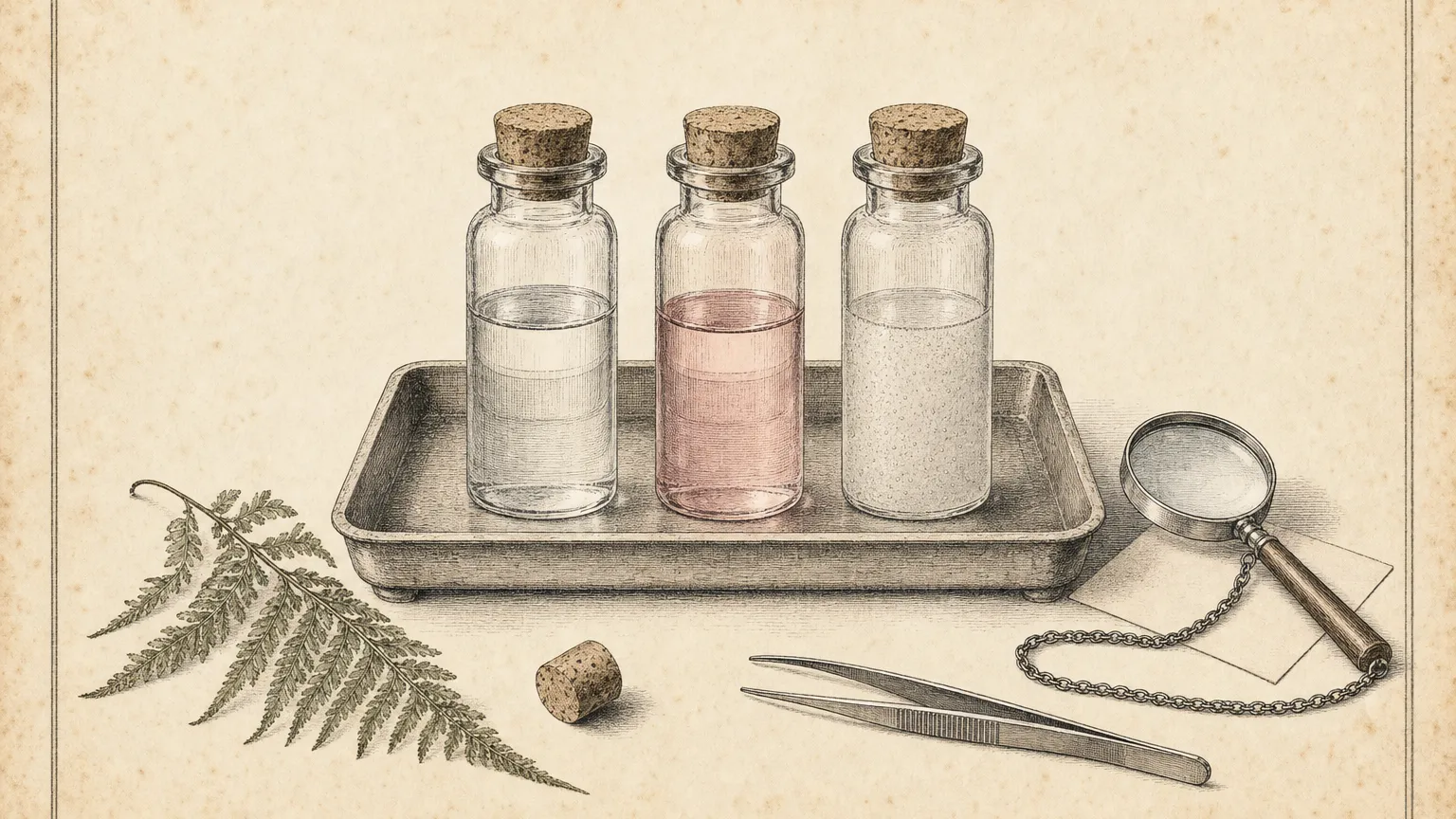
Quick answer: what color is semaglutide? Branded semaglutide injections, Ozempic and Wegovy, are a clear, colorless liquid. The labels say not to use them if they look cloudy, colored or contain particles.[1][2] Semaglutide tablets are white to light yellow.[2] If a compounded semaglutide is pink or red, it most likely contains an added ingredient such as vitamin B12 (cyanocobalamin), which is naturally red.[4][6]
Color is one of the quickest checks you can do before each dose. For an overview of the drug, see our semaglutide profile.
What branded semaglutide should look like
| Product | What it should look like |
|---|---|
| Ozempic pen or syringe | Clear, colorless solution[1] |
| Wegovy pens, syringes, FlexTouch | Clear, colorless solution with no particles[2] |
| Wegovy tablets | White to light yellow; round (1.5, 4, 9 mg) or oval (25 mg); stamped with the strength and “novo”[2] |
| Rybelsus / Ozempic tablets | White to light yellow, stamped with the strength and “novo”[10] |
| Mounjaro, Zepbound (tirzepatide, for comparison) | Clear, colorless to slightly yellow[3] |
The Ozempic instructions tell you to look through the pen window before each injection. If the liquid is cloudy or has particles, don’t use the pen.[1] Tirzepatide is allowed to be slightly yellow, but semaglutide injections are not.[1][3] If your Ozempic or Wegovy has any tint, treat that as a problem. See our tirzepatide profile for more on that drug.
What discoloration, cloudiness or particles can mean
The labels don’t list every cause, but they do give the rule: only use the injection if it is clear, colorless and free of particles.[2] Possible reasons a solution changes include:
- Freezing. The labels say not to use semaglutide that has been frozen.[1][2]
- Heat or light. The labels say to protect pens from excessive heat and light.[1]
- Contamination or a damaged pen. Reusing needles can contaminate the pen. The instructions say to use a new needle every time.[1]
- A different product than you think. It could be compounded with extra ingredients, mislabeled or counterfeit.
How to check your semaglutide before each dose
A quick check takes a few seconds and follows the labels’ instructions:[1][2]
- Check the name and label. The Ozempic instructions say to confirm the pen contains Ozempic, which matters most if you use more than one injectable.
- Look through the window or vial against a light background. The liquid should be as clear as water, with no tint.
- Look for particles or cloudiness. Any floating specks, haze or film means don’t use it.
- Check the date. Unopened pens are good until the printed expiration date if kept in the fridge. Ozempic pens in use must be thrown away 56 days after first use.[1]
- Think about storage. If the pen was frozen or left somewhere very hot, don’t use it, even if it looks normal.[1]
- For tablets, check that each one is white to light yellow, intact and stamped with the expected strength. Keep them in the original bottle to protect them from moisture.[2]
If anything is off, set it aside and call the pharmacy that dispensed it. For branded pens, Novo Nordisk’s phone number (1-888-693-6742) is printed in the Ozempic instructions.[1]
Why compounded semaglutide can be pink or red
Compounded semaglutide is made by a pharmacy rather than Novo Nordisk, and formulas vary. A 2025 search of compounding websites found 33 semaglutide or tirzepatide products that differed from the approved drugs. Nearly half (48%) combined the GLP-1 with other ingredients, including cyanocobalamin (vitamin B12), glycine, niacinamide, docusate or ondansetron. The authors found little justification for adding nutrients.[4] Real-world studies have described weekly injections of semaglutide combined with cyanocobalamin.[5]
Cyanocobalamin itself is red. Its prescribing information describes it as “dark red crystals” or a red powder.[6] A solution containing it will usually look pink to red depending on the amount. So a pink compounded product isn’t automatically spoiled, but:
- It is not the same product as Ozempic or Wegovy, which contain no B12.[1][2]
- Any color change beyond what the pharmacy told you to expect, such as cloudiness, particles or a color shift over time, is a reason not to use it.
- Compounded products often come in multi-dose vials you draw from with a syringe, which brings its own dosing risks. See our guide to semaglutide overdose.
For more on what gets added to compounded GLP-1s, see compounded GLP-1 additives. For a broader comparison, see compounded semaglutide vs Ozempic.
Where compounded semaglutide stands with the FDA
The FDA declared the semaglutide injection shortage resolved on February 21, 2025. The temporary allowance for compounding copies ended on April 22, 2025, for state-licensed pharmacies (503A), and May 22, 2025, for outsourcing facilities (503B).[9] As of the FDA’s April 2026 update:[9]
- A 503A pharmacy may compound for an individual patient with a prescription, but may not regularly make products that are “essentially a copy” of an approved drug, unless a prescriber documents a significant clinical difference for that patient.
- The FDA has said a product that combines semaglutide with another ingredient, such as vitamin B12, may still count as essentially a copy in some cases. Adding B12 doesn’t automatically make a product legal to compound.
- 503B outsourcing facilities can’t currently compound from bulk semaglutide, because it is on neither the 503B bulks list nor the shortage list.
The FDA also says salt forms such as semaglutide sodium and semaglutide acetate are different active ingredients from the one in approved drugs. It knows of no lawful basis for compounding with them.[8]
Counterfeit Ozempic: what the FDA has found
The FDA has issued three counterfeit Ozempic alerts, all involving 1 mg pens:[7]
| Date | Lot number | What to know |
|---|---|---|
| Dec 2023 | NAR0074 (serial 430834149057) | Thousands seized; needles were counterfeit and sterility couldn’t be confirmed |
| Apr 2025 | PAR0362 (serials starting 51746517) | Several hundred units seized |
| Dec 2025 | PAR1229 | Also a real lot number. Counterfeits print the EXP/LOT text to the left of the date and lot; on real pens it sits above |
The FDA also says counterfeit GLP-1 products could contain the wrong ingredient, the wrong amount or other harmful substances.[8] Color alone won’t reliably reveal a fake, since a counterfeit can look clear. Check the label details, buy only with a valid prescription from a state-licensed pharmacy, and inspect each pen before use.[7]
To check whether a pen still has a dose left, see how to tell when an Ozempic pen is empty. More guides are on the semaglutide topic hub.