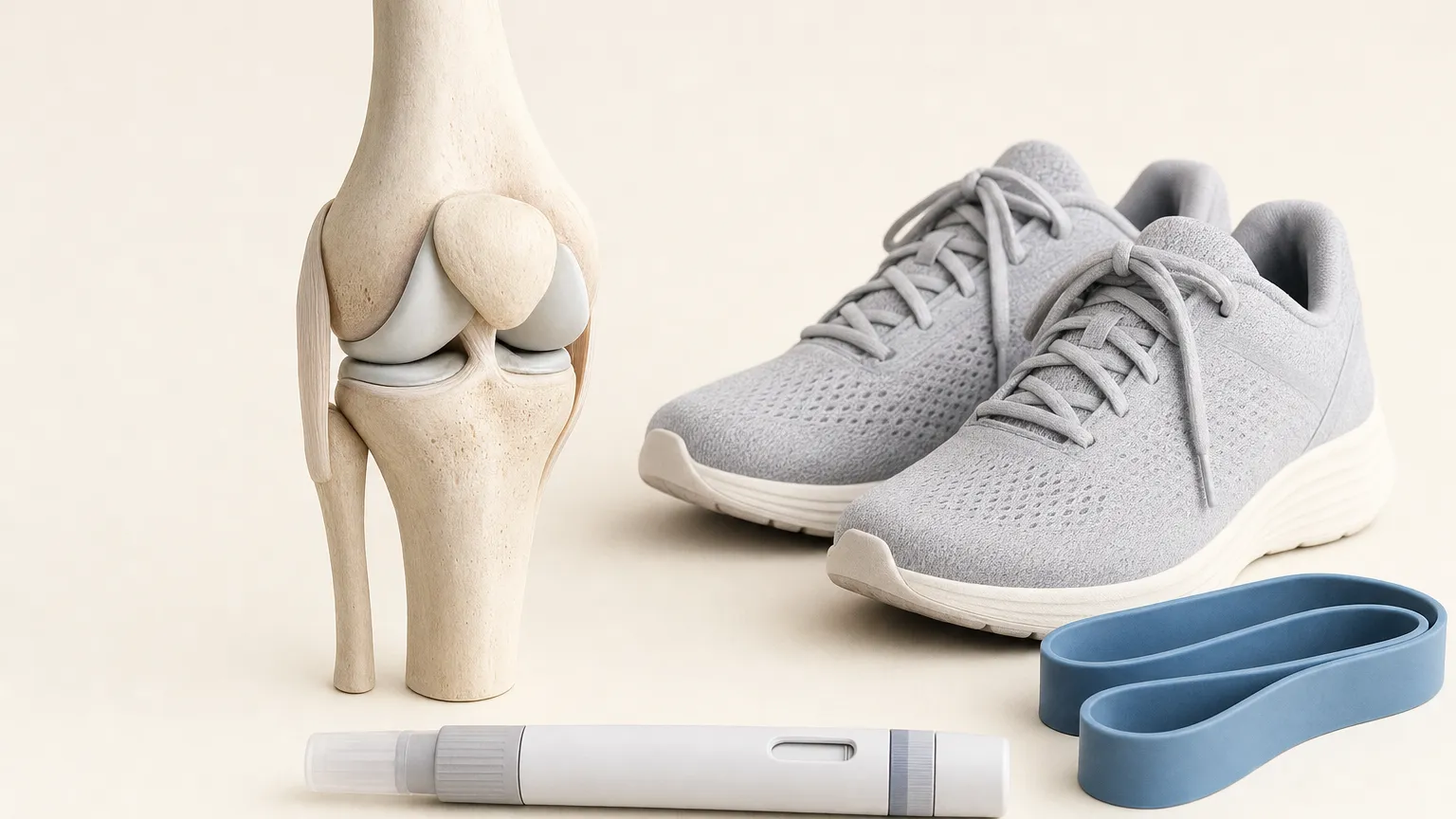
Quick answer: in TRIUMPH-4, the phase 3 retatrutide knee osteoarthritis trial, Lilly reported that knee pain scores fell by 75.8% on 9 mg and 74.3% on 12 mg, versus 40.3% on placebo, over 68 weeks, while weight fell by up to 28.7%.[1] These are company-reported topline results that have not been published in a journal. A separate, peer-reviewed knee osteoarthritis group within TRIUMPH-1 also showed less pain than placebo.[4]
Retatrutide is an investigational drug from Eli Lilly and is not FDA-approved. For background, see the retatrutide profile.
How we verified TRIUMPH-4
- Trial registry: TRIUMPH-4 is registered as NCT05931367. Lilly’s December 2025 press release lists NCT05869903, but that number belongs to ATTAIN-1, an orforglipron trial. The registry and the TRIUMPH design paper both confirm NCT05931367.[2][3]
- Status: the registry shows the trial completed on November 14, 2025, with 445 participants. As of October 2026, no results had been posted there.[2]
- Publication: we found no TRIUMPH-4 journal article on PubMed. Lilly said detailed results would be presented at a medical meeting and published later.[1]
So the TRIUMPH-4 numbers below come only from Lilly’s announcement. They have not been through peer review, and details may change.
How the knee trials measured pain
Both trials used the WOMAC, a standard knee arthritis questionnaire. People rate pain, stiffness and physical function on 0 to 10 scales, and the pain section (5 questions, such as pain when walking or on stairs) is averaged into one score.[3]
To enter, people needed knee pain plus X-ray evidence of knee osteoarthritis.[3] Knee X-rays were also taken at the end of the trials, along with diaries recording pain medicine use.[3]
TRIUMPH-4 results (company-reported)
TRIUMPH-4 enrolled 445 adults with knee osteoarthritis and a BMI of 27 or more, without diabetes. They took 9 mg or 12 mg of retatrutide, or placebo, weekly for 68 weeks alongside diet and activity advice.[1][2]
- Average starting weight: 112.7 kg (248.5 lb), with an average BMI of 40.4. 84% had a BMI of 35 or more.[1]
- Average starting pain: 6.0 out of 10 on the WOMAC pain scale.[1]
For people who stayed on treatment (the “efficacy estimand”), Lilly reported:[1]
| Measure | 9 mg | 12 mg | Placebo |
|---|---|---|---|
| WOMAC pain change | −4.5 points (−75.8%) | −4.4 points (−74.3%) | −2.4 points (−40.3%) |
| WOMAC physical function change | −4.1 points | −4.2 points | −2.1 points |
| Pain reduced by 70% or more | 73.0% | 67.7% | 26.2% |
| Pain-free at the end | 14.1% | 12.0% | 4.2% |
| Weight change | −26.4% | −28.7% | −2.1% |
The percentage pain figures and the pain-free numbers were added after the trial (post hoc) and were not planned in advance.[1]
Counting everyone randomized, including people who stopped treatment, results were smaller. Pain scores fell 4.0 points on 9 mg and 3.7 on 12 mg, versus 2.1 on placebo, and weight fell 20.0% and 23.7%, versus 4.6%.[1] Lilly said both doses met all primary and key secondary goals.[1]
Note the large placebo response. Pain fell by about 40% on placebo, which is common in pain trials and shows why a control group matters.
TRIUMPH-1 knee osteoarthritis results (peer-reviewed)
TRIUMPH-1 was a large 80-week obesity trial with a knee osteoarthritis group nested inside it. Its results were published in the New England Journal of Medicine in 2026.[4]
- Who: 574 participants with knee osteoarthritis.[4]
- Pain change (hybrid estimand): −3.2, −3.5 and −3.6 points on 4, 9 and 12 mg, versus −1.9 on placebo.[4]
- Counting everyone randomized: −3.4, −3.9 and −4.1 points, versus −2.5 on placebo.[4]
- Difference from placebo: 1.4 to 1.8 points for the 9 mg and 12 mg doses, which was statistically significant.[4]
This is the strongest evidence so far, because it is published in full. The benefit over placebo is smaller than the TRIUMPH-4 headline suggests, partly because the figures are calculated differently.
Side effects in TRIUMPH-4
The most common side effects were stomach-related. Lilly reported:[1]
- Nausea: 38.1% on 9 mg and 43.2% on 12 mg, versus 10.7% on placebo.
- Vomiting: about 20% on both doses, versus none on placebo.
- Dysesthesia (abnormal skin sensations such as tingling): 8.8% and 20.9%, versus 0.7%, generally mild.
- Stopping because of side effects: 12.2% and 18.2%, versus 4.0%.
Lilly said dropout tracked with starting weight and included people who stopped because they felt they had lost too much weight. Among people starting with a BMI of 35 or more, the rates were 8.8% and 12.1%.[1] See retatrutide side effects for other trials.
Is the benefit from weight loss alone?
Probably mostly, but it is not proven. Carrying less weight reduces load on the knee. The TRIUMPH design paper explains that the knee trials were sized using expected weight loss, and notes this could underestimate any effect that does not depend on weight.[3] No published analysis has yet separated the two.
Arthritis, joint pain and back pain
- Other joints: retatrutide has only been tested for knee osteoarthritis. There are no trial results for hip, hand or inflammatory arthritis such as rheumatoid arthritis.
- Back pain: TRIUMPH-7 is testing retatrutide in 586 adults with obesity and chronic low back pain, with pain intensity and weight as the main measures over up to 72 weeks. Its estimated primary completion is September 2027.[6]
For other options, see our guide to peptides for joint health.
Approval outlook
Lilly said in August 2026 that its clinical data package supports registrations for obesity, obstructive sleep apnea and knee osteoarthritis pain, and that it plans to submit to the FDA in the first quarter of 2027.[5] See when will retatrutide be available?
Questions to ask a clinician
- How much would losing weight be likely to help my knee pain?
- Which approved weight-loss medicines or therapies could I use now?
- Would physical therapy or strength training help alongside weight loss?
- Am I eligible for a retatrutide trial?
For the weight results and doses behind these trials, see retatrutide weight loss results and the retatrutide dosage guide.