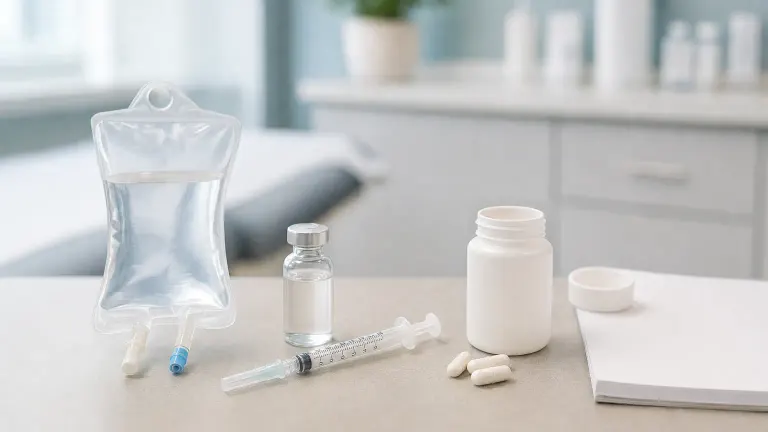
Quick answer: an oral NAD+ supplement usually contains a precursor such as NMN or NR, which the body turns into NAD+. These pills reliably raise blood NAD+ and have dozens of randomized trials behind them, while NAD+ injections and IV drips have only small pilot studies and no outcome trials.[8] Neither route has been shown to slow aging or boost energy in people.[8]
This guide compares the forms side by side, explains what each trial found, covers side effects and regulation, and clears up the “NAD peptide” confusion. For background, see our NAD+ profile and the NAD+ topic hub.
First: NAD+ is not a peptide
NAD+ (nicotinamide adenine dinucleotide) is a coenzyme, a helper molecule cells use to turn food into energy. It is not made of amino acids, so it is not a peptide; the body builds it from forms of vitamin B3 (niacin) and related molecules.[1] Searches for a “NAD peptide” usually reflect the fact that the same clinics and sellers offer NAD+ alongside peptides such as MOTS-c.
The forms compared
| Oral NMN or NR | Oral NAD+ or NADH | NAD+ injection | NAD+ IV drip | |
|---|---|---|---|---|
| How it works | Converted to NAD+ in the body | Largely broken down in the gut[1][17] | Delivered under the skin or into muscle | Delivered into a vein |
| Raises blood NAD+? | Yes[2][3] | Unclear | Not measured in published studies[12] | Yes, after about 2 hours[9] |
| Human trials | Dozens of randomized trials[8] | Few | Registered trial only[12] | Small pilot and clinic review[9][10] |
| Common side effects | Similar to placebo in most trials[4] | Not well studied | Not published | Nausea, chest pressure, faster heart rate[10] |
| Regulatory status | Sold as dietary supplements | Sold as dietary supplements | Not FDA-approved; under compounding review[15] | Not FDA-approved; under compounding review[15] |
Oral NAD+ supplements: what the trials show
Why most pills use precursors
Cleveland Clinic notes that NAD is difficult for the body to absorb in supplement form, so most products contain precursors the body uses to make its own NAD+.[1] A mouse study found that oral NAD+ was handled much like plain nicotinamide (vitamin B3), raising the same breakdown products in urine, while oral NADH seemed to be destroyed in the stomach.[17]
NMN and NR raise NAD+
- NR, dose by dose: in an 8-week trial, 100, 300 and 1,000 mg a day raised whole-blood NAD+ by 22%, 51% and 142% within 2 weeks.[2]
- NMN vs NR vs nicotinamide: in a 2026 randomized study of 65 healthy adults, 14 days of NR and NMN raised blood NAD+ by a similar amount, while nicotinamide did not. Gut bacteria appear to play a part in converting NR and NMN.[3]
- Timing: on 1,200 mg a day of NR or NMN, blood NAD+ leveled off after about two weeks and brain NAD+ rose after four weeks.[13]
But health results are mixed
- Metabolism: 250 mg of NMN daily for 10 weeks improved muscle insulin sensitivity in women with prediabetes.[7] But 2,000 mg of NR daily for 12 weeks did not improve insulin sensitivity or body composition in obese men.[6]
- Pooled NMN trials: across 15 trials using 250 to 2,000 mg a day, NMN did not change weight, blood sugar, HbA1c or cholesterol.[4]
- Parkinson’s disease: in the 410-person NOPARK trial, 500 mg of NR twice daily for a year left people slightly worse than placebo.[5]
A 2026 systematic review summed it up: oral NR and NMN consistently raise NAD-related markers and are generally well tolerated, but effects on function, metabolism and other health outcomes are mixed and often null.[8]
NAD+ injections and IV drips: what the evidence shows
- IV drips raise NAD+, slowly. In a pilot of 750 mg over 6 hours, blood NAD+ did not change for 2 hours, then rose about 400% by the end. No adverse events occurred during the slow infusion.[9]
- Faster clinic drips cause symptoms. In a review of 500 mg IV NAD+ given on 4 days in a row, people reported moderate to severe stomach symptoms, a faster heart rate and chest pressure, and infusions averaged 97 minutes. The same review found IV NR caused only minor tingling and mild cramping.[10]
- Shots are barely studied. The only registered trial of NAD+ injected under the skin or into a muscle tests a single 100 mg dose and has posted no results.[12]
- No outcome trials. No eligible trials tested IV or injected NAD+ for anti-aging or wellness outcomes.[8] A 2026 narrative review called the evidence preliminary and insufficient to support routine wellness use.[11]
Side effects compared
- Oral NMN and NR: in trials, they caused no more adverse events than placebo.[2][4] Cleveland Clinic lists possible supplement side effects as nausea, headache, lightheadedness, diarrhea, muscle cramps and skin irritation, mostly at higher doses, and notes that niacin-containing products can cause flushing.[1]
- IV NAD+: reported effects include nausea, cramping, flushing and chest discomfort, and long-term safety data are lacking.[11]
- Contamination: FDA has warned that some compounders made IV NAD+ from food-grade ingredients, and it received reports of severe chills, shaking, vomiting and fatigue after NAD+ injections.[16]
Regulation and quality
- Supplements: FDA does not have the authority to approve dietary supplements before they are marketed.[14] Quality depends on the maker, so look for independent third-party testing. For how supplement law applies to these products, see our guide to DSHEA and peptide supplements.
- Injections and drips: NAD+ is not an FDA-approved drug. FDA lists NAD among substances still under evaluation for use by compounding pharmacies.[15]
Do you need to raise NAD+ at all?
The marketing assumes NAD+ falls with age. A 2026 study of seven groups of people found whole-blood NAD+ stayed remarkably stable with age and lifestyle changes, rising only with NR supplementation.[18] Levels may still differ in specific tissues, but a blood test showing “low NAD+” is not a validated measure of aging.
Which option fits
- If you want the most studied option: oral NR or NMN, at amounts used in trials. See NAD+ dosage for the doses tested.
- If you are considering shots or drips: understand that the evidence is limited and the side effects are real; read our NAD+ injection guide.
- If you are considering a spray: see NAD+ nasal spray, which has no human studies.
Questions to ask a clinician
- What would I expect NAD+ to do for me, and what evidence supports that?
- Should I try an oral precursor before an injection or drip?
- Could any supplement interact with my medicines or conditions?
- How is the product’s quality and sterility checked?
Talk to a licensed clinician before starting any NAD+ product, especially if you are pregnant, breastfeeding or have a chronic illness.