Quick answer: the cagrilintide dosage used in clinical trials ranged from 0.3 mg to 4.5 mg injected once a week. The phase 3 trials settled on 2.4 mg weekly, given alone or with semaglutide 2.4 mg as CagriSema, reached gradually over 16 weeks.[1][5] Cagrilintide is not FDA-approved, so these are research doses, not a prescribing guide. A clinician, and eventually an approved label, would set any real dose.
Cagrilintide is Novo Nordisk’s long-acting version of amylin, a fullness hormone. For what it is and how it works, see the cagrilintide profile; for the combination product, our CagriSema guide.
Cagrilintide dosage chart: every dose studied
| Study | Who | Doses (once weekly) | Length |
|---|---|---|---|
| Phase 2, cagrilintide alone | 706 adults with overweight or obesity | 0.3, 0.6, 1.2, 2.4 or 4.5 mg | 26 weeks |
| Phase 1b, with semaglutide 2.4 mg | 95 adults with overweight or obesity | 0.16, 0.3, 0.6, 1.2, 2.4 or 4.5 mg | 20 weeks |
| REDEFINE 1 (phase 3) | 3,417 adults with obesity | 2.4 mg alone, or 2.4 mg + semaglutide 2.4 mg | 68 weeks |
| REIMAGINE 1 (phase 3) | 189 adults with early type 2 diabetes | 1.0 mg + 1.0 mg, or 2.4 mg + 2.4 mg | 40 weeks |
| REIMAGINE 2 (phase 3) | 2,713 adults with type 2 diabetes | 2.4 mg alone, 1.0 + 1.0 mg, or 2.4 + 2.4 mg | 68 weeks |
Sources: phase 2,[1] phase 1b,[3] REDEFINE 1,[4] REIMAGINE 1[7] and REIMAGINE 2.[8]
Doses tested in the phase 2 trial
The dose-finding trial randomized 706 adults without diabetes to one of five cagrilintide doses, daily liraglutide 3.0 mg, or placebo, for 26 weeks.[1] Each person injected once a week and raised the dose step by step until reaching the assigned target; the escalation period lasted up to 6 weeks.[1][2]
Weight loss rose with dose, from 6.0% on 0.3 mg to 10.8% on 4.5 mg, versus 3.0% on placebo. The top dose beat liraglutide 3.0 mg (10.8% versus 9.0%).[1]
Stomach side effects also rose with dose: 41% to 63% had them on cagrilintide versus 32% on placebo, mainly nausea (20% to 47% versus 18%).[1] Our page on cagrilintide side effects has more detail.
How titration works
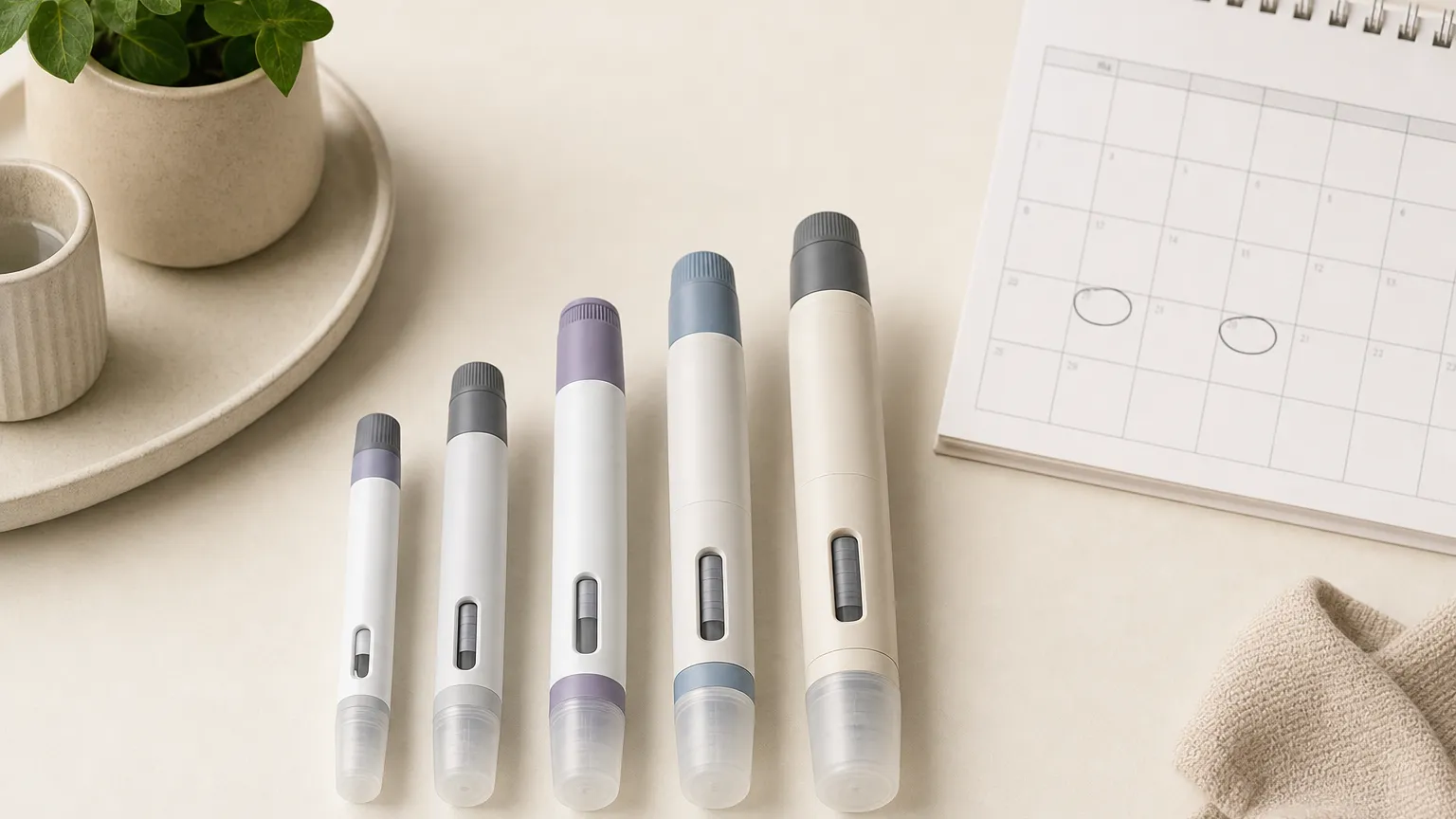
All cagrilintide trials start low and increase the dose in steps, because nausea is most common while the dose is rising.
- Phase 2: up to 6 weeks of escalation to the target dose.[1]
- Phase 1b: cagrilintide and semaglutide were raised together every 4 weeks over 16 weeks, then held at the target dose for 4 weeks.[3]
- Phase 3 (REDEFINE 1): 16 weeks of escalation, then 52 weeks of maintenance.[5]
REDEFINE 1 used a flexible protocol that let people stay on a lower dose if they needed to. At week 68, 82.5% of people taking cagrilintide 2.4 mg alone were on the top dose, compared with 57.3% on CagriSema and 70.2% on semaglutide alone.[6]
The published abstracts do not list each step’s exact dose, so we have not reproduced a week-by-week chart.
Results at 2.4 mg
Alone
In REDEFINE 1, cagrilintide 2.4 mg alone lowered weight by 11.5% at 68 weeks, counting everyone randomized, and by 11.8% among people who kept taking it. Placebo gave 3.0%.[6]
In a 32-week phase 2 trial in type 2 diabetes, cagrilintide escalated to 2.4 mg lowered HbA1c (average blood sugar) by 0.9 points and weight by 8.1%.[15]
In CagriSema
With semaglutide 2.4 mg, weight fell 20.4% at 68 weeks versus 3.0% on placebo.[4] In REIMAGINE 2, CagriSema 2.4/2.4 mg lowered HbA1c slightly more than semaglutide 2.4 mg alone (1.91 versus 1.75 points).[8]
Lower and higher doses
- 1.0 mg: in REIMAGINE 1, CagriSema 1.0/1.0 mg lowered HbA1c by 1.5 points and weight by 11.8% at 40 weeks, versus 1.8 points and 13.8% for 2.4/2.4 mg.[7]
- 1.7 mg: the REDEFINE 9 trial found that CagriSema 1.0/1.0 mg and 1.7/1.7 mg both beat placebo for weight loss; full results were due at a conference later in 2026.[9]
- 4.5 mg: the highest dose tested. Besides the phase 2 trial, a heart-rhythm study escalated healthy volunteers to 4.5 mg and found no clinically relevant QT prolongation.[12]
- What’s next: Novo started a phase 3 trial of CagriSema with a higher semaglutide dose (2.4 mg/7.2 mg) in 2026, and listed a high-dose cagrilintide phase 3 start among its 2026 milestones.[9]
Cagrilintide alone: the RENEW trials
Novo is now testing cagrilintide by itself in phase 3. RENEW 1 (about 300 adults with overweight or obesity) and RENEW 2 (about 330 adults who also have type 2 diabetes) give a once-weekly injection or placebo for 64 weeks. Their registry entries do not list the dose, and primary completion is estimated for May 2027.[10][11]
How long a dose lasts
In the phase 1b trial, cagrilintide had a half-life of 159 to 195 hours, roughly 7 to 8 days, and reached its peak level 24 to 72 hours after an injection. Blood levels rose in proportion to the dose, and cagrilintide did not change semaglutide levels.[3] That long half-life is what allows once-weekly injections.
Kidney and liver function
In two single-dose studies (0.6 mg and 0.9 mg), mild, moderate or severe kidney or liver impairment did not change cagrilintide levels in a clinically relevant way. The authors concluded that dose adjustment did not appear warranted, while noting the studies were small.[13]
Why there is no “real-world” dose yet
- Not approved. CagriSema was submitted to FDA in December 2025, with a decision expected by late 2026.[16] Cagrilintide alone is still in phase 3.
- Cannot be compounded. FDA says cagrilintide cannot be used in compounding under federal law and has not been found safe and effective for any condition.[14]
- “10 mg” vials are not trial products. Searches for a “cagrilintide 10 mg dosage chart” refer to vials sold online. The phase 2 trial gave fixed doses with a pen-injector; vials of unknown content cannot be matched to trial doses.[2][14]
Questions to ask a clinician
- Is an approved option, such as semaglutide or tirzepatide, right for me now?
- Am I eligible for a cagrilintide or CagriSema trial?
- How would we handle nausea while a dose is increased?
- Do my kidney or liver tests change anything?
For context on the wider field, see GLP-1 drugs compared, CagriSema vs Zepbound, cagrilintide with retatrutide and the GLP-1 drugs hub.