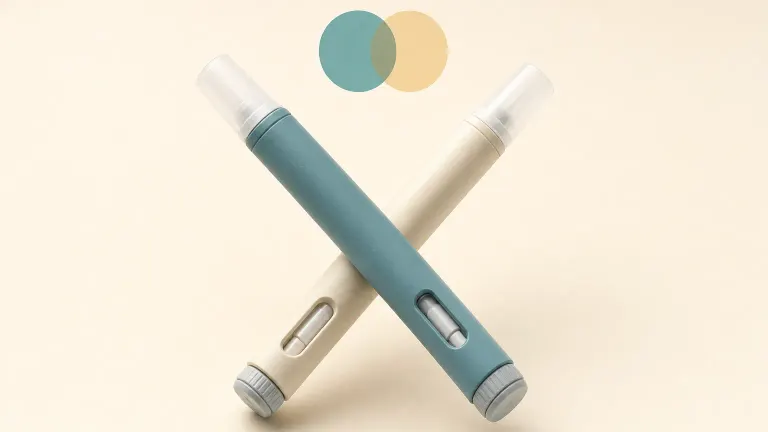
AOD-9604 vs semaglutide: semaglutide has strong evidence and AOD-9604 does not. In AOD-9604’s largest human trial, 502 adults with obesity took it daily for 24 weeks and lost no more weight than placebo.[1] Semaglutide 2.4 mg (Wegovy) produced 14.9% average weight loss over 68 weeks versus 2.4% on placebo, and it is FDA-approved for weight management and heart risk reduction.[8][9] AOD-9604 is not approved by any regulator.[1]
People often see AOD-9604 sold as a “fat-burning peptide” next to GLP-1 drugs. Here’s how the two really compare. For details, see our AOD-9604 profile, semaglutide profile and the GLP-1 drugs hub.
At a glance
| AOD-9604 | Semaglutide (Wegovy, Ozempic) | |
|---|---|---|
| What it is | 16-amino-acid fragment of growth hormone[1] | GLP-1 receptor agonist[9] |
| Proposed action | Fat breakdown, without growth hormone’s other effects[4] | Reduces appetite and food intake[9] |
| Largest human trial | 502 adults, 24 weeks: no significant weight loss[1] | 1,961 adults, 68 weeks: −14.9% vs −2.4%[8] |
| Heart outcomes | Never studied | 20% lower risk of heart attack, stroke or heart death (SELECT)[10] |
| Approved? | No, anywhere[1] | Yes: Wegovy for weight; Ozempic for type 2 diabetes[9][11] |
| Route studied | By mouth or IV; never injected under the skin in trials[1] | Weekly injection or daily pill[9] |
How each works
AOD-9604 is the last 15 amino acids of human growth hormone with one extra amino acid added. Australian researchers designed it in the 1990s to keep growth hormone’s fat-burning effect while avoiding effects on growth and blood sugar.[1][5] In obese mice it increased fat burning and reduced weight gain without raising blood sugar.[4]
Semaglutide copies GLP-1, a gut hormone released after eating. It acts on the brain to reduce hunger and slows stomach emptying, so people eat less.[9]
Evidence quality: what the human trials found
AOD-9604
- About 900 people took part in six company-funded human trials.[6]
- OPTIONS (phase 2b): 502 adults with obesity took 0.25 to 1 mg by mouth daily, or placebo, for 24 weeks. There was no significant difference in weight loss at 12 or 24 weeks, and the developer stopped obesity development in 2007.[1]
- 12-week trial: in 300 adults, weekly weight loss was only slightly greater than placebo; FDA found no full publication.[1]
- The lead investigator later said the six-month study showed no effect on weight.[7]
Semaglutide
- STEP 1: 1,961 adults without diabetes lost 14.9% of body weight on 2.4 mg weekly versus 2.4% on placebo over 68 weeks.[8]
- STEP UP: the newer 7.2 mg dose produced 18.7% weight loss over 72 weeks.[12]
- SELECT: in 17,604 adults with heart disease and overweight or obesity, semaglutide cut heart attack, stroke or cardiovascular death from 8.0% to 6.5%.[10]
Results compared
| Outcome | AOD-9604 | Semaglutide 2.4 mg |
|---|---|---|
| Average weight loss vs placebo | No significant difference at 24 weeks[1] | About 12.4 percentage points more at 68 weeks[8] |
| Lost 5% or more of body weight | Not reported as a benefit | 86.4% vs 31.5% on placebo[8] |
| Effect on blood sugar | None found in trials[6] | Lowers HbA1c; Ozempic approved for type 2 diabetes[11] |
Side effects and safety
AOD-9604
- Headache was the most common side effect in company trials, followed by stomach upset such as diarrhea.[6]
- In the 12-week trial, five people developed cancers or tumors. Investigators judged them unrelated, but FDA said there was too little detail to assess.[1]
- FDA warns its structure can degrade and clump, raising concern about immune reactions, and lists it among compounding substances with possible safety risks.[1][3]
- Long-term human safety is unknown.[7]
Semaglutide
- The most common side effects are nausea, diarrhea, vomiting and constipation, mostly during dose increases.[9]
- It carries a boxed warning about thyroid C-cell tumors in rodents and is not for people with a personal or family history of medullary thyroid cancer or MEN 2. Other warnings include pancreatitis and gallbladder problems.[9]
- In STEP 1, 4.5% stopped because of gastrointestinal side effects versus 0.8% on placebo.[8]
Legal status
- AOD-9604: not approved by FDA or any other regulator. Two compounding nominations were withdrawn; FDA reviewed it anyway, and in December 2024 its advisory committee voted 0 to 12 against allowing it in compounding.[1][2] In 2012 its then-owner announced a self-affirmed “GRAS” determination for food use, made by its own expert panel rather than FDA.[13] It is prescription-only (Schedule 4) in Australia,[14] and WADA bans it at all times as a growth hormone fragment.[15]
- Semaglutide: FDA-approved as Wegovy, Ozempic and the Ozempic and Wegovy pills.[9][11] FDA has declared the semaglutide shortage over, which limits compounded copies,[18] and it warns that unapproved semaglutide sold online may contain the wrong ingredient or dose.[17]
Cost and access
Wegovy’s list price is $1,349.02 a month. Through NovoCare, new self-pay patients pay $199 for their first two fills of the lowest doses, then $349 a month for most doses.[16] Many insurers cover it with prior authorization. See semaglutide cost and our comparison of every GLP-1 drug in 2026.
AOD-9604 has no approved product and no official price. Products sold online as “research peptides” are not tested for identity, purity or sterility.[3]
Who each may suit: questions for your clinician
- “I want help losing weight.” Ask whether semaglutide or another approved option is right for your BMI, health conditions and budget. See also best peptides for weight loss.
- “I’ve heard AOD-9604 targets belly fat without appetite effects.” Ask what human evidence supports that. The trials did not show it.[1]
- “GLP-1 side effects worry me.” Ask about slower dose increases, managing nausea, and other approved medicines, rather than unapproved alternatives.
The verdict
This is not a close comparison. Semaglutide has large, published trials showing meaningful weight loss and heart benefits, and it is FDA-approved. AOD-9604 worked in rodents but failed its main human trial, has never been tested the way it is sold, is unapproved, and is banned in sport. What remains unknown about AOD-9604 is mostly its safety when injected, not whether it works for weight loss: the trials already answered that. Related comparisons: CagriSema vs Zepbound and survodutide vs tirzepatide.